
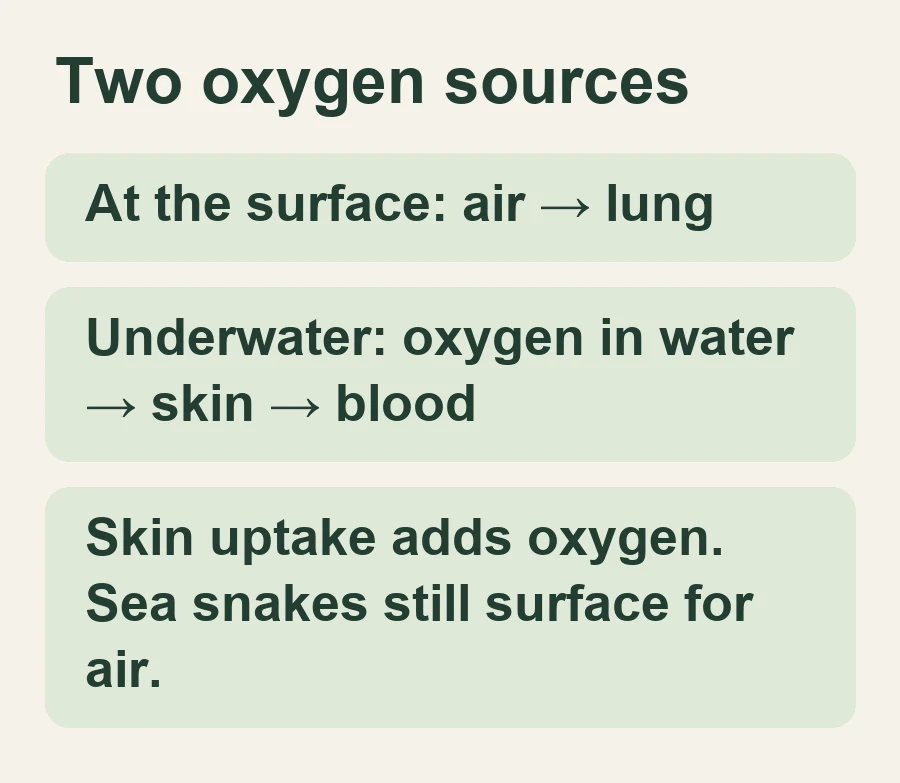
Sea snakes need to surface to breathe air, but they can also absorb some oxygen from water through their skin. Skin gas exchange supplements their oxygen supply.

Do sea snakes have gills?
No. Sea snakes breathe air into a lung. They return to the surface to take a breath, then dive again. Living in the ocean does not mean they can fill their lungs with water.
The Natural History Museum explains that sea snakes combine air breathing with the ability to take oxygen into their blood through their skin. That is why a simple “yes” or “no” to underwater breathing can be misleading: taking a breath and absorbing oxygen are different processes.
How does skin breathing help?
Oxygen dissolved in the surrounding water can pass through the skin into the blood. Scientists call this cutaneous gas exchange. It supplements the oxygen obtained from air and can help a sea snake stay submerged for longer.
How long can a sea snake stay underwater?
There is no single dive time that applies to every sea snake. Conditions matter as well as the species.
In a 2016 study of spine-bellied and elegant sea snakes, warmer water increased oxygen consumption and how often the snakes surfaced, while dives became shorter. Oxygen uptake through the skin did not increase with the warmer water to match that greater demand.
Those results explain why a quoted maximum dive time should not be treated as a normal schedule for all sea snakes.
If you find a snake near the water
A snake swimming in a creek or dam is not necessarily a sea snake. Our guide to snakes near water explains that distinction.
If a sea snake is washed ashore, keep your distance and do not pick it up or push it back into the water. Follow the separate guide to finding a sea snake on the beach for help with that situation.
Learn more about where sea snakes get drinking water.