
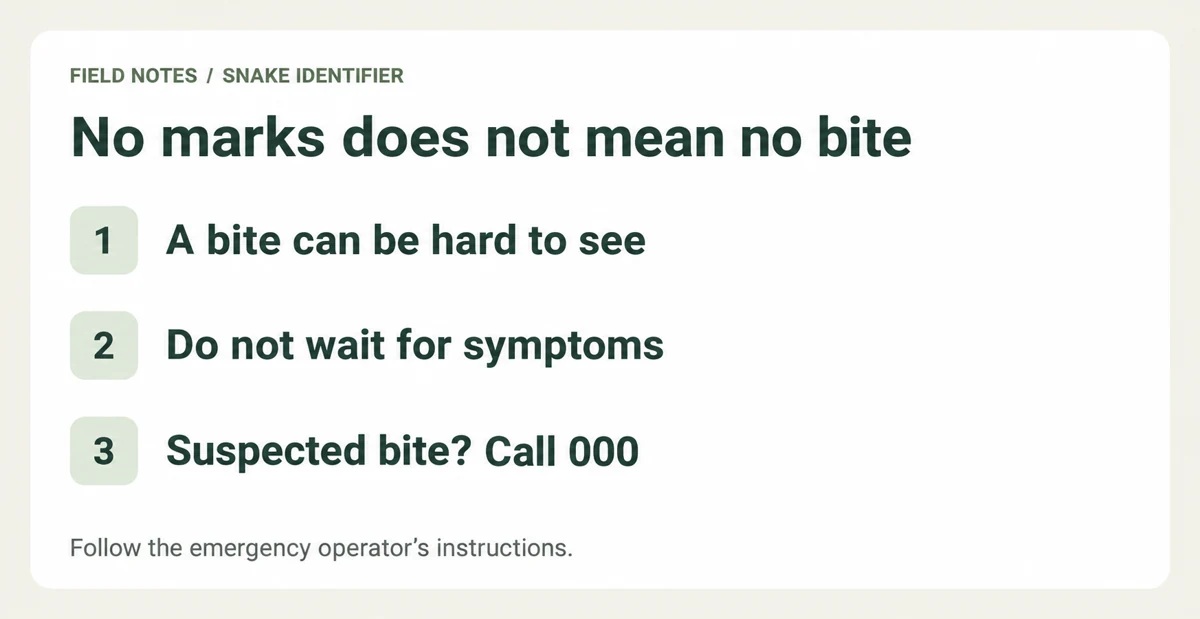
Yes. A suspected Australian snakebite can leave no visible mark. It may be painless, and one faint scratch is possible. If there has been possible contact with a snake, call 000 for an ambulance. Do not wait for two neat punctures, swelling or a symptom to prove the bite happened.
Imagine reaching into long grass, feeling a brief touch at the ankle and seeing a snake move away. You look at the skin and find nothing. That is useful to tell the emergency operator, but it is not a home all-clear. The question is what happened, not whether your skin matches a photograph online.
What a bite can look like
ANZCOR’s Australian snakebite guideline says a bite may be painless and have no visible marks. Where a mark is visible, it may be a pair of fang marks, a single mark or a scratch. Redness and bruising are uncommon in Australian snakebite. St John Australia also warns that signs can be almost invisible and symptoms may take an hour or more to appear.
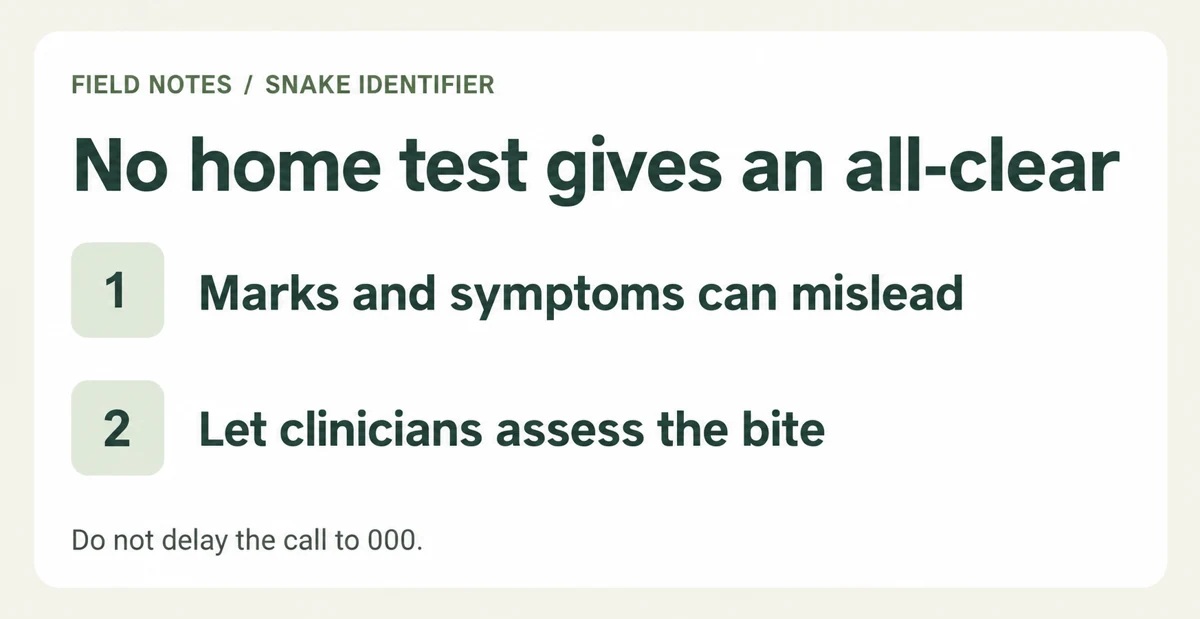
This is why the familiar diagram of two matching punctures is a poor test. Skin is difficult to inspect in bad light, under socks or beneath hair. Even a close photograph taken later cannot tell you whether venom was injected. An unexplained scratch by itself does not prove a snakebite either. Report the circumstances to the emergency operator and let clinicians assess the person.
The same applies when nobody saw the precise moment of contact. A child may say a snake touched them, a walker may have felt a sharp sensation in grass, or someone may find a snake beside their boot. You may never know from the scene whether fangs reached the skin. Give 000 the observation in plain words: what was seen, where the person was, whether contact is possible and how they feel now. Avoid presenting an uncertain guess as a confirmed bite or a confident denial. The operator can guide the next steps from the full picture.
What to do while help is coming
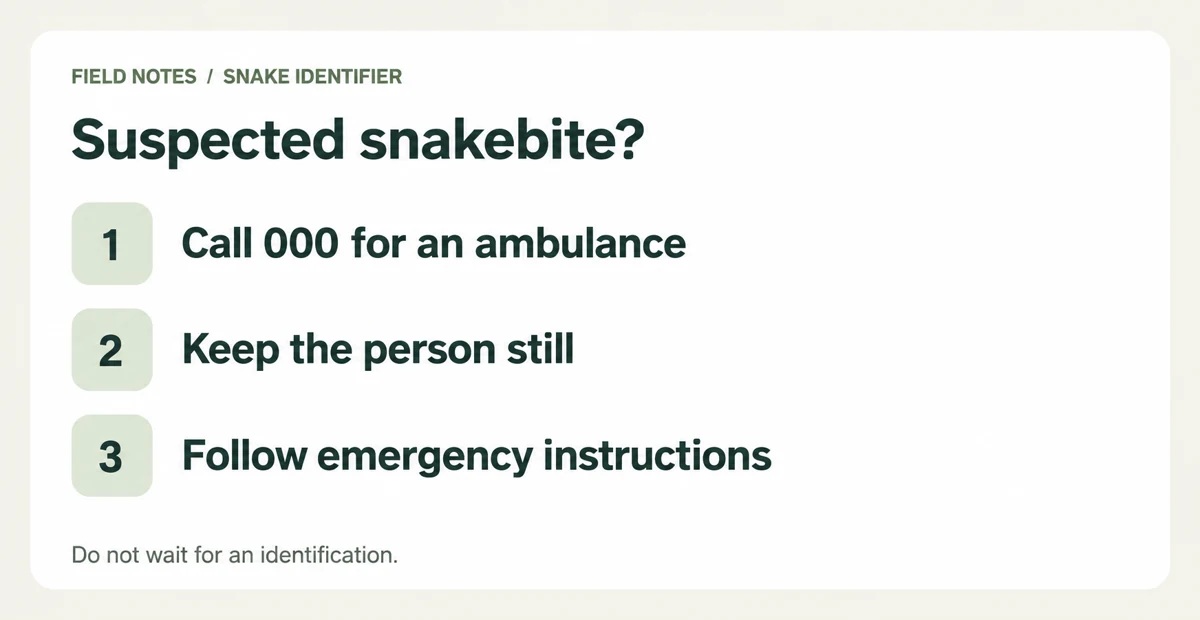
Keep the person still, reassure them and stay with them. ANZCOR recommends sending for an ambulance, immobilising the person and applying pressure bandaging with immobilisation for a suspected Australian snakebite. Follow the emergency operator’s instructions and a current first-aid guide if you have been trained. Do not ask the person to walk to “test” the leg or move about looking for the snake.
If the bite is on a limb, St John Australia describes an elasticised bandage over the site, then a further bandage from just above the fingers or toes up the limb, followed by a splint to keep it still. Record the approximate time of the event and when the bandage was applied. Do not remove the bandage because the person feels well. If they become unresponsive and are not breathing normally, follow the emergency operator’s CPR directions.
Do not cut the skin, use an arterial tourniquet, suck the bite or wash the site. These measures are contrary to ANZCOR guidance. The skin or clothing may retain venom traces that help clinical testing. Avoid turning first aid into a search for a mark: the call, stillness and bandaging matter more.
Make the scene easier for the arriving team. Have someone note the time and exact location of the incident, open a gate if necessary and keep other people away from the snake. One helper can talk with 000 while another stays beside the person. If you are alone, put the call on speaker so you can listen without making the person move. These practical tasks are more useful than taking repeated close-ups of apparently unmarked skin.
Describe the uncertainty clearly
A useful handover sounds like: “I felt something touch my ankle beside a snake at about 10:30. I cannot see a mark. I have stayed still since then.” Add any symptoms and changes, even if they seem to pass. ANZCOR notes that an initial collapse or confusion after some brown snake bites can be followed by apparent recovery. Feeling better does not cancel the need for assessment.
If someone else can photograph the snake from a safe distance without delaying care, a photo may help identification. Do not pursue, catch or kill it; that risks another bite. A photo does not establish whether a bite occurred or whether venom entered the body. Our photo-identification guide explains the limits. The snakebite first-aid page gives the broader response.
The simple rule is deliberately cautious: when contact is plausible, act on the event rather than the appearance of the skin. A quiet-looking ankle can still belong to a person who needs urgent medical assessment.
Sources checked 9 October 2026: ANZCOR, Australian snakebite first aid; St John Australia, snake bite. This guide supports, and does not replace, emergency advice.