
Elapidae
Bardick
Echiopsis curta
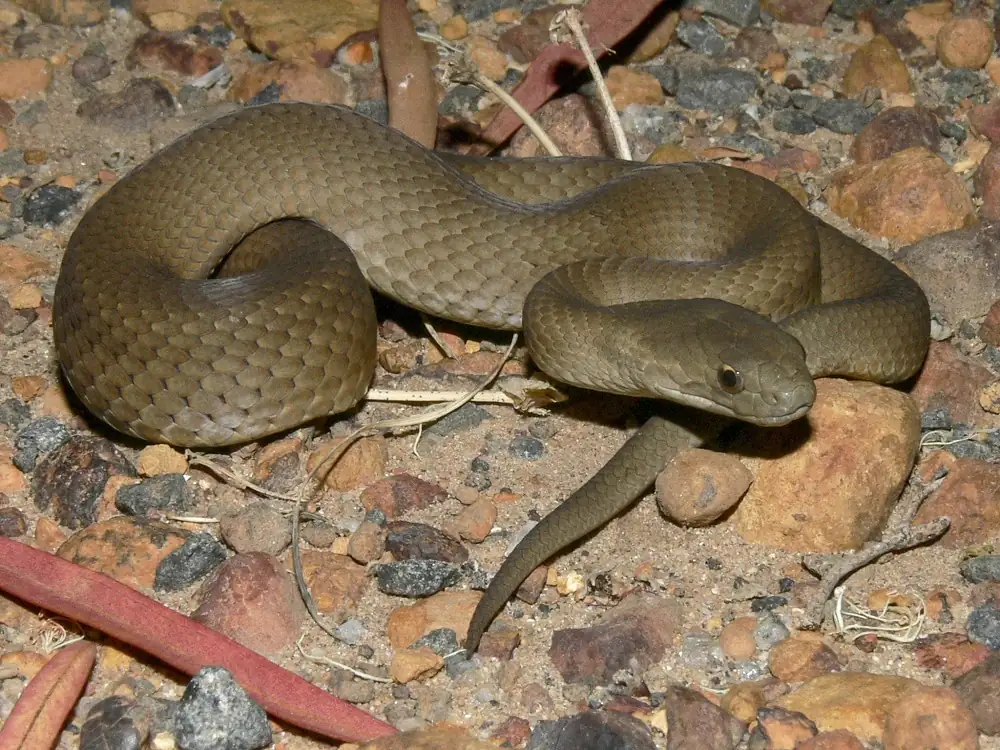
A short, stout snake with a broad head and generally plain olive-brown, brown or reddish-brown upperparts. Its separated populations include south-western NSW, Victoria, South Australia and Western Australia.
Venomous
Identification and appearance
A short, stout snake with a broad head and generally plain olive-brown, brown or reddish-brown upperparts; pale flecks can occur on the head.
Typical length
The NSW Government profile gives an average of about 40 cm and a reported total-length maximum of 70 cm; AROD lists a different species average of 60 cm.
Body build
robust
Head appearance
broad head distinct from neck
Key identification features
- Stout body and broad head
- Generally plain brown or olive-brown body
- Local pale flecks may occur on the head
Where it is found
The separated populations include south-western NSW around Balranald and near Mildura, north-western Victoria with adjoining south-eastern SA, Eyre Peninsula, and south-western WA.
Habitat
In the NSW account, habitat includes mallee and hummock grassland on sand or loam, often where water runs off nearby rises. Spinifex, thick ground vegetation, leaf litter, fallen timber and rocks provide cover.
Activity
Active partly at night. It shelters beneath fallen wood and rocks, and in leaf litter or thick vegetation. It is often seen crossing sandy tracks on warm evenings.
Diet
Reptiles and frogs, occasionally mammals.
Reproduction
Live-bearing.
Medical significance
The consulted sources label this species venomous but do not establish a simple field estimate of clinical severity. Treat any suspected bite as an emergency. Call 000 and follow snakebite first aid for any suspected bite.
What to do if you encounter one
Keep well clear and leave a route towards cover. Do not chase, corner, handle or inspect it. If it is inside a building, keep people and pets away and contact a qualified local snake remover.
Similar-looking snakes
Similar-looking Australian snakes may overlap in colour, banding and habitat; location is not a safe field test. Keep distance and wait for an expert if identification matters.
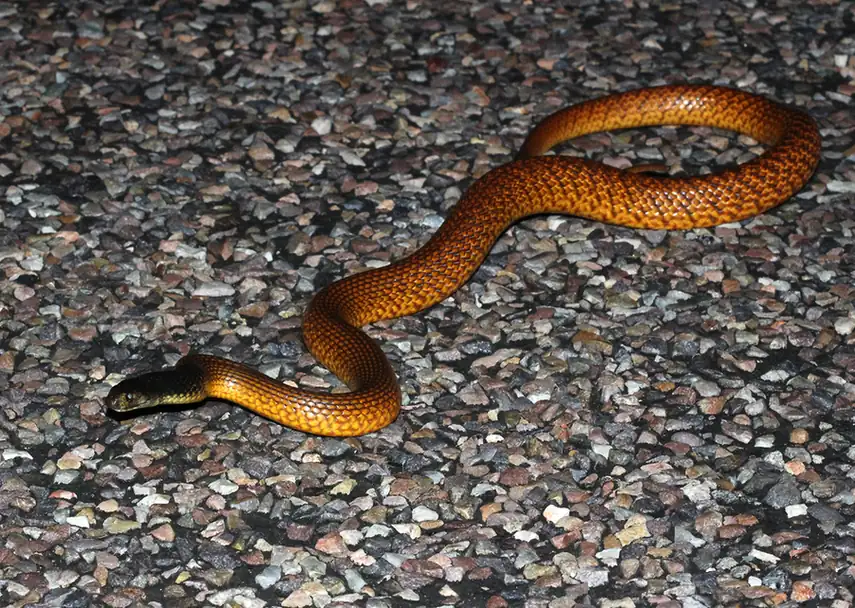
Photo: Lachlan Copeland · CC BY-SA 4.0 (Licence)
Elapidae
Western Brown Snake
Pseudonaja mengdeni
A slender inland brown snake with yellow, orange or brown body forms and variable dark markings.
Open identification guideElapidae
Spotted Mulga Snake
Pseudechis butleri
A dark-backed mulga snake from arid midwestern Western Australia, with pale-yellow scale centres and irregular darker patches.
Open identification guideSources checked
- Australian Reptile Online Database — Bardick (2026-09-25)
- The Reptile Database — Echiopsis curta (2026-09-25)
- NSW Government — Bardick profile (2026-09-25)
Still not sure?
Compare this snake with more clues.
A profile is a guide, not a reason to approach or handle a snake.