

Elapidae
Blacksoil Whip Snake
Demansia rimicola
A brown-grey whipsnake with fine pale and dark lines along its sides. It inhabits cracking-clay country across parts of northern and inland eastern Australia.
Venomous
Identification and appearance
A light brown to grey whipsnake with dark-and-pale side striping. It has a pale-edged collar and a dark teardrop near the eye; both are local head or neck markings.
Typical length
AROD lists a species average of about 49 cm and a separately reported maximum of 74 cm.
Key identification features
- Brown-grey body
- Pale and dark lines along the sides
- A neck collar may fade with age
Where it is found
The range follows cracking-clay country from the south-eastern Kimberley through the Northern Territory and Queensland to north-eastern South Australia, with NSW records around Tibooburra and Sturt National Park.
Diet
Presumably feeds mostly on lizards.
Reproduction
Oviparous.
Medical significance
The consulted sources label this species venomous but do not establish a simple field estimate of clinical severity. Treat any suspected bite as an emergency. Call 000 and follow snakebite first aid for any suspected bite.
What to do if you encounter one
Keep well clear and leave a route towards cover. Do not chase, corner, handle or inspect it. If it is inside a building, keep people and pets away and contact a qualified local snake remover.
Similar-looking snakes
Similar-looking Australian snakes may overlap in colour, banding and habitat; location is not a safe field test. Keep distance and wait for an expert if identification matters.
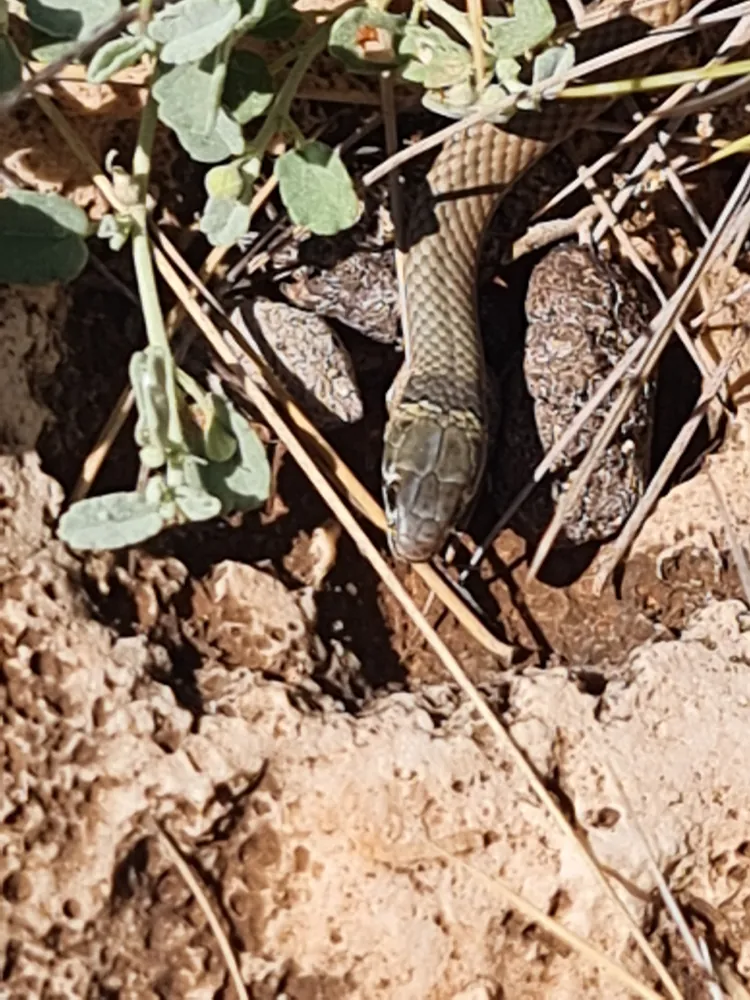
Photo: Belinda Forbes · CC BY 4.0 (Licence)
Elapidae
Black-necked Whip Snake
Demansia calodera
A small olive-brown to brown whipsnake with a pale-edged dark collar and obscure spots. The current diagnosis supports Western Australia; AROD also lists NT without a precise locality, so the range remains partial.
Open identification guide
Photo: Max Tibby · CC0 1.0 (Licence)
Elapidae
Greater Black Whip Snake
Demansia papuensis
A large, slender whipsnake that is dark grey, brown or black above and often becomes redder toward the rear. Its tropical northern range runs from the Kimberley to Cape York and inland Queensland.
Open identification guide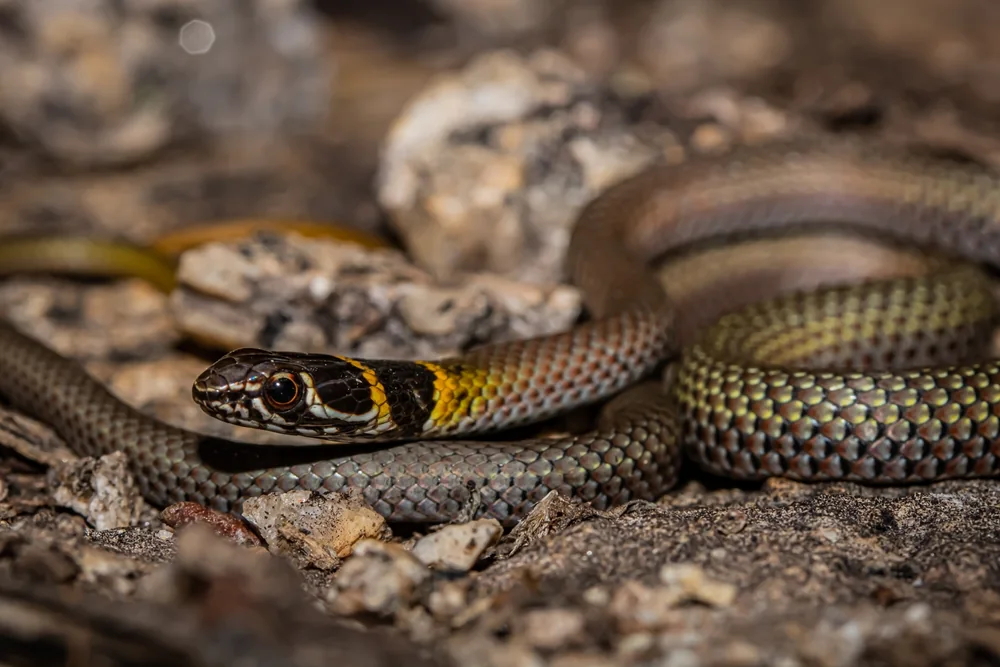
Photo: Noah Kirkland · CC BY 4.0 (Licence)
Elapidae
Collared Whip Snake
Demansia torquata
A grey-brown whipsnake with a darker head and a pale-edged band across the neck. The checked range follows eastern Queensland from Cape York to the central coast.
Open identification guideTaxonomy notes
Older AROD material used Demansia torquata broadly for related forms; that historical application is not an interchangeable current name for D. rimicola. NSW records are retained from the current government profile.
Sources checked
- Australian Reptile Online Database — Blacksoil Whip Snake (2026-09-25)
- The Reptile Database — Demansia rimicola (2026-09-25)
- NSW Government — Blacksoil Whip Snake profile (2026-09-25)
Still not sure?
Compare this snake with more clues.
A profile is a guide, not a reason to approach or handle a snake.