
Elapidae
Blue-banded Sea Krait
Laticauda laticaudata
A blue-grey and black-banded sea krait known from occasional Australian records, with no verified Australian breeding population.
Venomous
Occasional visitor: this species is included for reference and is not part of the usual identifier results.
Identification and appearance
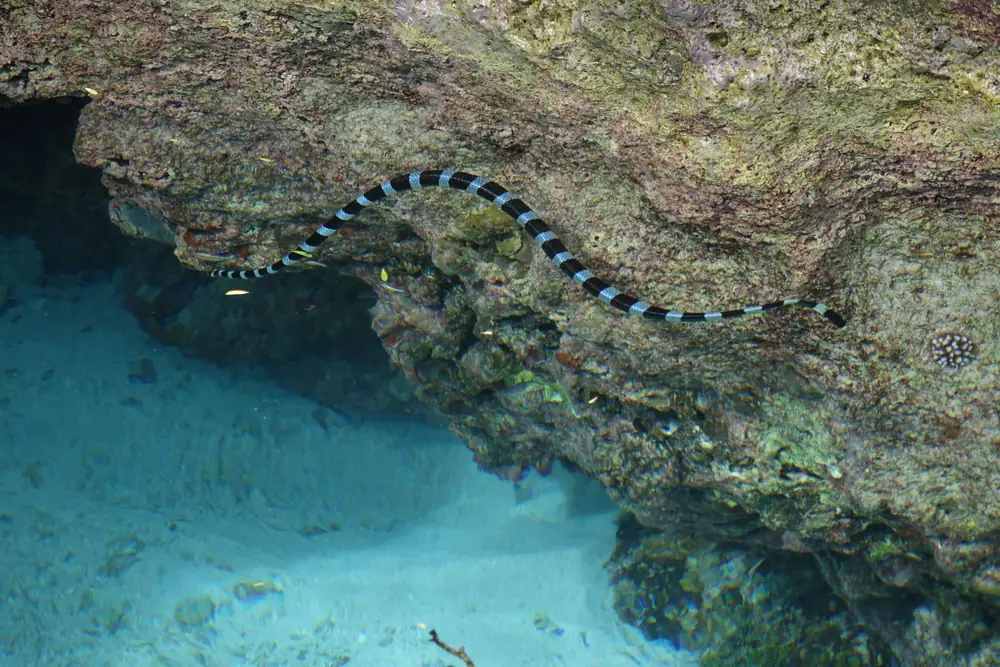
Black bands cross a blue to grey-blue body above a pale cream or yellow belly. The upper lip is dark; a pale yellow mark above the eye may extend across the snout. Some bands do not fully join beneath the animal.
Other names
Black-lipped Sea Krait, Brown-lipped Sea Krait
Typical length
Ineich and Laboute’s species account gives a mean adult length around 90–100 cm. This is not an Australian population estimate.
Key identification features
- Blue-grey body with black bands
- Dark upper lip
- Pale yellow marking above the eye
Where it is found
Historical specimens labelled Tasmania, Sydney and Torres Strait were interpreted as occasional arrivals in the 2014 Australian review. No Australian breeding population has been verified.
Diet
Feeds mainly on eels, including moray eels.
Reproduction
Egg-laying.
Medical significance
For any suspected snakebite, call 000 and follow snakebite first aid. Do not wait for identification.
What to do if you encounter one
Keep clear on shore or in the water. Do not handle or return a stranded snake to the sea; contact qualified wildlife help if needed.
Taxonomy notes
Australian records are treated as occasional visitors. A reference profile is retained, but this species is excluded from the usual identifier results.
Sources checked
Still not sure?
Compare this snake with more clues.
A profile is a guide, not a reason to approach or handle a snake.