
Elapidae
Broad-headed Snake
Hoplocephalus bungaroides
A venomous, threatened sandstone snake of the Sydney Basin and surrounding New South Wales.
Venomous
Identification and appearance
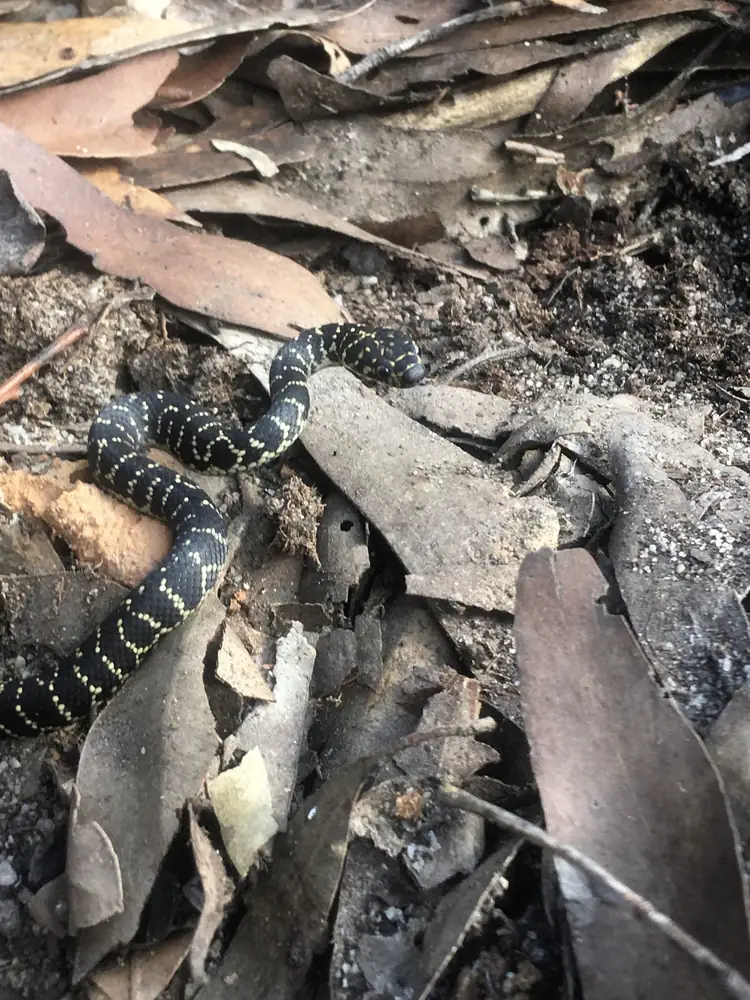
A black snake with irregular narrow yellow crossbands, associated with sandstone habitats around the Sydney Basin.
Typical length
Australian Museum reports a length range of 50–90 cm; this is a source range, not a confirmed typical-adult interval.
Key identification features
- Black body with irregular narrow yellow crossbands
- Sandstone heath and bush-rock habitat in the Sydney region
- Australian Museum reports skink and frog prey
Where it is found
The Sydney Basin and a radius of about 250 km around Sydney, in New South Wales, according to the Australian Museum account.
Habitat
The species occupies sandstone heath in the Sydney Basin. Bush rock provides important places to shelter and find food.
Activity
Partly arboreal; it may use trees as well as sandstone heath and bush-rock habitat.
Diet
Lizards and frogs.
Reproduction
Live-bearing; the Australian Museum reports litters of 8–20 young.
Medical significance
Potentially dangerous venomous snake; treat any suspected bite as an emergency and call 000.
What to do if you encounter one
Keep your distance and leave the snake a clear route away. Do not handle it, chase it for a photograph or attempt to inspect its mouth. If it is inside a building, keep people and pets clear and contact a qualified local snake catcher.
Similar-looking snakes
Young Diamond Pythons, included in the Carpet Python profile, can look similar to Broad-headed Snakes. Both can show pale markings on a dark body.

Photo: Andrew Mercer (www.baldwhiteguy.co.nz) · CC BY-SA 4.0 (Licence)
Pythonidae
Carpet Python
Morelia spilota
A patterned python that can live in woodland, gardens and buildings as well as less disturbed habitats. Brown and cream blotches are common, but some forms have much darker bodies with pale spots. The diamond python is included within this variable species.
Open identification guideSources checked
- Australian Reptile Online Database — Broad-headed Snake (2026-09-25)
- Australian Museum — Broad-headed Snake (2026-09-25)
- The Reptile Database — Hoplocephalus bungaroides (2026-09-25)
- ANZCOR — First Aid Management of Australian Snake Bite (2026-09-25)
- Species identification comparison (2026-09-26)
- Species identification comparison (2026-09-26)
Still not sure?
Compare this snake with more clues.
A profile is a guide, not a reason to approach or handle a snake.