
Elapidae
Brown-headed Snake
Furina tristis
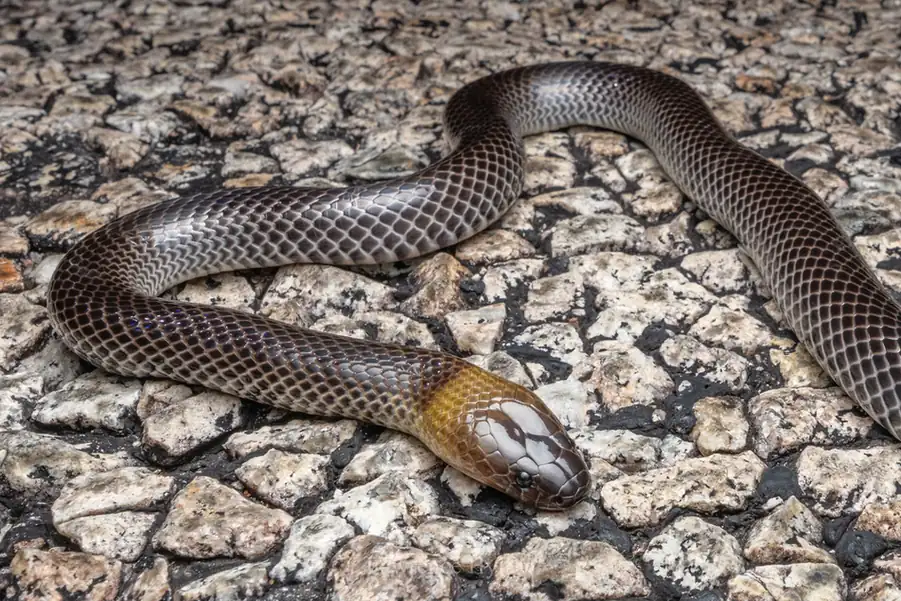
A dark northern Queensland snake with a paler collar and light scale edges along its sides.
Venomous
Identification and appearance
The body is blackish-brown with a paler collar behind the head. Light edges around the side scales can be conspicuous. These broad features overlap with other snakes and are not a safe identification test.
Typical length
The Australian Museum Lizard Island guide reports total length up to 100 cm; local individuals are usually around 80 cm. That local figure is not a species-wide average.
Head appearance
Paler collar behind the head
Key identification features
- Blackish-brown body
- Paler collar behind the head
- Light edges on the side scales
Where it is found
Queensland, including Cape York and Torres Strait records.
Activity
Usually active at night.
Diet
Skinks were found in a small museum sample. A Cape York observation also reported apparent scavenging of a dead blind snake.
Reproduction
Egg-laying; AROD reports an average clutch size of 6.
Medical significance
The Australian Museum guide warns that a bite from a large individual could cause severe symptoms. Treat any possible bite as an emergency and call 000.
What to do if you encounter one
Keep your distance and leave the snake a clear route away. Do not handle it, chase it for a photograph or attempt to inspect its mouth. If it is inside a building, keep people and pets clear and contact a qualified local snake catcher.
Taxonomy notes
Also published under the genus combination Glyphodon tristis; this profile follows Furina tristis.
Sources checked
- Australian Reptile Online Database — Brown-headed Snake (2026-09-25)
- The Reptile Database — Furina tristis (2026-09-25)
- ANZCOR — First Aid Management of Australian Snake Bite (2026-09-25)
- Australian Museum — Lizard Island Brown-headed Snake guide (2026-09-26)
- Australian Museum — Herpetofauna of the Weipa region, page 74 (2026-09-26)
- Herpetological Review 46(4), Furina tristis (Brown-headed snake). DIET (2026-09-26)
Still not sure?
Compare this snake with more clues.
A profile is a guide, not a reason to approach or handle a snake.