
Typhlopidae
Brown-snouted Blind Snake
Anilios wiedii
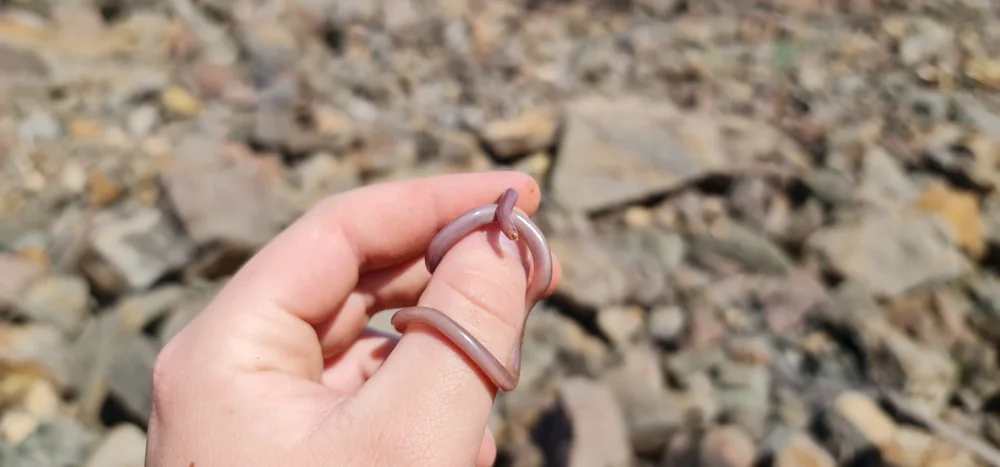
A small blind snake recorded in Queensland and New South Wales, with a prominent rounded snout.
Non-venomous
Identification and appearance
The museum catalogue describes a very prominent rounded snout and a spined tail, with buff upperparts and a yellowish underside in its specimen account. Live colour is not independently verified here.
Other names
Wied's Blind Snake, Ramphotyphlops wiedii
Typical length
Boulenger's catalogue records a 290 mm specimen and AROD lists a species maximum of 30 cm plus a 20 cm species average. These figures are not converted into a typical adult interval.
Head appearance
very prominent, rounded snout
Key identification features
- Very prominent rounded snout
- Buff above and yellowish below in the museum description
- Queensland and New South Wales occurrence
Where it is found
Queensland and New South Wales in the checked current occurrence accounts; the Reptile Database notes that older literature has reported a broader range requiring taxonomic and locality review.
Diet
Ant pupae have been found in examined museum specimens.
Reproduction
Egg-laying.
Medical significance
Blind snakes are non-venomous. Do not handle an unfamiliar snake or rely on a brief sighting to identify it.
What to do if you encounter one
Leave small burrowing snakes undisturbed and seek expert help rather than picking one up.
Similar-looking snakes
Similar blind snakes require specialist identification.
Taxonomy notes
Originally described as Typhlops wiedii Peters, 1867; now placed in Anilios. Older accounts report a broader range whose basis remains uncertain.
Sources checked
- Peters 1867, Herpetologische Notizen — BHL/BioStor record (2026-09-26)
- Boulenger 1893, Catalogue of the Snakes in the British Museum, volume I (2026-09-26)
- AROD — Brown-snouted blind snake (2026-09-26)
- NSW Government — Non-venomous blind snakes (2026-09-26)
- Webb & Shine 1993, Dietary Habits of Australian Blindsnakes (2026-09-26)
Still not sure?
Compare this snake with more clues.
A profile is a guide, not a reason to approach or handle a snake.