
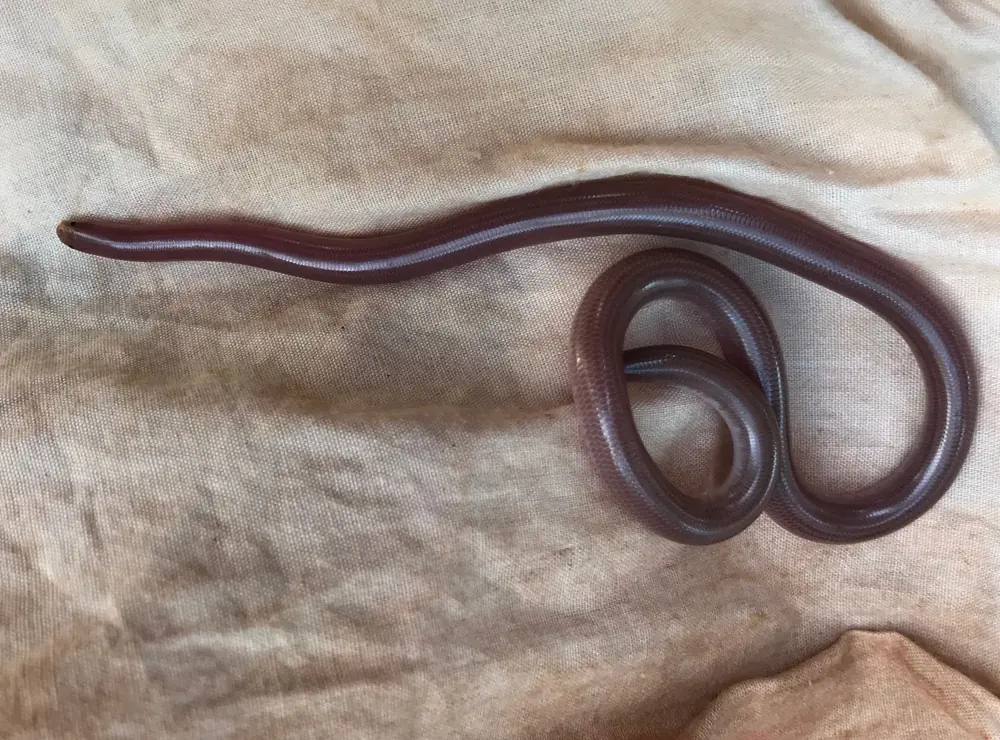
Photographed on light cloth.
Typhlopidae
Buff-snouted Blind Snake
Anilios margaretae
A very slender blind snake described from Lake Throssell in Western Australia.
Non-venomous
Identification and appearance
A very slender blind snake with an angular snout. Its described museum specimen has a pale snout and greyish upperparts; live colour is not established by that account.
Typical length
The holotype measured 30.6 cm in total length. This single specimen does not establish a typical adult range or species maximum.
Body build
slender
Key identification features
- Very slender build
- Angular snout
Where it is found
Known from the type locality at Lake Throssell in arid inland Western Australia; the original account provides only that locality.
Medical significance
Blind snakes are non-venomous. Identification from appearance alone remains uncertain; do not handle an unfamiliar snake.
What to do if you encounter one
Leave it undisturbed and keep people and pets away. Do not pick it up to inspect its scales or head.
Similar-looking snakes
Similar blind snakes require specialist identification.
Taxonomy notes
Storr described the taxon as Ramphotyphlops margaretae sp. nov. in 1981 from the holotype WAM R15710; current sources use Anilios margaretae.
Sources checked
- Storr 1981 Western Australian revision (2026-09-26)
- Reptile Database current taxonomy (2026-09-26)
- AROD species account (2026-09-26)
- Fauna of Australia Typhlopidae treatment (2026-09-26)
- NSW Government — Non-venomous blind snakes (2026-09-26)
Still not sure?
Compare this snake with more clues.
A profile is a guide, not a reason to approach or handle a snake.