
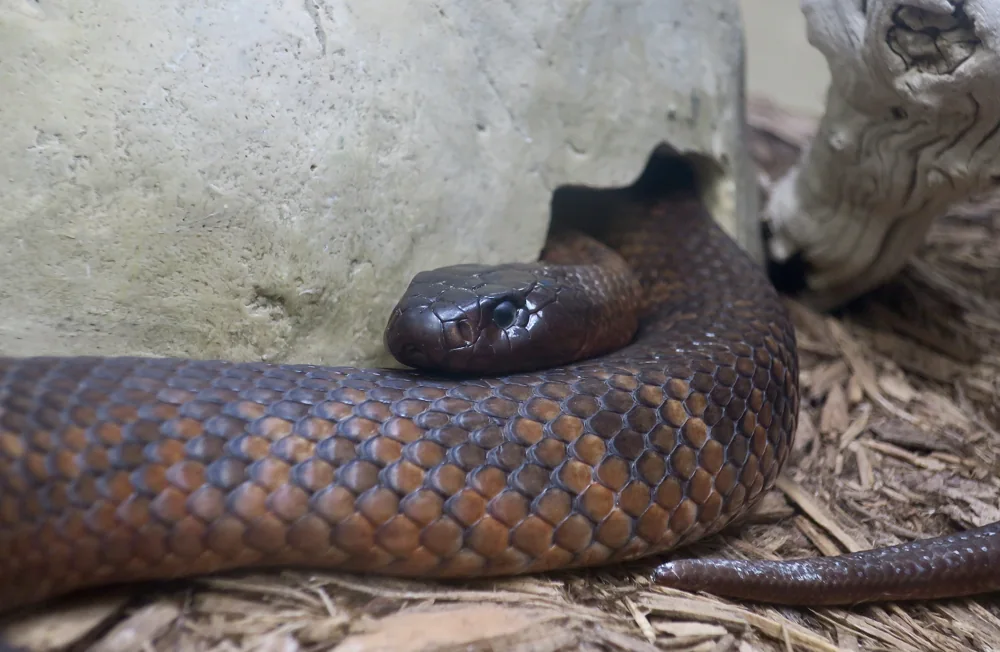
Collett’s Snake (Pseudechis colletti) at Phoenix Herpetological Sanctuary (captive).

Elapidae
Collett's Snake
Pseudechis colletti
A robust, boldly patterned snake of central Queensland’s black-soil plains.
Dangerously venomous
Identification and appearance
The Australian Museum describes a strongly built snake with a robust body, broad blunt head and irregular reddish to salmon-pink patches on a darker brown or black background. Ventral scales are yellow-orange to cream. It is restricted to drier central inland Queensland.
Other names
Downs Tiger Snake, Collett's Black Snake
Typical length
The Australian Museum reports the largest measured male as 177.5 cm SVL and separately describes average total length as around 1.5 m. SVL is not converted to total length, and neither figure is used as a typical interval.
Body build
robust
Head appearance
broad, blunt
Key identification features
- Robust body and broad blunt head
- Irregular reddish to salmon-pink bands on brown or black
- Central Queensland black-soil plains
Where it is found
Drier central inland Queensland, especially the black-soil plains of the Mitchell Grass Downs.
Habitat
Collett’s Snakes inhabit the black-soil plains of central inland Queensland, which flood seasonally during monsoonal rains. They shelter in deep soil cracks, small soil depressions and under fallen timber.
Activity
Terrestrial and usually diurnal or crepuscular; secretive and rarely seen, sheltering in deep soil cracks, gilgais and fallen timber.
Diet
Mammals, lizards, snakes and frogs.
Reproduction
Egg-laying; captive observations report approximately 7–14 eggs.
Medical significance
Treat any suspected bite as an emergency. Call 000 and follow Australian snakebite first aid; do not wait for identification.
What to do if you encounter one
Keep well clear and do not disturb cracks, gilgais or fallen timber where the snake may shelter.
Similar-looking snakes
The Australian Museum notes a possible resemblance to a reddish-brown Blue-bellied Black Snake, but the known distributions generally do not overlap. Do not rely on a photograph or colour alone to judge safety.
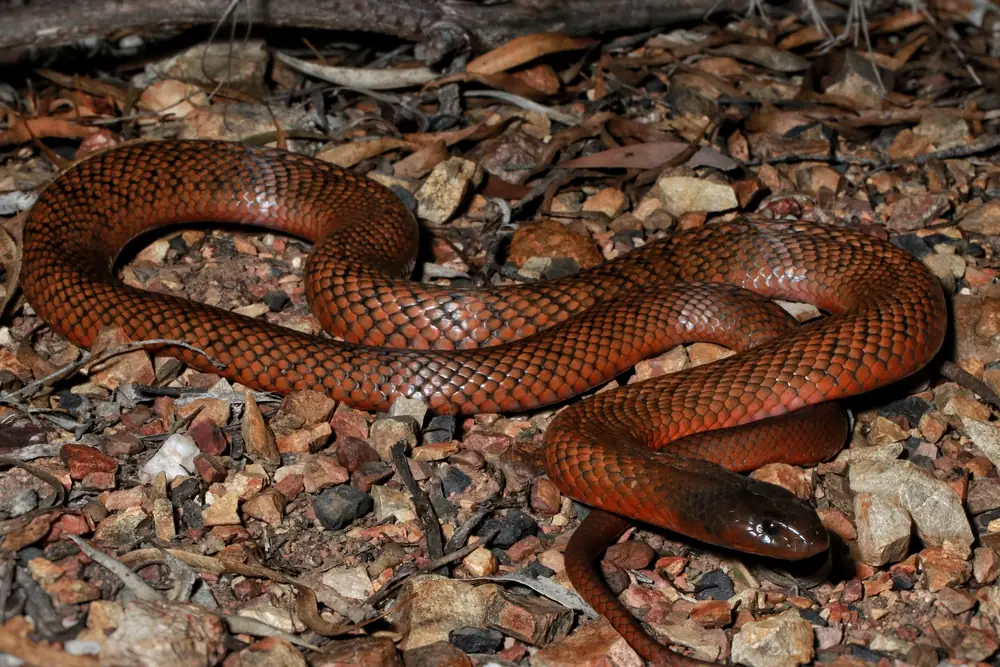
Photo: Max Tibby · CC0 1.0 (Licence)
Elapidae
Spotted Black Snake
Pseudechis guttatus
A large dangerous black snake with variable dark, pale and broken-crossbanded forms, recorded from New South Wales and Queensland.
Open identification guideTaxonomy notes
Current name Pseudechis colletti; original descriptions and later revisions are listed in the Reptile Database.
Sources checked
- Australian Museum — Collett's Snake (2026-09-26)
- Queensland Government — Snakes of the Mt Isa region (2026-09-26)
- The Reptile Database — Pseudechis colletti (2026-09-26)
- ANZCOR — Australian snake bite first aid (2026-09-26)
Still not sure?
Compare this snake with more clues.
A profile is a guide, not a reason to approach or handle a snake.