

Elapidae
Common Death Adder
Acanthophis antarcticus
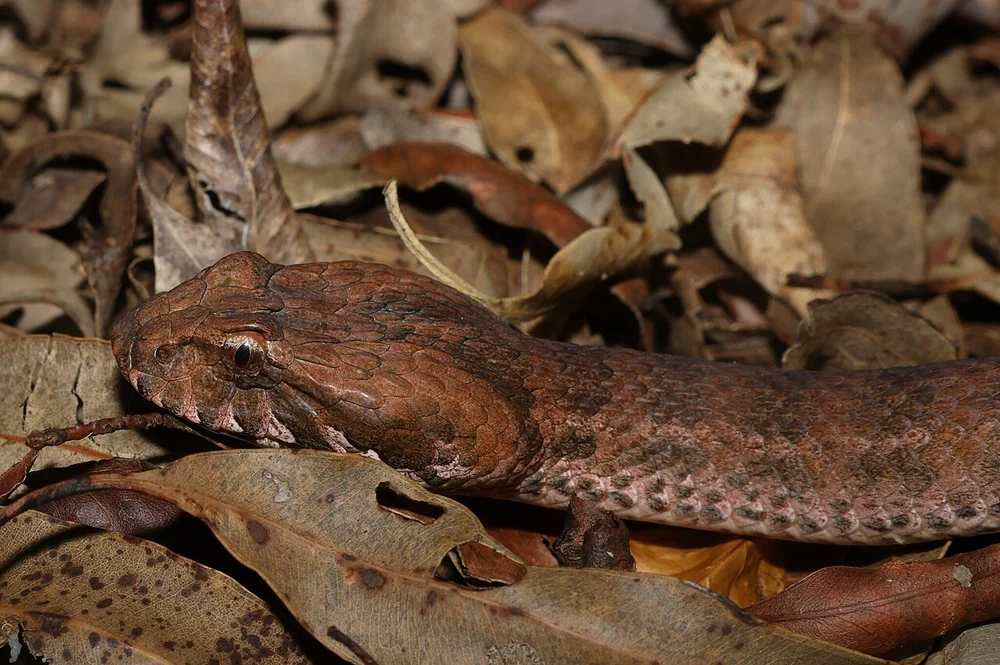
A short, heavy-bodied snake with a broad head and a fine tail. Death adders often remain concealed in leaf litter instead of moving away early. Their camouflage and habit of waiting for prey make the shape of the whole animal particularly useful to notice.
Highly venomous
Identification and appearance
The broad head narrows sharply into the neck, while the body is stout and the tail unusually thin. Grey and reddish-brown animals occur, generally with darker irregular bands. Pale and dark markings around the lips can be visible in an existing photograph. The tail tip is a lure, but a person should never approach to watch it work.
Typical length
A relatively short snake; Queensland guidance gives about 40 cm as average and up to 1 m as maximum.
Body build
robust
Head appearance
broad, triangular, distinct from neck
Key identification features
- Very stout body with a narrow neck
- Broad, triangular-looking head
- Thin tail sharply contrasting with the body
Where it is found
Records extend through eastern and southern mainland Australia. The limits of northern populations and their separation from other death adders are not fully consistent between sources; Northern Territory occurrence has not been independently verified for this guide.
Habitat
Common Death Adders live in forests and woodlands, grasslands and heath, where leaf litter and other ground cover can conceal them.
Activity
An ambush hunter that can remain hidden under loose litter. Stillness should not be read as absence of a living snake.
Diet
Takes small vertebrates including lizards, frogs, birds and mammals, attracting prey with movements of the tail tip.
Reproduction
Gives birth to live young.
Medical significance
A bite can cause life-threatening envenoming. Its small length does not make it a low-risk species.
What to do if you encounter one
Stop well short of a suspected snake in leaf litter and take a clear route around it. Do not probe with a stick or uncover it for a photograph. Keep children and pets away from the immediate area.
Similar-looking snakes
Other death adders require careful regional assessment. De Vis' banded snake can also confuse an inexperienced observer; a broad head alone is not diagnostic.

Photo: dhfischer · CC BY 4.0 (Licence)
Elapidae
Northern Death Adder
Acanthophis praelongus
The Northern Death Adder is a short, banded death adder recorded from Cape York Peninsula in Queensland. AROD describes grey, brown or reddish colouring with lighter bands across the body.
Open identification guide
Photo: Max Tibby · CC0 1.0 (Licence)
Elapidae
Desert Death Adder
Acanthophis pyrrhus
A banded death adder of sandy and stony deserts across inland Australia. Its red or orange colouring blends with many desert soils.
Open identification guide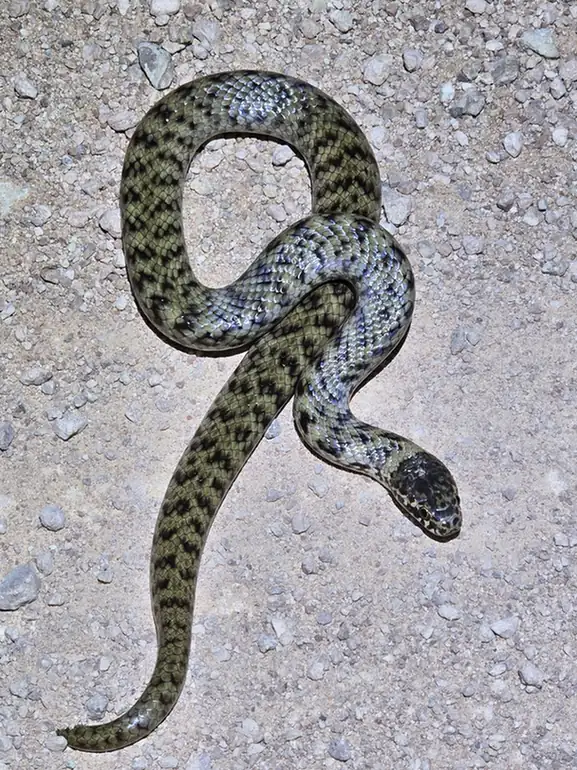
Photo: Max Tibby · CC0 1.0 (Licence)
Elapidae
De Vis’ Banded Snake
Denisonia devisi
A heavily built, banded inland snake with a patchy eastern Australian range.
Open identification guideTaxonomy notes
Published northern range boundaries conflict, so the range described in this guide should not be read as complete.
Sources checked
- Australian Museum — Common Death Adder (2026-09-25)
- Queensland Government — Targeted species survey guideline (2026-09-25)
- Queensland Government — Regional snake guide (2026-09-25)
- Reptile Database — Acanthophis antarcticus (2026-09-25)
Still not sure?
Compare this snake with more clues.
A profile is a guide, not a reason to approach or handle a snake.