
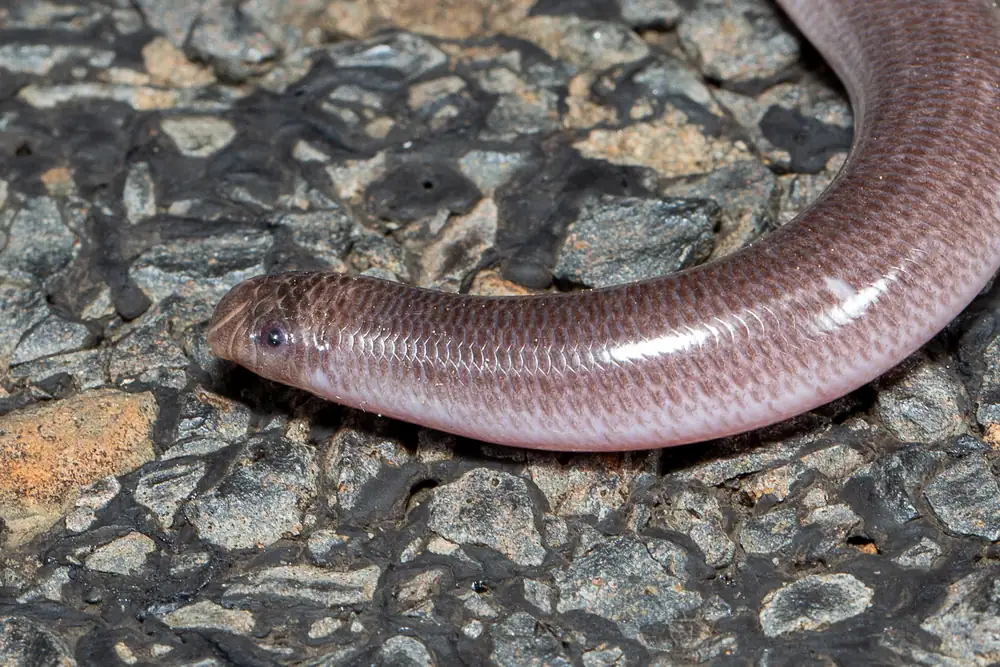
Typhlopidae
Dark-spined Blind Snake
Anilios bicolor
A relatively stout blind snake recorded across southern Australia.
Non-venomous
Identification and appearance
A relatively stout, elongated blind snake with a slight edge across the front of the snout and a dark tail spine. These small features require specialist examination.
Other names
Ramphotyphlops bicolor
Typical length
AROD lists a species average of 42 cm. It is retained as an average only and is not converted into a typical interval or maximum.
Body build
robust
Head appearance
snout with a weak to moderate transverse edge
Key identification features
- Moderately elongate blindsnake
- Heavily pigmented tail spine in the revision diagnosis
- Southern Australian occurrence
Where it is found
Southern Australia, from the Mount Jackson and Ravensthorpe areas of Western Australia east to western New South Wales and Victoria, including South Australia.
Reproduction
Egg-laying.
Medical significance
Blind snakes are non-venomous. Do not handle an unfamiliar snake or rely on a brief sighting to identify it.
What to do if you encounter one
Leave small burrowing snakes undisturbed and seek expert help rather than picking one up.
Similar-looking snakes
Similar blind snakes require specialist identification.
Taxonomy notes
The 2004 revision resurrected Ramphotyphlops bicolor from synonymy with R. australis; current placement is Anilios bicolor.
Sources checked
- Rabosky et al. 2004, Australian Journal of Zoology — bicolor revision (2026-09-26)
- Rabosky et al. 2004 — open e-print (2026-09-26)
- AROD — Dark-spined blind snake (2026-09-26)
- NSW Government — Non-venomous blind snakes (2026-09-26)
Still not sure?
Compare this snake with more clues.
A profile is a guide, not a reason to approach or handle a snake.