
Elapidae
Desert Banded Snake
Simoselaps anomalus
A small burrowing banded snake of the Northern Territory, South Australia and Western Australia.
Venomous
Identification and appearance
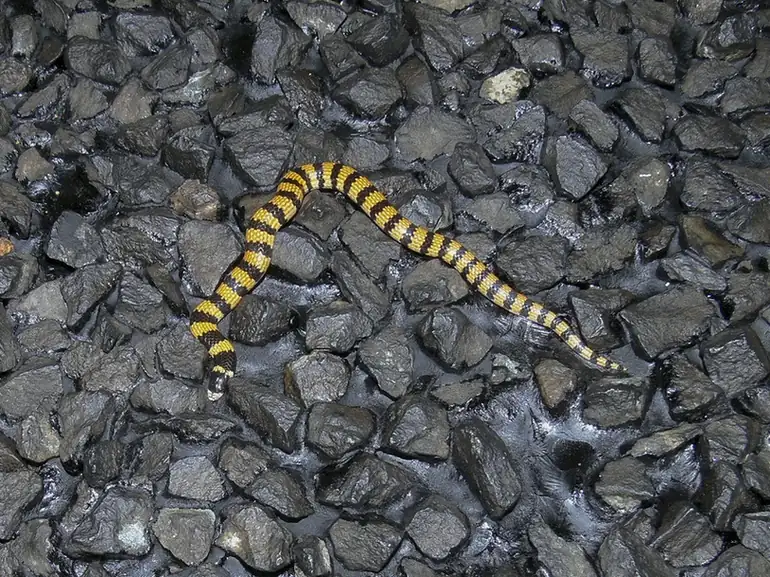
A small, robust burrowing snake with a glossy pale yellow to orange body crossed by black bands. The head is mainly black with a pale snout tip. Its protruding snout lacks the cutting edge of shovel-nosed snakes.
Other names
Northern Desert Banded Snake
Typical length
AROD reports an average of about 25 cm; a maximum was not given.
Body build
robust
Head appearance
Mostly black head with a pale snout tip
Key identification features
- Robust body with black bands
- Pale yellow to orange upperparts
- Mostly black head with a pale snout tip
Where it is found
Northern Territory, South Australia and Western Australia.
Activity
Active at night.
Diet
A Western Australian field study found that its prey consisted almost entirely of Lerista skinks.
Reproduction
Egg-laying.
Medical significance
Accounts describe low usual danger to people, but this cannot establish the safety of an unidentified snakebite. For any suspected bite, call 000 and follow snakebite first aid.
What to do if you encounter one
Keep clear and do not handle it. Use a qualified snake catcher or local wildlife authority if it is trapped near people.
Sources checked
- Australian Reptile Online Database — Desert Banded Snake (2026-09-25)
- The Reptile Database — Simoselaps anomalus (2026-09-25)
- Keogh 1999 — Simoselaps phylogeny (2026-09-26)
- DBCA — Burrowing snakes of Western Australia, pages 60–61 (2026-09-26)
- Goodyear and Pianka 2008, Sympatric ecology of five species of fossorial snakes (Elapidae) in Western Australia (2026-09-26)
Still not sure?
Compare this snake with more clues.
A profile is a guide, not a reason to approach or handle a snake.