

Elapidae
Desert Whip Snake
Demansia cyanochasma
Desert Whip Snake is a venomous central Australian species ranging from southeastern inland Western Australia through South Australia and central/southern Northern Territory to south-western Queensland. It is bluish-grey to brown, with a cream-edged dark line across the snout.
Venomous
Identification and appearance
The front of the body can be bluish-grey, becoming pale orange or yellowish-brown towards the rear. Narrow dark scale margins and a pale-edged dark snout line are described in the 2023 revision.
Typical length
The 2023 manuscript reports a mean snout–vent length of 510 mm (51 cm), excluding the tail. It is not used as a typical adult total-length interval or a total maximum.
Key identification features
- Bluish-grey to brown colouration
- Cream-edged dark snout line
- Semiarid and arid central Australian range
Where it is found
Semiarid and arid central Australia, from southeastern inland Western Australia through much of South Australia and central/southern Northern Territory to south-western Queensland.
Diet
Reptiles and frogs.
Medical significance
Venomous. A suspected bite needs urgent medical assessment; do not use a website result to judge risk. Call 000 and follow snakebite first aid for any suspected bite.
What to do if you encounter one
Keep well clear, leave a route for the snake to move away and do not approach for a closer look. If it is inside a building, keep people and pets away and contact a qualified local snake catcher.
Similar-looking snakes
Desert Whips resemble Yellow-faced and Reticulated Whips and were often recorded under those names before 2023. The sighting location is especially useful when comparing them.

Photo: James K. Douch · CC BY-SA 4.0 (Licence)
Elapidae
Yellow-faced Whip Snake
Demansia psammophis
Yellow-faced Whip Snake is an eastern Australian species recorded in NSW, QLD, VIC, SA and ACT. It is variable in grey, olive, yellow and brown tones, with a dark facial line and dark-edged scales that can give a reticulated appearance.
Open identification guide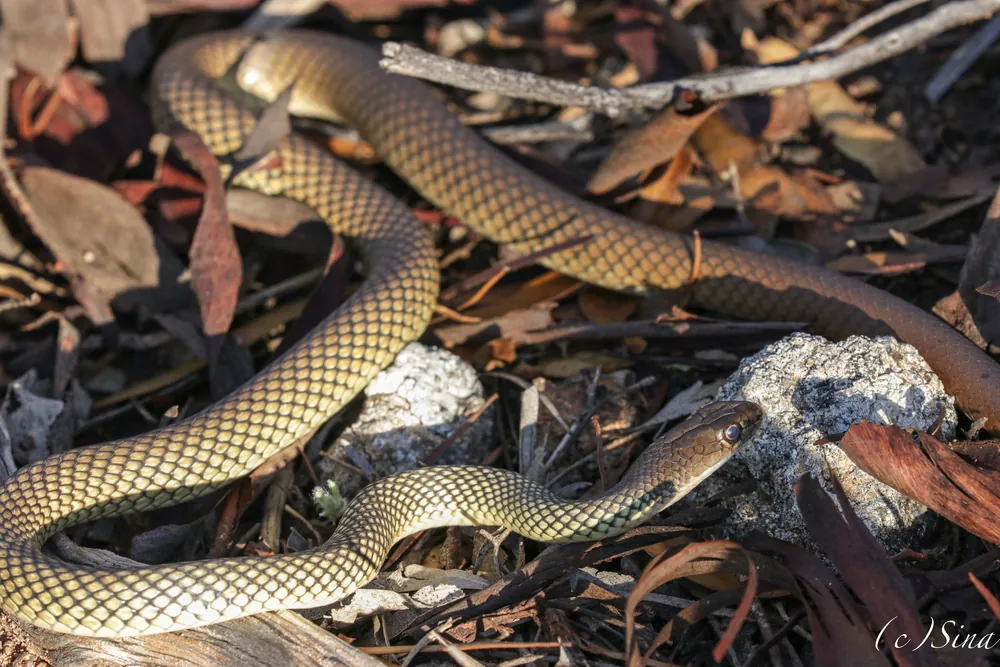
Photo: Ursina Gringer · CC BY 4.0 (Licence)
Elapidae
Reticulated Whip Snake
Demansia reticulata
A Western Australian whipsnake with dark scale edges that can produce a net-like appearance.
Open identification guideSources checked
- The Reptile Database — Demansia cyanochasma (2026-09-25)
- Nankivell et al. 2023 — Demansia complex revision (2026-09-25)
- Nankivell 2023 thesis — Demansia cyanochasma distribution and habitat (2026-09-26)
- Nankivell et al. — Whip snake revision (2026-09-26)
Still not sure?
Compare this snake with more clues.
A profile is a guide, not a reason to approach or handle a snake.