
Elapidae
Dwyer’s Snake
Suta dwyeri
A small snake associated with rocky shelter in parts of eastern Australia.
Venomous
Identification and appearance
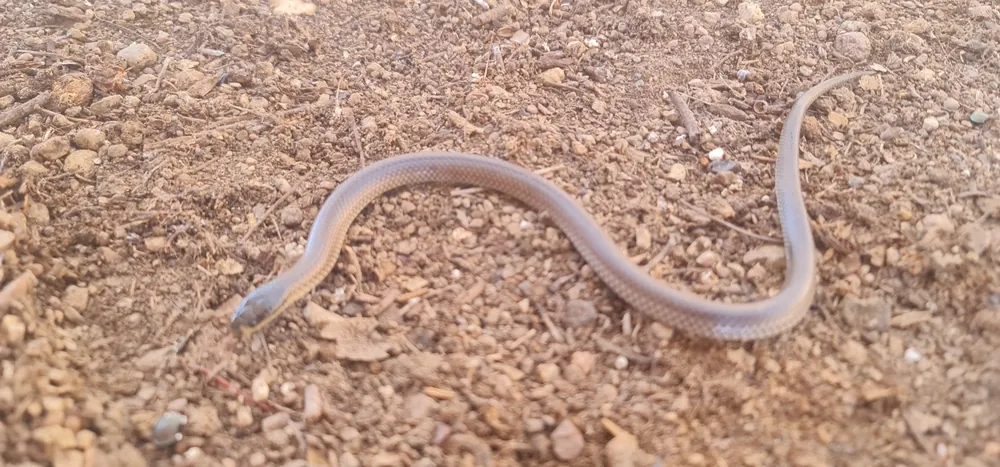
Tan-to-brown body with a dark glossy head; a regional field guide describes it around rocky shelter. Avoid relying on colour or size alone in the field.
Typical length
The Albury–Wodonga field guide gives a total length of 500 mm without identifying it as an average or maximum. No typical adult interval is inferred.
Head appearance
Dark glossy head
Key identification features
- tan-to-brown body
- dark glossy head
- rocky-shelter association
Where it is found
Recorded in the ACT, NSW, QLD and VIC, with South Australian populations included under the preliminary eastern-population interpretation in the 2020 revision.
Activity
Nocturnal.
Diet
Small lizards.
Reproduction
Live-bearing.
Medical significance
The consulted sources label this species venomous but do not establish a simple field estimate of clinical severity. Treat any suspected bite as an emergency. Call 000 for an ambulance and do not wait for identification.
What to do if you encounter one
Keep well clear and leave a route towards cover. Do not chase, corner, handle or inspect it. If it is inside a building, keep people and pets away and contact a qualified local snake remover.
Similar-looking snakes
Grey Snake is a documented lookalike. Both can be small, earth-coloured snakes; dark head markings may be stronger in younger Grey Snakes.

Photo: Max Tibby · CC0 1.0 (Licence)
Elapidae
Grey Snake
Hemiaspis damelii
A plain grey to olive-grey snake associated with floodplains and temporary wetlands in NSW and Queensland. Young snakes have a dark head marking that reduces with age.
Open identification guideTaxonomy notes
Maryan et al. (2020) tentatively associated the eastern part of the former nigriceps complex with Suta dwyeri, extending its range into South Australia, while calling for further study. The ACT biodiversity report documents three Gungahlin records under the older name Suta spectabilis dwyeri.
Sources checked
- Australian Reptile Online Database — Dwyer’s Snake (2026-09-25)
- The Reptile Database — Suta dwyeri (2026-09-25)
- Michael 2025 — Field guide to the reptiles of Albury-Wodonga (2026-09-26)
- ANZCOR — Australian snake bite first aid (2026-09-26)
- NSW Government — Grey Snake profile (2026-09-26)
- Maryan et al. 2020 discussion and specimen appendix (2026-09-26)
- ACT Government, The extent and significance of Gungahlin's biodiversity values (2026-09-26)
Still not sure?
Compare this snake with more clues.
A profile is a guide, not a reason to approach or handle a snake.