
Elapidae
Jan’s Banded Snake
Simoselaps bertholdi
A small venomous burrowing snake with records in Western Australia, South Australia and the Northern Territory.
Venomous
Identification and appearance
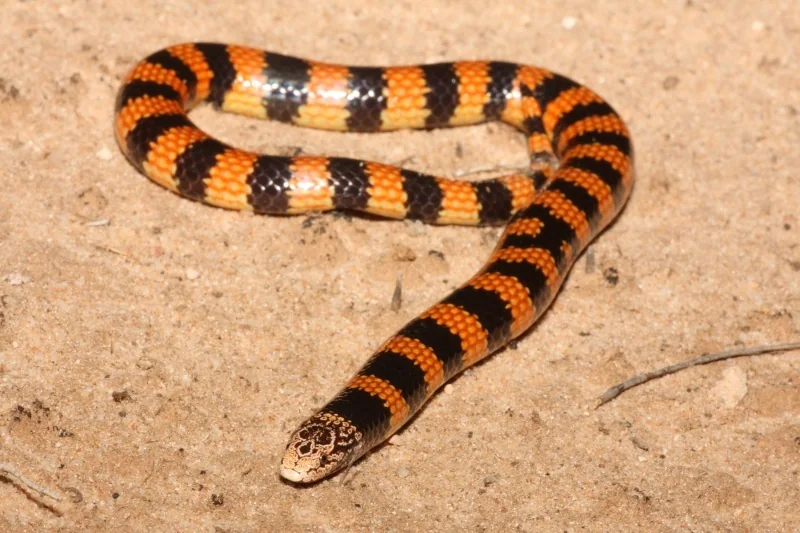
Black bands encircle a glossy pale-yellow to orange body. The head is mostly pale, with darker and orange markings. It has a compact body and a short, quickly tapering tail, and burrows through loose sand and leaf litter.
Other names
Desert Banded Snake, Southern Desert Banded Snake
Typical length
AROD lists an average size of about 30 cm; no separate maximum is given.
Body build
robust
Key identification features
- Pale-yellow to orange body with black bands
- Mostly pale head with complex darker markings
- Robust body and short tapering tail
Where it is found
South-western Australia, including Swan Coastal Plain sandplain habitat, with additional records in the Northern Territory and South Australia.
Diet
Surface-dwelling skinks.
Reproduction
Egg-laying; AROD reports an average clutch size of 4.
Medical significance
Venomous; the checked sources do not establish species-specific clinical outcomes. Treat any suspected bite as an emergency and call 000.
What to do if you encounter one
Keep your distance and leave the snake a clear route away. Do not handle it, chase it for a photograph or attempt to inspect its mouth. If it is inside a building, keep people and pets clear and contact a qualified local snake catcher.
Sources checked
- Australian Reptile Online Database — Jan’s Banded Snake (2026-09-25)
- Western Australian Museum — Strahan, How and Dell 1998 burrowing snakes (2026-09-25)
- The Reptile Database — Simoselaps bertholdi (2026-09-25)
- ANZCOR — First Aid Management of Australian Snake Bite (2026-09-25)
- DBCA — Snakes of Western Australia, pages60–61 (2026-09-26)
Still not sure?
Compare this snake with more clues.
A profile is a guide, not a reason to approach or handle a snake.