
Acrochordidae
Little File Snake
Acrochordus granulatus
A non-venomous coastal and waterway snake of northern Australia and south-east Asia.
Non-venomous
Identification and appearance
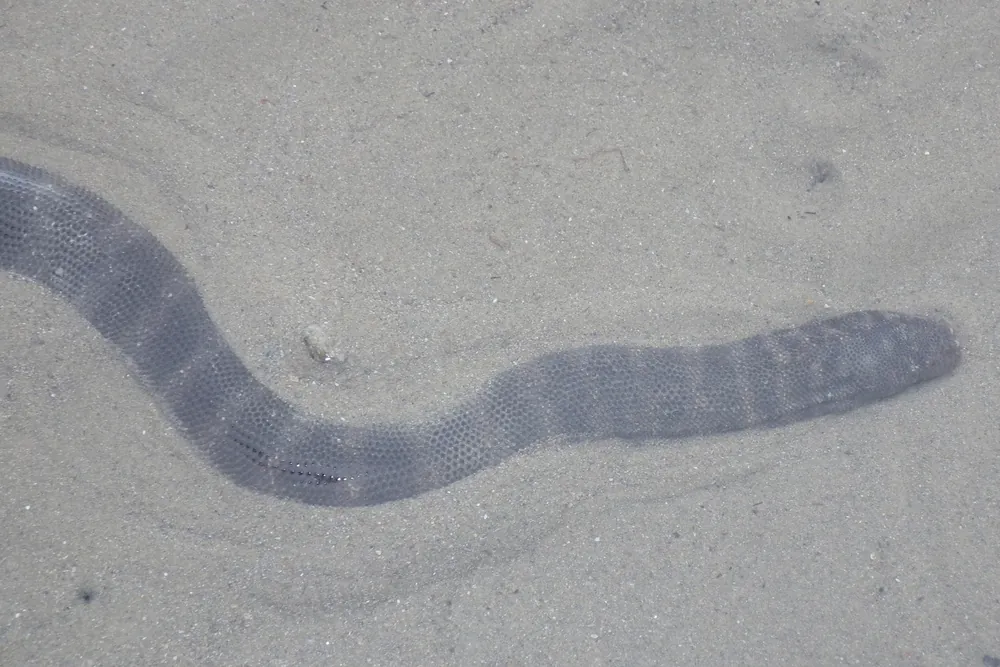
Fine pale bands cross a grey-brown body. Its loose skin and rough scales are characteristic of file snakes, but do not handle one to check texture. It lives in northern coastal and estuarine waters, including mangrove waterways.
Other names
Little Wart Snake, Marine File Snake, Wart Snake
Typical length
AROD lists an average size of about 60 cm and a reported maximum of 120 cm.
Key identification features
- Grey-brown body with fine pale bands
- Loose skin and rough scales
- Marine and estuarine habitat
Where it is found
Northern Australian coastal waters and mangrove-lined waterways; the species also occurs in south-east Asia.
Habitat
Uses coastal rivers, estuaries, mangrove waterways and marine waters in northern Australia.
Activity
Individuals have been observed at the water surface at night in a museum survey near Weipa.
Diet
AROD records small fish and aquatic invertebrates, including crustaceans and snails.
Reproduction
Gives birth to live young; AROD lists an average of four young per litter.
Medical significance
Non-venomous. If identity is uncertain and a snakebite is suspected, call 000 and follow snakebite first aid.
What to do if you encounter one
Give the snake space in the water or on shore. Do not catch, handle or approach it for a closer photograph.
Similar-looking snakes
Arafura file snakes share northern mangrove habitat; the source comparison uses belly folds and pattern, but a live snake must not be handled to check them.

Photo: garywwilson · CC BY 4.0 (Licence)
Acrochordidae
Arafura File Snake
Acrochordus arafurae
The Arafura File Snake is an aquatic northern Australian snake with loose skin and a dark, mesh-like pattern. It lives mainly in freshwater streams and billabongs but also enters estuaries and the sea.
Open identification guideSources checked
- Australian Reptile Online Database — Little File Snake (2026-09-25)
- The Reptile Database — Acrochordus granulatus (2026-09-25)
- The Herpetofauna of the Weipa Region (2026-09-26)
- Australian Government — Key species in the Northern Peninsula Area (2026-09-26)
- Fox2008 tropical rivers exact species contrast (2026-09-26)
Still not sure?
Compare this snake with more clues.
A profile is a guide, not a reason to approach or handle a snake.