
Elapidae
Masters’ Snake
Drysdalia mastersii
A small venomous snake recorded from South Australia, Victoria and Western Australia.
Venomous
Identification and appearance
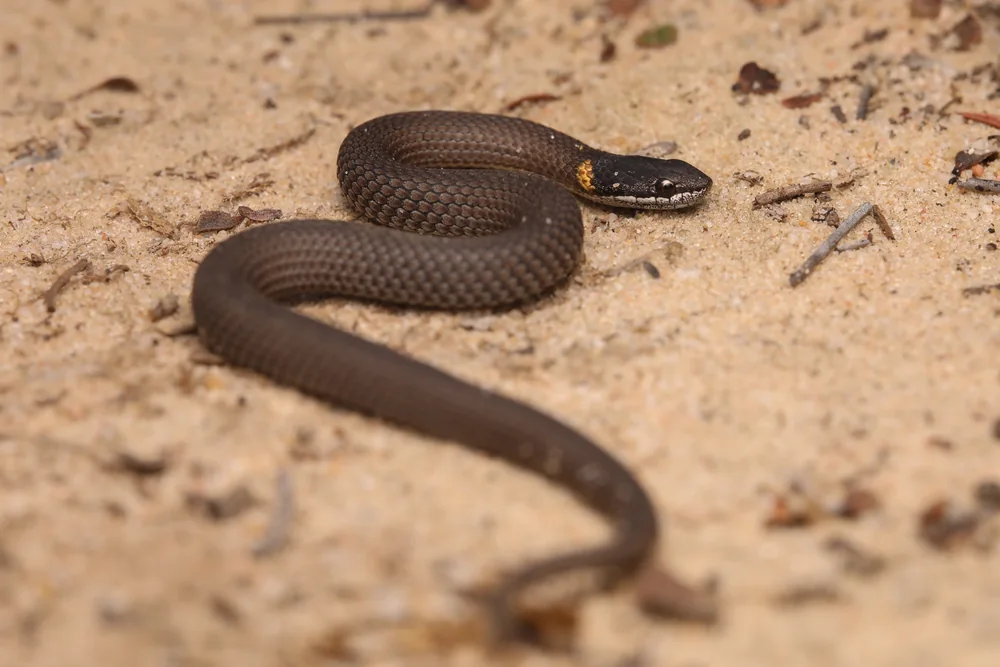
Light brown to dark grey above, with a darker head and a white stripe along the upper lip. The orange-yellow band behind the head is often broken. Pale edges to the side scales can form faint lengthwise lines.
Typical length
AROD reports an average of about 40 cm; a maximum was not given.
Head appearance
dark head
Key identification features
- Light brown to dark-grey body
- Pale nape band, often broken
- White upper-lip stripe
Where it is found
South Australia, Victoria and Western Australia.
Activity
Active during the day.
Diet
Mostly small lizards, including skinks.
Reproduction
Live-bearing.
Medical significance
AROD describes low usual danger to people. That does not establish the safety of an unidentified snakebite: call 000 and follow snakebite first aid for any suspected bite.
What to do if you encounter one
Keep clear and do not handle it. Use a qualified snake catcher or local wildlife authority if it is trapped near people.
Similar-looking snakes
White-lipped Snakes lack the pale neck band seen in Masters’ Snakes. Western Crowned Snakes have a dark band instead. Those markings may be incomplete or difficult to see in a photograph.
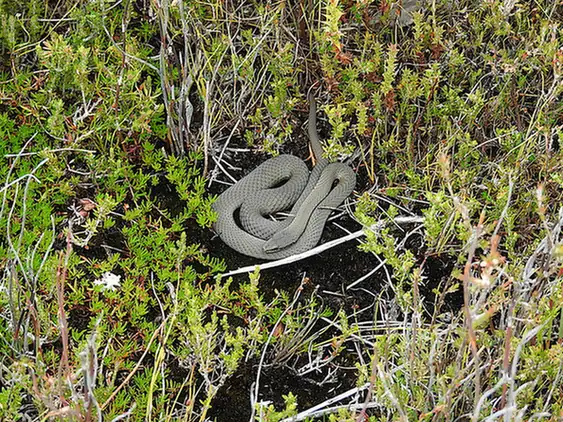
Photo: george_vaughan · CC0 1.0 (Licence)
Elapidae
White-lipped Snake
Drysdalia coronoides
White-lipped Snake is recorded across south-eastern Australia, including Tasmania and New South Wales. It varies from olive-brown and grey to reddish brown or dark grey, with a white stripe on the upper lip and no pale or dark nape band.
Open identification guide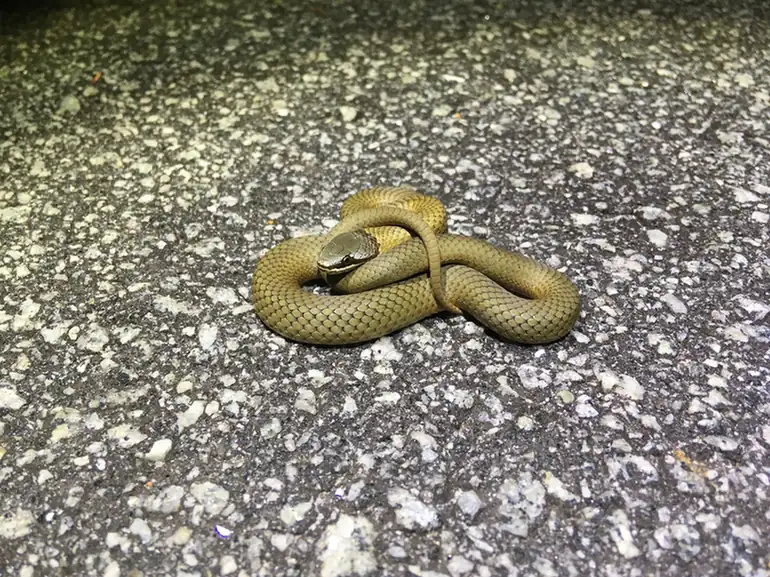
Photo: Donna Belder · CC BY 4.0 (Licence)
Elapidae
Western Crowned Snake
Elapognathus coronatus
A small live-bearing snake of coastal southern and south-western Western Australia.
Open identification guideSources checked
- Australian Reptile Online Database — Masters’ Snake (2026-09-25)
- The Reptile Database — Drysdalia mastersii (2026-09-25)
- Victorian Government — Masters’ Snake assessment (2026-09-26)
Still not sure?
Compare this snake with more clues.
A profile is a guide, not a reason to approach or handle a snake.