
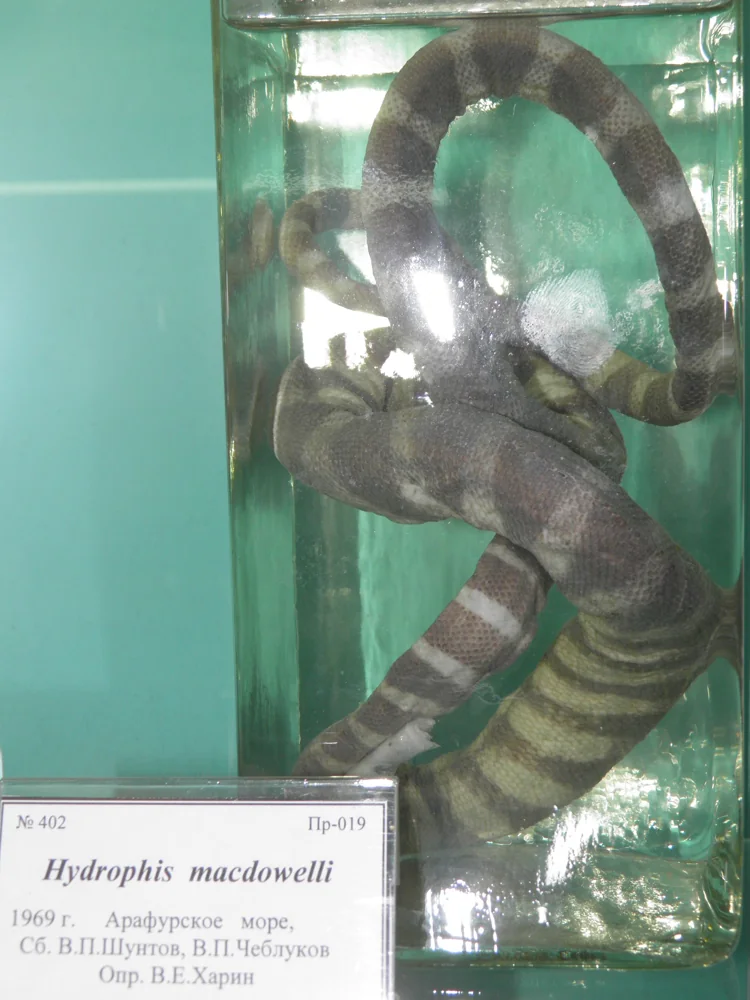
McDowell’s Sea Snake (Hydrophis macdowelli) preserved museum specimen in a labelled jar.

Elapidae
McDowell’s Sea Snake
Hydrophis macdowelli
An Australian sea snake with a small head, compressed rear body and a banded pattern accompanied by rows of spots, recorded in the Northern Territory, Queensland and Western Australia.
Highly venomous
Identification and appearance
The Australian sea-snake review describes a small head and compressed hindbody, with dark bands and intervening or lateral rows of spots.
Other names
Hydrophis mcdowelli
Typical length
AROD lists a species average of about 80 cm; the entry gives no separate maximum.
Key identification features
- Small head and compressed hindbody.
- Dark bands with intervening or lateral rows of spots.
Where it is found
Australian records are listed for the Northern Territory, Queensland and Western Australia, with the wider range extending to New Caledonia, the Loyalty Islands and Papua New Guinea.
Activity
In New Caledonia, it searches for prey inside fish burrows on lagoon bottoms at depths of 10–40 m.
Reproduction
Live-bearing.
Medical significance
For any suspected snakebite, call 000 and follow snakebite first aid. Do not wait for identification.
What to do if you encounter one
Keep away from the animal and do not enter its path. Never handle, net or disentangle a sea snake; alert local marine authorities or a qualified wildlife professional if intervention is necessary.
Similar-looking snakes
Elapidae
Dwarf Sea Snake
Hydrophis caerulescens
A small sea snake confirmed in the Gulf of Carpentaria, with bluish-grey upperparts, a pale underside and broad bands that can fade in older adults.
Open identification guide
Horned Sea Snake (Hydrophis peronii) recorded by a remotely operated vehicle at Ashmore Reef in 2021. The inset shows a closer view of the head. Underwater lighting affects the apparent colour.
Photo: Speed et al. (2022), Frontiers in Marine Science 9:921542, Figure 3H · CC BY 4.0 (Licence)
Elapidae
Horned Sea Snake
Hydrophis peronii
An Indo-Pacific sea snake with Australian records in the Northern Territory, Queensland and Western Australia. It has blunt projections on certain head shields and may be cream to pale brown with bands that fade in older adults.
Open identification guideSources checked
- Australian Reptile Online Database — McDowell’s Sea Snake (2026-09-25)
- The Reptile Database — Hydrophis macdowelli (2026-09-25)
- Rasmussen et al. 2014 — Sea snakes in Australian waters (2026-09-26)
- Ineich and Laboute — Sea snakes of New Caledonia (2026-09-26)
Still not sure?
Compare this snake with more clues.
A profile is a guide, not a reason to approach or handle a snake.