

Elapidae
Narrow-banded Shovel-nosed Snake
Brachyurophis fasciolatus
A small burrowing snake with narrow dark bands across a pale body. Red and black flecks occur between the bands.
Venomous
Identification and appearance
A cream to whitish burrowing snake with narrow irregular dark bands and red-black flecks. Historical accounts describe different head and nape bars in western and central forms, but those form names are not treated as settled subspecies here.
Other names
Simoselaps fasciolatus
Typical length
AROD lists a species average of about 30 cm and a separately reported maximum of 40 cm.
Key identification features
- Pale cream to whitish body with narrow dark bands
- Flecks occur between the bands
- Darker bars mark the head and nape
Where it is found
The current species-level range covers New South Wales, the Northern Territory, Queensland, South Australia and Western Australia. Older accounts divide the species between south-western and central Australia, but the current record does not use those forms as a precise modern map.
Activity
Burrowing.
Diet
Feeds on reptiles, largely skinks, and reptile eggs.
Reproduction
Oviparous.
Medical significance
The consulted sources label this species venomous but do not establish a simple field estimate of clinical severity. Treat any suspected bite as an emergency.
What to do if you encounter one
Keep well clear and leave a route towards cover. Do not chase, corner, handle or inspect it. If it is inside a building, keep people and pets away and contact a qualified local snake remover.
Similar-looking snakes
Similar-looking Australian snakes may overlap in colour, banding and habitat; location is not a safe field test. Keep distance and wait for an expert if identification matters.

Photo: dhfischer · CC BY 4.0 (Licence)
Elapidae
Southern Shovel-nosed Snake
Brachyurophis semifasciatus
A variable shovel-nosed snake with reddish-brown to orange colouration, a barred head and regular dark bands along the body. AROD mentions Queensland, but the current Reptile Database lists only southern Western Australia and South Australia, so the mapped range is partial.
Open identification guide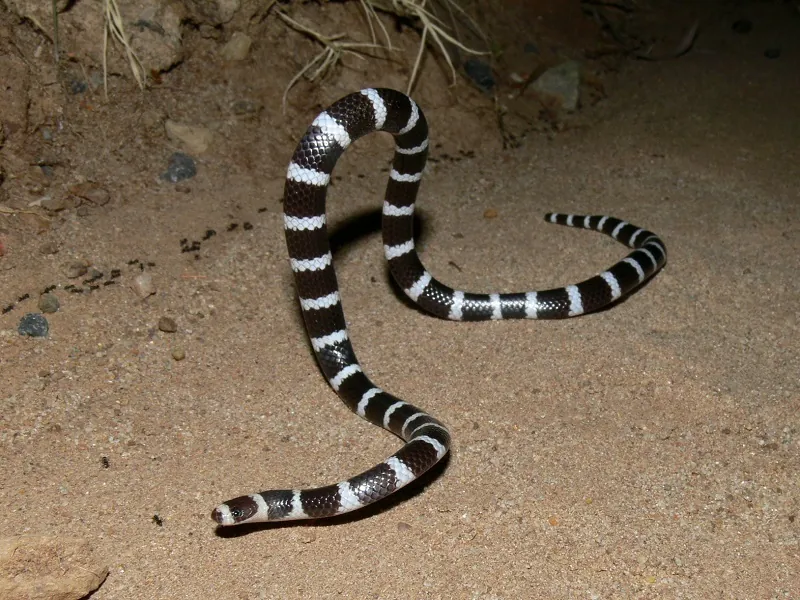
Photo: dhfischer · CC BY 4.0 (Licence)
Elapidae
Common Bandy-bandy
Vermicella annulata
A snake with bold black-and-white rings around its body, found across much of eastern and central Australia.
Open identification guideTaxonomy notes
The species-level record is retained without resolving the historical fasciolatus/fasciatus form names; the broad current state list is used, while fine-scale form boundaries remain unverified.
Sources checked
Still not sure?
Compare this snake with more clues.
A profile is a guide, not a reason to approach or handle a snake.