
Typhlopidae
Northern Long-beaked Blind Snake
Anilios grypus
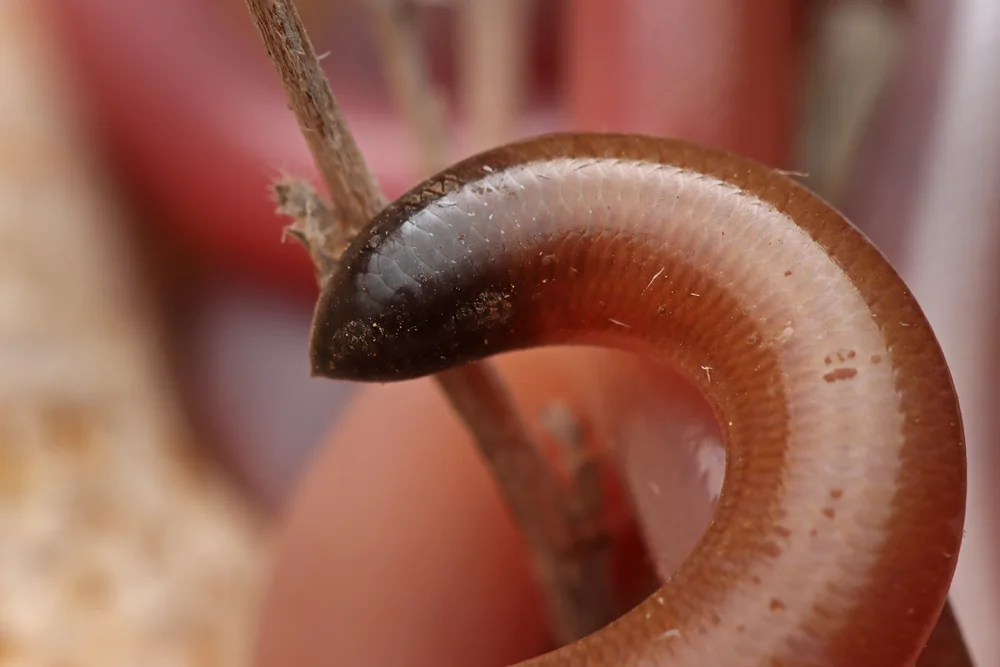
The Northern Long-beaked Blind Snake is a very slender blind snake from northern Australia, recognised in specialist descriptions by its beaked snout and dark tail.
Non-venomous
Identification and appearance
The specialist diagnosis describes a moderately large, very slender blind snake with a snout beaked in profile and a black tail. These are not features to inspect by handling.
Other names
Long-beaked Blind Snake, Parrot-beaked Blind Snake
Typical length
AROD lists an average of about 35 cm and a maximum of 45 cm; no typical adult interval is asserted here.
Body build
slender
Head appearance
beaked snout
Key identification features
- Very slender blind-snake form
- Beaked snout in profile
- Black tail described in specialist diagnosis
Where it is found
Northern and north-western Australia, including Western Australia, the Northern Territory and north-west Queensland.
Habitat
Recorded in sand and sandy loam where summer soil moisture is unreliable.
Reproduction
Egg-laying.
Medical significance
Blind snakes are non-venomous. If the snake has not been reliably identified and a bite is suspected, call 000 and follow snakebite first aid.
What to do if you encounter one
Leave it under cover and keep people and pets back.
Similar-looking snakes
Other long-snouted Anilios can overlap in appearance. Use location only as a broad clue and do not handle the snake.
Taxonomy notes
Historical names include nigroterminatus; the Reptile Database notes uncertainty about its evolutionary relationships.
Sources checked
- Australian Reptile Online Database — Long-beaked blind snake (2026-09-25)
- The Reptile Database — Anilios grypus (2026-09-25)
- Queensland Government — Snakes near you: Cairns region (2026-09-25)
- Fauna of Australia — blind snakes (2026-09-26)
Still not sure?
Compare this snake with more clues.
A profile is a guide, not a reason to approach or handle a snake.