
Elapidae
Northern Small-eyed Snake
Cryptophis pallidiceps
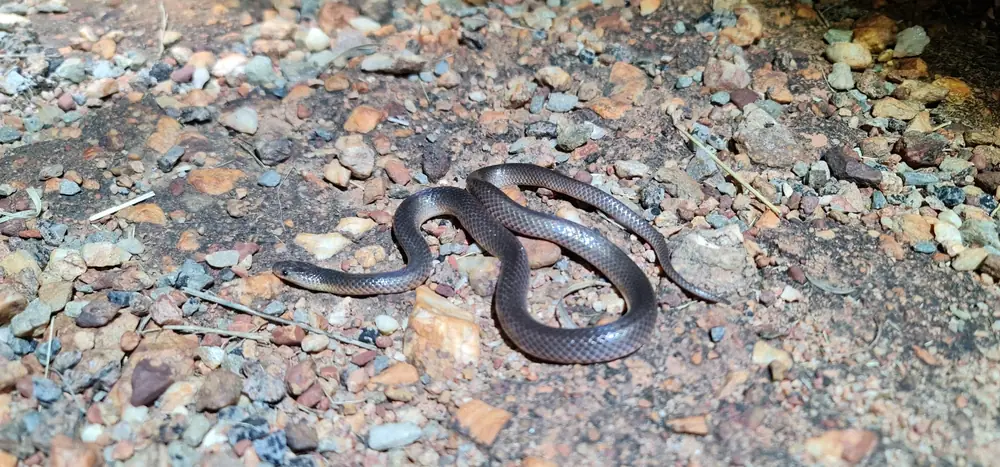
The Northern Small-eyed Snake is a secretive venomous snake of northern Australia. It can be brown, grey or black above, with paler yellow-orange flanks and a white belly.
Venomous
Identification and appearance
The upper body may be brown, grey or black, sometimes with a paler head. The lower flanks can be yellowish to orange above a white belly. Colour varies, and these features overlap with other small snakes.
Other names
Western Carpentaria Snake
Typical length
AROD reports an average of about 50 cm; a maximum was not given on the consulted page.
Head appearance
round pupil described in specialist account
Key identification features
- Brown, grey or black upperparts
- Yellowish to orange lower flanks and white belly
- Secretive northern Australian small-eyed snake
Where it is found
Northern Territory and Western Australia in the current Reptile Database distribution account.
Habitat
Uses tropical woodland in the Top End and Kimberley.
Activity
Nocturnal and secretive.
Diet
Lizards predominate; frogs are also recorded.
Reproduction
Live-bearing.
Medical significance
Species-specific clinical effects are not established in this profile. For any suspected bite, call 000 and follow snakebite first aid without waiting for identification.
What to do if you encounter one
Keep clear and allow it to move away. Use a qualified snake catcher if it is trapped near people.
Similar-looking snakes
No pairwise lookalike link is included without a direct source comparison. Do not approach a small dark snake to inspect its eyes or fangs.
Taxonomy notes
The Reptile Database notes a corrected type locality in northwestern Australia.
Sources checked
- Australian Reptile Online Database — Northern small-eyed snake (2026-09-25)
- The Reptile Database — Cryptophis pallidiceps (2026-09-25)
- Shine 1984 (2026-09-26)
Still not sure?
Compare this snake with more clues.
A profile is a guide, not a reason to approach or handle a snake.