
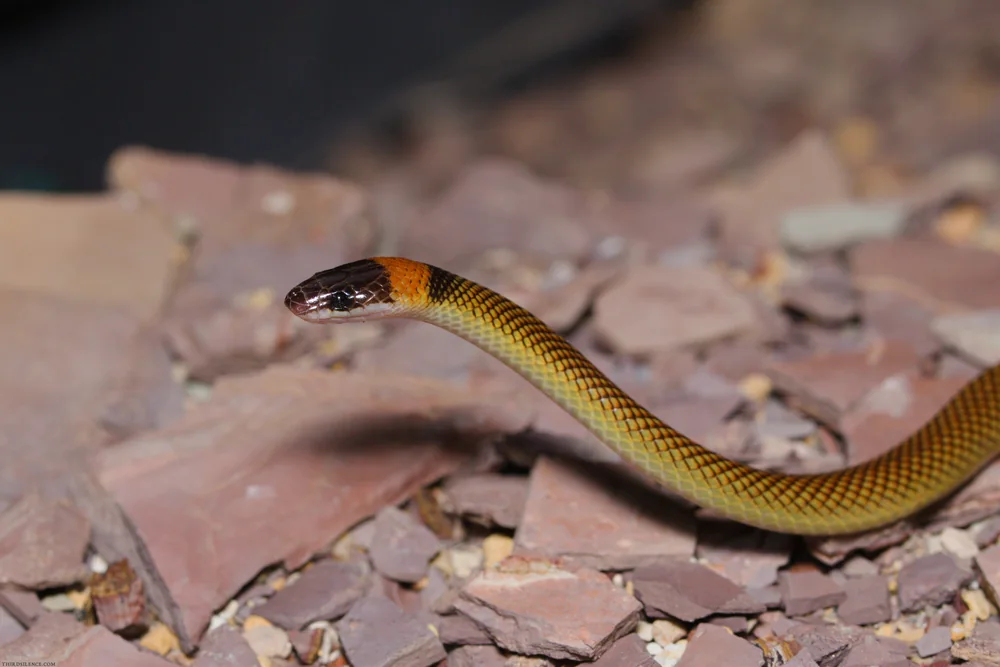
Elapidae
Orange-naped Snake
Furina ornata
A small northern Australian snake recognised by a red nape blotch not completely enclosed by black.
Venomous
Identification and appearance
Body colour ranges from buff to reddish brown, with darker edges to the scales. Colour darkens with age. A red patch at the nape has an incomplete black border.
Other names
Moon Snake
Typical length
The Western Australian revision measured specimens at 12.8–50.8 cm snout–vent length, averaging 30.47 cm. The sample includes juveniles and excludes tail length, so it does not establish a typical adult total-length interval or a species-wide maximum.
Key identification features
- Pale buff, brown or reddish body
- Red nape blotch
- Black does not completely enclose the blotch
- Northern Australian range
Where it is found
Northern Territory, Queensland, South Australia and Western Australia.
Activity
In a central Australian study, snakes were encountered in every month except the coldest one. That regional study found no clear relationship between activity and the measured temperature, rainfall or humidity.
Diet
Mainly skinks that are active during the day.
Reproduction
Oviparous.
Medical significance
Treat any suspected snakebite as an emergency: call 000 and follow snakebite first aid. Do not wait for identification.
What to do if you encounter one
Keep clear and do not handle it. Use a qualified snake catcher or local wildlife authority if it is trapped near people.
Similar-looking snakes
Red-naped Snakes have similar head colouring. Their red neck patch is usually surrounded by black, whereas the Orange-naped Snake’s patch is not completely enclosed. Individual variation can blur the distinction.

Photo: Max Tibby · CC0 1.0 (Licence)
Elapidae
Red-naped Snake
Furina diadema
A slender red-brown snake with a black head and nape, pale belly and a red or orange nape patch enclosed by black. Its checked range spans NSW, Queensland, SA, Victoria and the ACT.
Open identification guideSources checked
- Australian Reptile Online Database — Orange-naped Snake (2026-09-25)
- Western Australian Museum — The genus Furina in Western Australia (2026-09-26)
- The Reptile Database — Furina ornata (2026-09-25)
- McDonald et al. — Orange-naped Snake field study (2026-09-26)
- Supporting species research (2026-09-26)
- AROD — Red-naped Snake (2026-09-26)
Still not sure?
Compare this snake with more clues.
A profile is a guide, not a reason to approach or handle a snake.