
Elapidae
Pilbara Bandy-bandy
Vermicella snelli
A slender bandy-bandy from parts of northern Western Australia, including the Pilbara.
Venomous
Identification and appearance
A slender body is marked with black-and-white bands. The pattern is shared by related bandy-bandies, so range and expert confirmation matter.
Typical length
AROD reports an average length of about 50 cm; no typical adult interval or maximum is established here.
Body build
slender
Key identification features
- slender body
- black-and-white bands
- related bandy-bandy pattern shared by other species
Where it is found
Northern Western Australia, including the Pilbara region; the checked sources do not establish occurrence across all northern WA.
Reproduction
Egg-laying.
Medical significance
The consulted sources label this species venomous but do not establish a simple field estimate of clinical severity. Treat any suspected bite as an emergency. Call 000 for an ambulance and do not wait for identification.
What to do if you encounter one
Keep well clear and leave a route towards cover. Do not chase, corner, handle or inspect it. If it is inside a building, keep people and pets away and contact a qualified local snake remover.
Similar-looking snakes
Other bandy-bandies share this banded appearance; photographs of the pattern alone may not establish species.
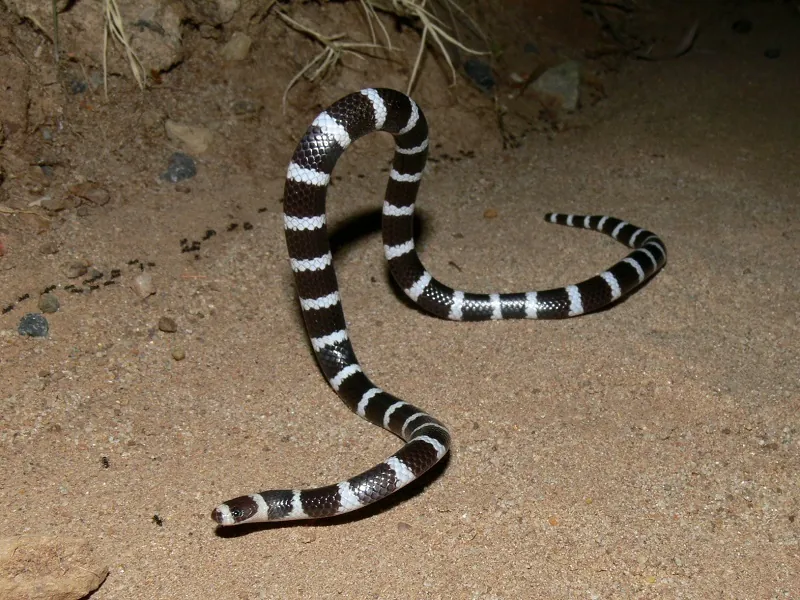
Photo: dhfischer · CC BY 4.0 (Licence)
Elapidae
Common Bandy-bandy
Vermicella annulata
A snake with bold black-and-white rings around its body, found across much of eastern and central Australia.
Open identification guideTaxonomy notes
Older samples identified as snelli before the 1996 revision may include more than one currently recognised species.
Sources checked
- Australian Reptile Online Database — Pilbara Bandy Bandy (2026-09-25)
- The Reptile Database — Vermicella snelli (2026-09-25)
- Derez et al. 2018 — Vermicella comparative and venom study (2026-09-26)
- ANZCOR — Australian snake bite first aid (2026-09-26)
Still not sure?
Compare this snake with more clues.
A profile is a guide, not a reason to approach or handle a snake.