
Elapidae
Pilbara Death Adder
Acanthophis wellsi
Pilbara Death Adder is a banded death adder recorded from stony soils in the Pilbara region of Western Australia.
Dangerously venomous
Identification and appearance
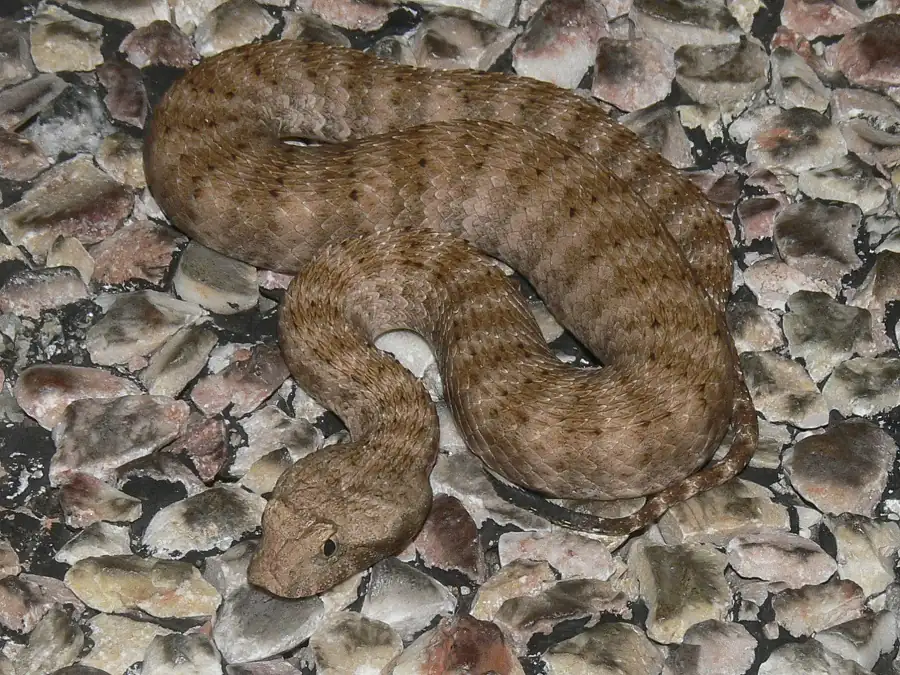
AROD describes a reddish-brown snake with either pale transverse bands or a dark head and dark transverse bands. The body is moderately keeled dorsally and smoother laterally. These details are for comparison at a distance only; do not inspect scales on a live snake.
Typical length
AROD lists a 43 cm species average and a maximum of 52 cm; these figures do not establish a typical adult interval.
Key identification features
- Reddish-brown body
- Pale transverse bands or a darker banded form
- Stony-soil habitat in the Pilbara
Where it is found
The Pilbara region of Western Australia, including an isolated population on North West Cape.
Habitat
Associated with stony ground in its western Australian range.
Activity
Usually active at night. It waits for prey and moves its tail tip to lure animals closer.
Diet
Takes varied prey, including frogs, lizards and small mammals, with birds also eaten occasionally.
Reproduction
Live-bearing.
Medical significance
A bite can cause serious envenoming. Treat any suspected bite as an emergency and do not use an identification result to judge safety.
What to do if you encounter one
Keep well clear, leave a route for the snake to move away and do not approach for a closer look. If it is inside, keep people and pets away and contact a qualified local snake catcher.
Similar-looking snakes
AROD separates it from the Desert Death Adder using scale characters such as the prefrontal scales; those are not safe close-up checks.

Photo: Max Tibby · CC0 1.0 (Licence)
Elapidae
Desert Death Adder
Acanthophis pyrrhus
A banded death adder of sandy and stony deserts across inland Australia. Its red or orange colouring blends with many desert soils.
Open identification guideSources checked
- Australian Reptile Online Database — Pilbara Death Adder (2026-09-25)
- The Reptile Database — Acanthophis wellsi (2026-09-25)
- University of Melbourne AVRU, Death Adders (2026-09-26)
Still not sure?
Compare this snake with more clues.
A profile is a guide, not a reason to approach or handle a snake.