

Elapidae
Plain-nosed Burrowing Snake
Antaioserpens albiceps
Plain-nosed Burrowing Snake is recorded in north-eastern Queensland. It is orange to brown with a dark nape band, head flecks and a reticulated appearance from dark-edged scales.
Venomous
Identification and appearance
The body is orange to brown, with dark scale edges creating a net-like pattern. A dark band crosses the nape, while black-and-white flecks mark the head and snout.
Other names
North-eastern Plain-nosed Burrowing Snake
Typical length
AROD lists a species average of 29 cm and a maximum of 40 cm; these figures do not establish a typical adult interval.
Key identification features
- Orange-to-brown body
- Dark nape band and head flecks
- Reticulated appearance from dark-edged scales
Where it is found
North-eastern Queensland.
Activity
Seldom seen; it probably spends much of its time below ground or among deep leaf litter.
Diet
Skinks.
Reproduction
Egg-laying.
Medical significance
For any suspected bite, call 000 and follow snakebite first aid. Do not wait for an identification result.
What to do if you encounter one
Keep well clear, leave a route for the snake to move away and do not approach for a closer look. If it is inside a building, keep people and pets away and contact a qualified local snake catcher.
Similar-looking snakes
AROD lists a related species as similar; do not approach or handle a snake to compare it.
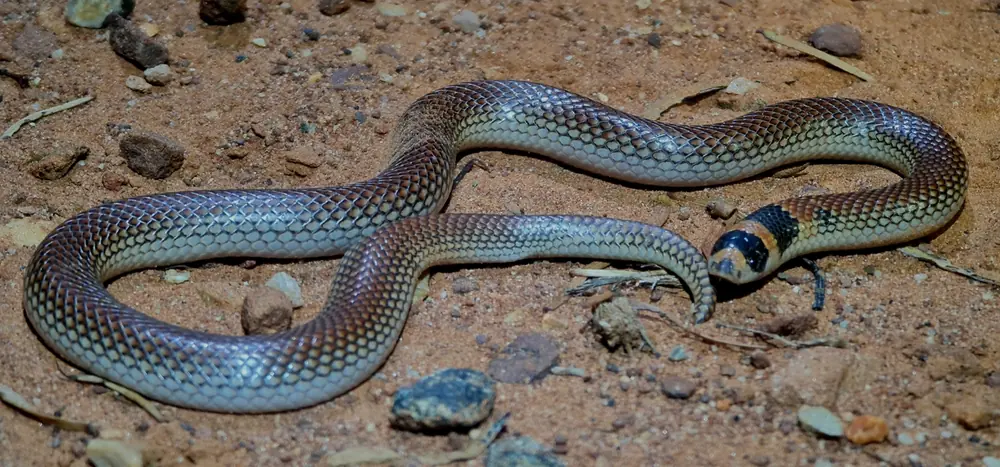
Photo: Max Tibby · CC0 1.0 (Licence)
Elapidae
Unbanded Shovel-nosed Snake
Brachyurophis incinctus
Unbanded Shovel-nosed Snake is recorded from central Australia north to the Gulf of Carpentaria and across western Queensland. It is orange, pink or brown above, with dark-edged scales and local head and nape bands.
Open identification guideSources checked
- Australian Reptile Online Database — Antaioserpens albiceps (2026-09-25)
- The Reptile Database — Antaioserpens albiceps (2026-09-25)
Still not sure?
Compare this snake with more clues.
A profile is a guide, not a reason to approach or handle a snake.