
Pythonidae
Pygmy Python
Antaresia perthensis
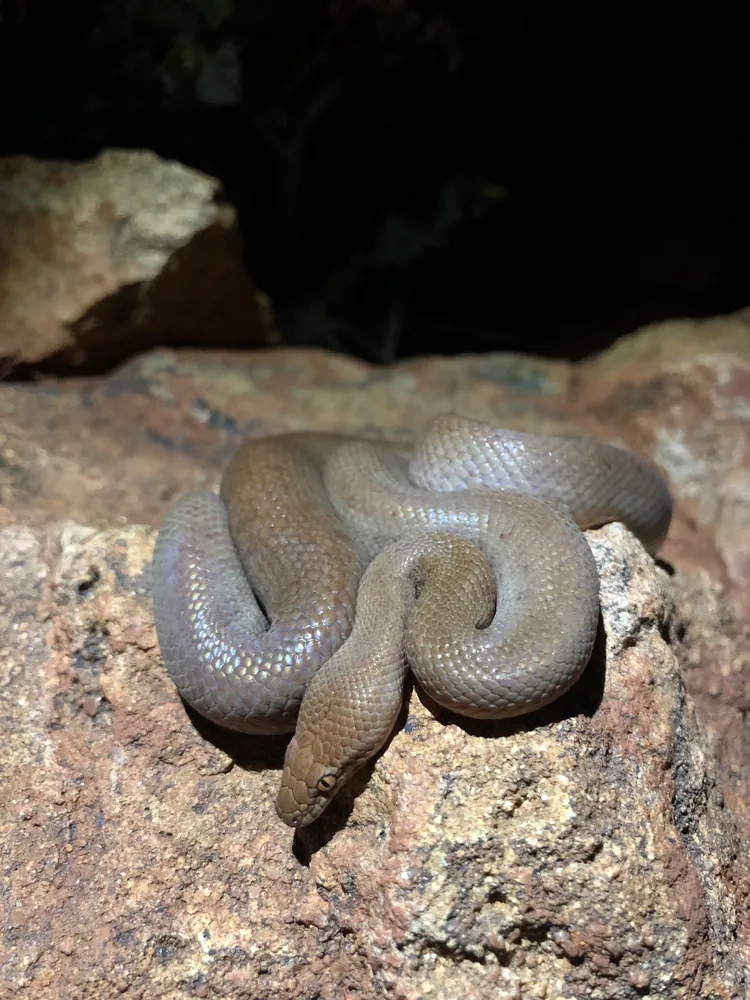
The Pygmy Python is a very small Western Australian python with reddish-brown colouring and irregular darker spots. It is associated with rocky scrub and termite mounds in the Pilbara region.
Non-venomous
Identification and appearance
A small python with reddish-brown colouring and irregular darker spots. Appearance varies with age; a young specimen described in older literature had spots arranged in rows resembling broken crossbars.
Other names
Ant Hill Python
Typical length
AROD reports an average of about 40 cm and a maximum of 60 cm.
Key identification features
- Very small python
- Reddish-brown or pale back with dark spots
- Often associated with rocky areas, scrub and termite mounds
Where it is found
North-western Western Australia, especially the Pilbara, Gascoyne and Murchison regions.
Habitat
A ground-dwelling python that uses termite mounds as well as other habitats in north-western Western Australia.
Activity
A Western Australian Museum field account records a juvenile searching for frogs at night.
Diet
Small lizards, especially geckos.
Reproduction
Egg-laying.
Medical significance
Not considered medically significant, but a python can still bite. Do not handle wild snakes.
What to do if you encounter one
Give it room to move away and do not pull it from a termite mound, rock crevice or shelter.
Similar-looking snakes
Other Antaresia pythons can share spotted patterns. Size and documented range help, but do not handle a python to compare scale or head characters.
Taxonomy notes
The scientific name does not mean the species occurs around Perth; the Reptile Database notes that the type locality was mistaken.
Sources checked
- Australian Reptile Online Database — Pygmy python (2026-09-25)
- The Reptile Database — Antaresia perthensis (2026-09-25)
- Western Australian Museum, Wildlife of the Pilbara (2026-09-26)
- Western Australian Museum Collections, Antaresia perthensis (2026-09-26)
- Western Australian Museum — Antaresia perthensis (2026-09-26)
Still not sure?
Compare this snake with more clues.
A profile is a guide, not a reason to approach or handle a snake.