
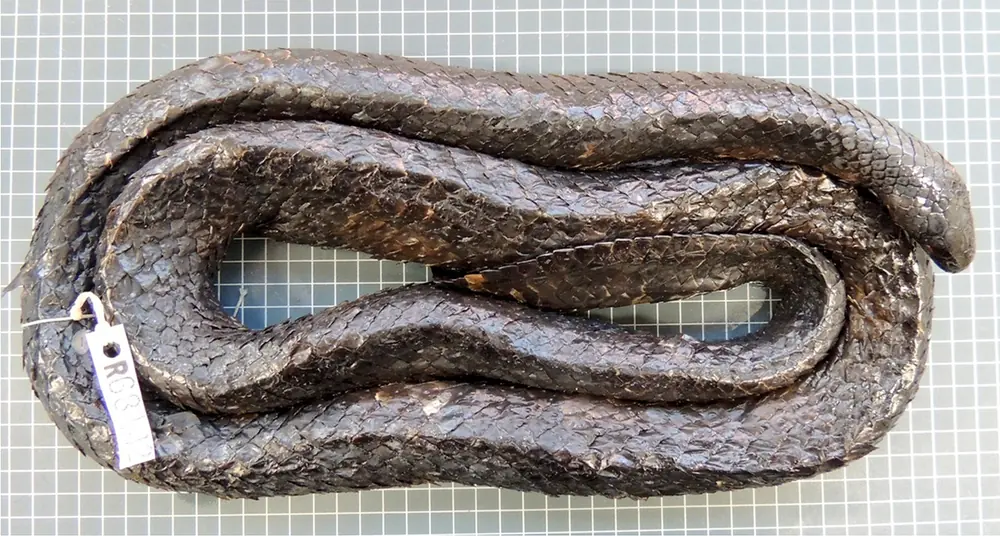
Preserved short-nosed sea snake specimen SAMA R68142 from Ashmore Reef. Preserved colours do not represent a living snake reliably.

Elapidae
Short-nosed Sea Snake
Aipysurus apraefrontalis
A rare sea snake recorded in north-western Australian waters. Coastal and offshore populations vary in size and colour; an older museum account describes a cream form with bluish-brown bars.
Highly venomous
Identification and appearance
An older Western Australian Museum description records a small head and a cream body with bluish-brown bars that narrow along the sides. Coastal and offshore populations differ in appearance, so this colour form is not universal. Observe from a distance and never try to catch a sea snake.
Other names
Sahul Reef Snake
Typical length
AROD reports a species average of about 100 cm; the WA Museum account records a largest examined specimen of 108.3 cm. This is a reported specimen measurement, not an absolute maximum or a usual adult range.
Head appearance
very small
Key identification features
- Very small head relative to the body
- Cream body with bluish-brown bars narrowing towards the flanks
- Marine species of north-western Australian waters
Where it is found
Current WA evidence includes Ningaloo Marine Park near Exmouth; historical records include Ashmore Reef and the Timor Sea. The species is marine, and the WA label refers to those waters only rather than every WA coast.
Activity
Uses coral reefs for shelter and foraging.
Diet
Forages around coral reefs, taking small reef fish and eels.
Reproduction
Live-bearing.
Medical significance
AROD labels the species dangerously venomous. A suspected sea-snake bite requires immediate emergency care, even when the mark is small or pain is limited.
What to do if you encounter one
Keep away from the animal and do not enter its path. Never handle, net or disentangle a sea snake; alert local marine authorities or a qualified wildlife professional if intervention is necessary.
Similar-looking snakes
The consulted sources do not establish a supported appearance lookalike pairing for this species. Do not use shared marine habitat or bars to decide whether a sea snake is safe.
Taxonomy notes
The 2025 Aipysurus study describes A. apraefrontalis as Data Deficient on the IUCN Red List and Critically Endangered under Australia's EPBC Act 1999. Coastal and offshore populations differ in size and colour; the older museum description is not universal. States are limited to checked WA waters.
Sources checked
- Australian Reptile Online Database — Short-nosed Sea Snake (2026-09-25)
- The Reptile Database — Aipysurus apraefrontalis (2026-09-25)
- Western Australian Museum — The sea snakes of Western Australia (2026-09-25)
- 2025 population-genomics study — Aipysurus apraefrontalis (2026-09-25)
- WA Government — Short-nosed sea snakes found off WA coast (2026-09-25)
- DCCEEW — Short-nosed Sea Snake (2026-09-26)
Still not sure?
Compare this snake with more clues.
A profile is a guide, not a reason to approach or handle a snake.