
Elapidae
Small-eyed Snake
Cryptophis nigrescens
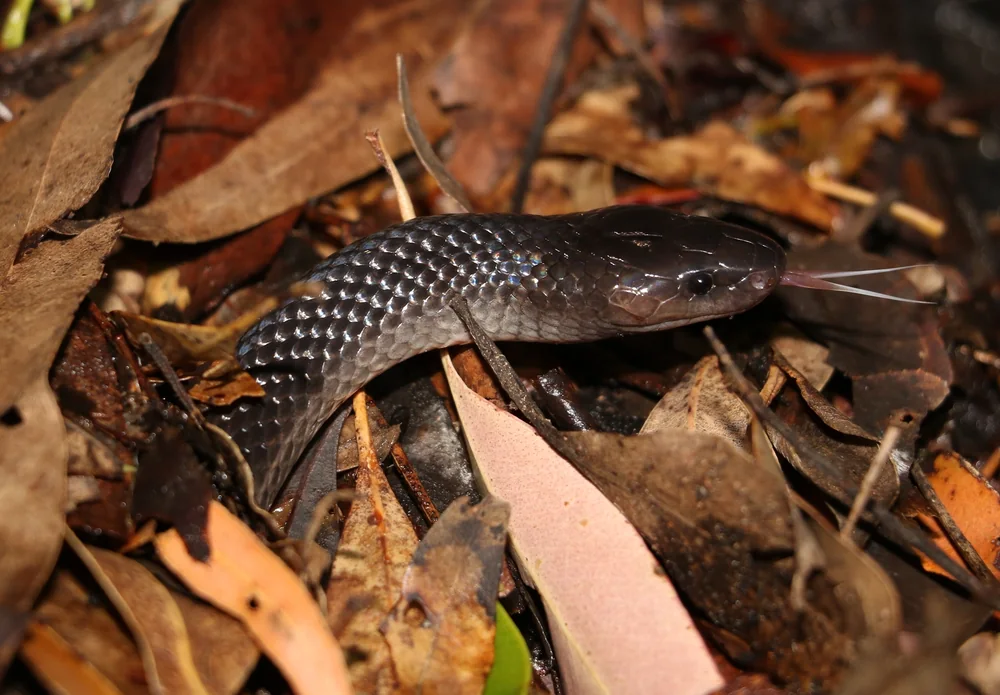
A glossy black snake of eastern Australia. Its pale to pinkish-red belly can resemble markings on other dark snakes, so colour alone is unreliable.
Highly venomous
Identification and appearance
Usually black above, with a variable cream to pinkish-red belly that can show local darker spots or blotches.
Typical length
AROD lists a species average of about 50 cm and a separately reported maximum of 120 cm.
Key identification features
- Black upper body
- Pale to pinkish-red underside; dark belly marks may occur
Where it is found
Recorded along eastern Australia from northern Queensland to Victoria, including NSW and the ACT.
Habitat
Eastern Small-eyed Snakes occupy moist habitats including rainforest, wet sclerophyll forest, woodland, heath and rocky outcrops. They shelter beneath stones, loose bark and fallen timber, and in rock crevices.
Activity
Mostly active at night.
Diet
Feeds mainly on lizards and skinks; a frog has been observed in the mouth, but ingestion was not confirmed.
Reproduction
Live-bearing.
Medical significance
The consulted sources classify this snake as highly or dangerously venomous. Any suspected bite requires immediate emergency medical care. Call 000 and follow snakebite first aid for any suspected bite.
What to do if you encounter one
Keep well clear and leave a route towards cover. Do not chase, corner, handle or inspect it. If it is inside a building, keep people and pets away and contact a qualified local snake remover.
Similar-looking snakes
The museum identifies Red-bellied Black Snakes and Carpentaria Snakes as possible lookalikes with overlapping ranges. Do not handle a snake to inspect belly colour or scales.
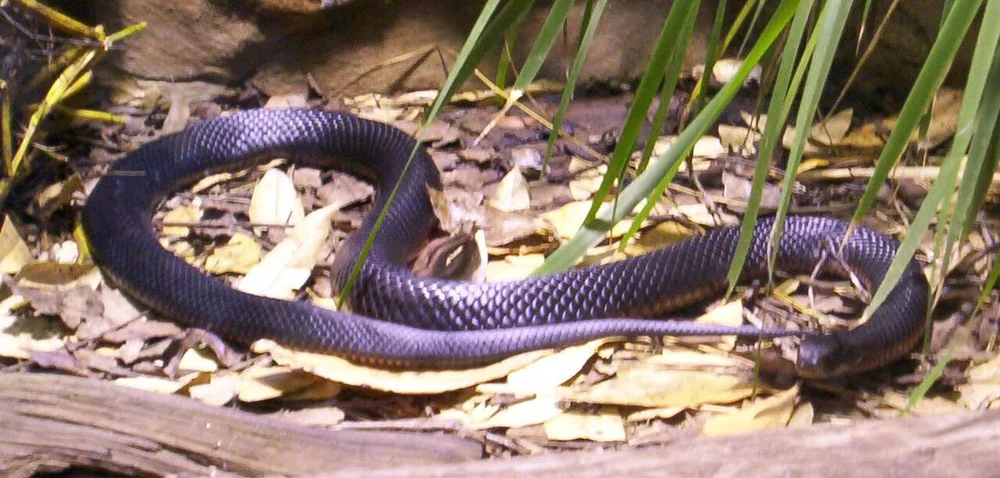
Photo: The original uploader was Figaro at English Wikipedia. · Public domain (Licence)

Elapidae
Red-bellied Black Snake
Pseudechis porphyriacus
A glossy black snake often seen around creeks, wetlands and farm dams in eastern Australia. Red or pink along the lower sides is a useful clue, but it can be hidden by the snake's position and is much paler in some northern animals.
Open identification guide
Photo: Noah Kirkland · CC BY 4.0 (Licence)
Elapidae
Carpentaria Snake
Cryptophis boschmai
The Carpentaria Snake is a small Queensland snake that can be tan, brown or dark brown, sometimes with a faint dark line down the back. It occurs in dry forest and woodland.
Open identification guideSources checked
- Australian Reptile Online Database — Small-eyed Snake (2026-09-25)
- The Reptile Database — Cryptophis nigrescens (2026-09-25)
- Australian Museum — Small-eyed Snake (2026-09-25)
- Species account — Small-eyed Snake (2026-09-26)
- Victorian Government Wildlife Rehabilitation Guidelines, Part B (2026-09-26)
Still not sure?
Compare this snake with more clues.
A profile is a guide, not a reason to approach or handle a snake.