
Elapidae
Spine-bellied Sea Snake
Hydrophis curtus
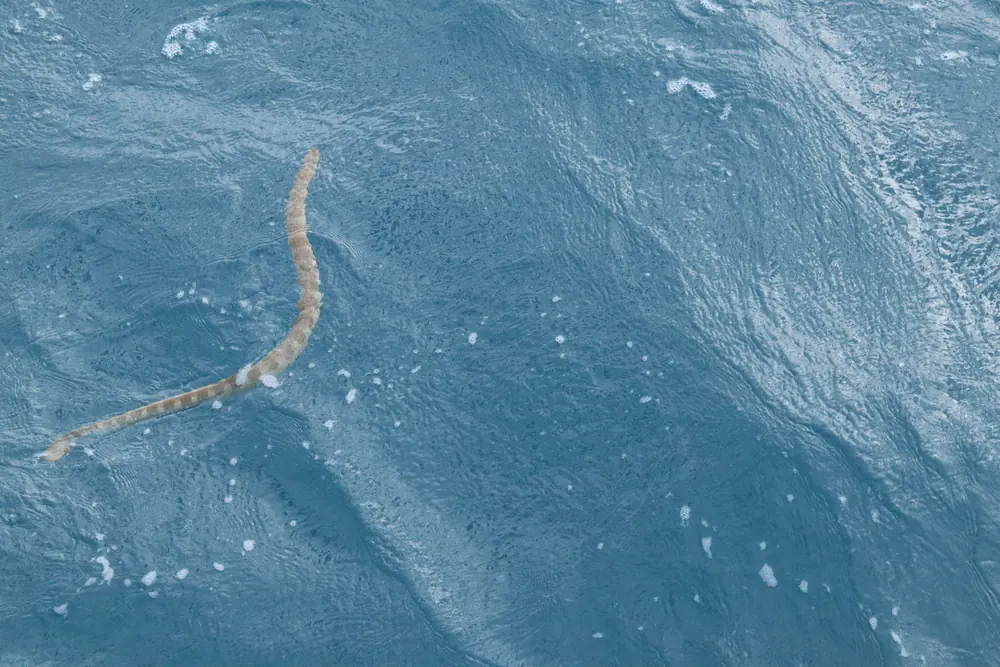
A marine snake with a greenish or yellowish back crossed by dark bands.
Venomous.
Identification and appearance
The Reptile Database describes greenish or yellowish upperparts, a pale underside and dark bands that may fuse dorsally or encircle the body.
Other names
Shaw’s Sea Snake, Short Sea Snake
Typical length
A total-length figure was not available on the consulted account.
Key identification features
- Greenish or yellowish upperparts
- Whitish belly
- Dark bands
Where it is found
Recorded from northern Australian waters in the Northern Territory, Queensland and Western Australia. The Reptile Database warns that its distribution has not been revised following the resurrection of H. hardwickii; Australian occurrence is also supported by the 2014 sea-snake review.
Habitat
In Cleveland Bay, Queensland, tracked Spine-bellied Sea Snakes used coastal seagrass habitat.
Activity
A North Queensland tracking study found wider movements near the surface at night and more restricted movements in deeper water during the day.
Diet
In a North Queensland study, prey included several kinds of fish and a young snake of the same species. Some snakes had also swallowed fishing bait.
Reproduction
Live-bearing.
Medical significance
Treat any suspected snakebite as an emergency: call 000 and follow snakebite first aid. Do not wait for identification.
What to do if you encounter one
Keep clear and do not handle, net or disentangle a sea snake. Contact qualified wildlife help if a stranded animal or fishing-gear entanglement needs attention.
Taxonomy notes
The Reptile Database flags a distribution requiring revision after resurrection of H. hardwickii. The 2014 Australian checklist includes H. curtus. State matching remains partial, not an exhaustive current range.
Sources checked
Still not sure?
Compare this snake with more clues.
A profile is a guide, not a reason to approach or handle a snake.