

Deceased Barkly death adder photographed on a road at Marrakai, Northern Territory. Body posture is not representative of a living snake.
Elapidae
Barkly Death Adder
Acanthophis hawkei
Barkly Death Adder is a stout-bodied death adder associated with the black-soil plains of the Barkly Tableland and fragmented populations in western Queensland and the Northern Territory.
Highly venomous
Identification and appearance
The Australian Reptile Online Database describes a stout, robust snake, usually pale brown or greyish with darker cross-bands. Australian Government advice also notes a somewhat flattened, triangular-shaped head and lighter bands across the body. The species is difficult to separate from the Top End Death Adder by appearance alone.
Other names
Barkly Tableland Death Adder, Floodplain Death Adder
Typical length
Australian Government advice reports a maximum length of approximately 1.2 m; this is not a typical adult interval.
Body build
robust
Head appearance
somewhat flattened, triangular-shaped
Key identification features
- Stout, robust body
- Pale brown or greyish colour with darker cross-bands
- Somewhat flattened, triangular-shaped head
Where it is found
The exact distribution is unclear. Known populations include the Mitchell Grass Downs of western Queensland, the Barkly Tableland on the Queensland–Northern Territory border and areas east of Darwin in the Northern Territory.
Habitat
Suitable habitat includes treeless river floodplains with cracking soils. Populations occur on the Barkly Tableland near the Northern Territory–Queensland border.
Activity
Typically a secretive ambush predator; the government advice describes caudal luring and notes that the species is associated with periodically inundated cracking-soil plains.
Diet
Native frogs make up a large part of the diet in the Australian Government account.
Reproduction
Live-bearing.
Medical significance
A bite can cause serious envenoming. Treat any suspected bite as an emergency and do not use an identification result to judge safety.
What to do if you encounter one
Keep well clear, leave a route for the snake to move away and do not approach for a closer look. If it is inside, keep people and pets away and contact a qualified local snake catcher.
Similar-looking snakes
AROD says it is very similar to the Top End Death Adder and reports no reliable characters to differentiate them; location and a clear photograph may help a qualified expert, but neither makes handling safe.
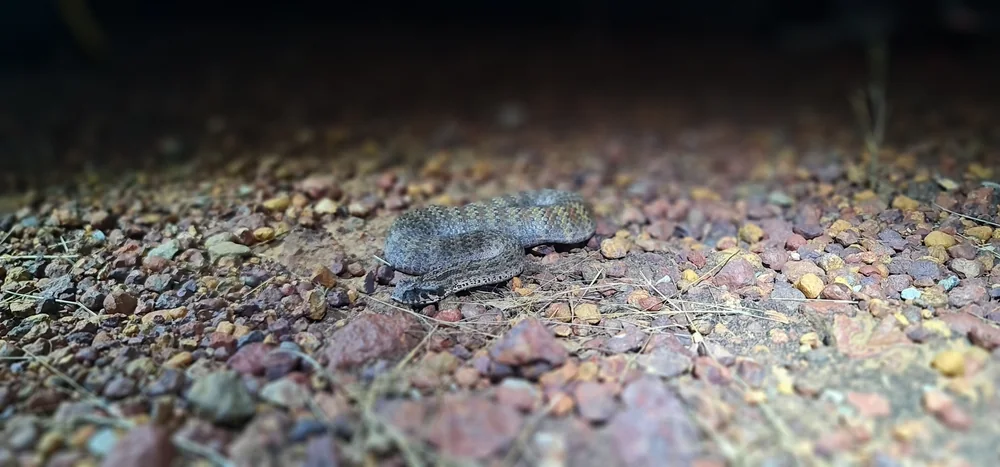
Photo: Max Tibby · CC0 1.0 (Licence)
Elapidae
Top End Death Adder
Acanthophis rugosus
A stocky death adder of the Top End and north-western Queensland, usually marked with alternating pale and dark cross-bands. Some individuals have faint banding, so a brown or grey snake cannot be ruled out by colour alone.
Open identification guideTaxonomy notes
AROD lists a larger 130 cm species average; this unresolved conflict is retained in evidence and is not used as a typical-length label.
Sources checked
Still not sure?
Compare this snake with more clues.
A profile is a guide, not a reason to approach or handle a snake.