
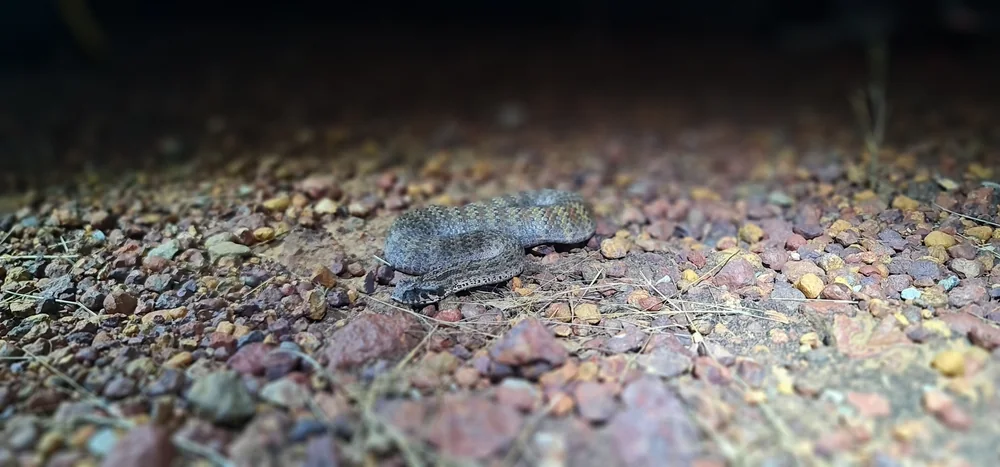
Elapidae
Top End Death Adder
Acanthophis rugosus
A stocky death adder of the Top End and north-western Queensland, usually marked with alternating pale and dark cross-bands. Some individuals have faint banding, so a brown or grey snake cannot be ruled out by colour alone.
Highly venomous
Identification and appearance
The consulted account describes a stocky, robust snake with variable alternating pale and dark cross-bands. Reported combinations include cream and brown, yellow and red, or grey and black, and some animals retain only faint bands. These traits overlap with other death adders and are not a safe identification test.
Typical length
AROD reports a species average of about 60 cm; the entry gives no separate usual-size range or measured maximum.
Body build
robust
Key identification features
- Stocky, robust build
- Variable pale-and-dark cross-bands
- Banding can be faint; colour combinations vary
Where it is found
The Top End of the Northern Territory and north-western Queensland in the AROD account. The current Reptile Database also lists Western Australia, but that overlap is retained as an unresolved taxonomic/range conflict rather than treated as a verified WA occurrence.
Habitat
Habitat includes northern savannah woodland and sandstone escarpments, as well as dry, stony grassland and shrubland in western Queensland.
Activity
Usually active at night. It waits for prey and moves its tail tip to lure animals closer.
Diet
Eats several kinds of small vertebrates, including frogs, lizards and mammals.
Reproduction
Live-bearing.
Medical significance
The consulted species account describes it as highly dangerous with very toxic venom. Treat any possible bite as a medical emergency.
What to do if you encounter one
Do not approach or handle it. Move people and pets away, leave the snake a clear escape route and use a qualified local snake remover if removal is needed.
Similar-looking snakes
AROD places it alongside Kimberley and Desert Death Adders. Faint bands and variable colours make visual separation uncertain; keep distance from any suspected death adder.

Kimberley Death Adder (Acanthophis cryptamydros), holotype WAM R174083 photographed in life by R. J. Ellis.
Photo: R. J. Ellis, in Maddock et al. (2015), Zootaxa 4007(3):301–326, Figure 5 · CC BY 3.0 (Licence)
Elapidae
Kimberley Death Adder
Acanthophis cryptamydros
A stout Kimberley death adder of north-western Australia, usually orange-brown, tan-brown or grey with darker cross-bands. Its dangerous venom means a distant comparison is the only safe use of this page.
Open identification guideTaxonomy notes
AROD gives NT and north-western Queensland, while the current Reptile Database includes Western Australia as well. Because the Kimberley population is now treated as A. cryptamydros and the complex has unresolved historical range records, WA is not blindly added; the listed states remain NT and QLD with partial status.
Sources checked
- Australian Reptile Online Database — Top End Death Adder (2026-09-25)
- The Reptile Database — Acanthophis rugosus (2026-09-25)
- Primary death-adder revision — Acanthophis rugosus complex (2026-09-25)
- University of Melbourne AVRU, Death Adders (2026-09-26)
Still not sure?
Compare this snake with more clues.
A profile is a guide, not a reason to approach or handle a snake.