

Kimberley Death Adder (Acanthophis cryptamydros), holotype WAM R174083 photographed in life by R. J. Ellis.
Elapidae
Kimberley Death Adder
Acanthophis cryptamydros
A stout Kimberley death adder of north-western Australia, usually orange-brown, tan-brown or grey with darker cross-bands. Its dangerous venom means a distant comparison is the only safe use of this page.
Highly venomous
Identification and appearance
The species account describes a stout, robust snake with orange-brown, tan-brown or grey colouration and darker cross-bands. The underside is usually cream-white, with darker marks concentrated near the lateral edges; those underside details must never be checked by approaching or turning a snake over.
Other names
Acanthophis lancasteri
Typical length
The original description reports a largest total length of 64.5 cm. A typical adult length range has not been established here.
Body build
robust
Key identification features
- Stout, robust build
- Orange-brown, tan-brown or grey ground colour
- Darker cross-bands with a pale underside and darker edge marks
Where it is found
Known from the Kimberley region of Western Australia, including mainland and offshore Kimberley localities. A single Adelaide River, Northern Territory record has incomplete collection data and the primary description says that locality may be erroneous; it is not treated as a verified Northern Territory occurrence.
Habitat
Recorded among basalt boulders in savannah woodland, in grassy creek margins and among grass or leaf litter in sandstone country in the Kimberley.
Activity
The specimen used to describe this species was found among basalt boulders in Kimberley savannah woodland and retreated into grass tussocks when disturbed.
Diet
Stomach contents reported for two specimens included frogs, lizards and mammals.
Reproduction
Live-bearing.
Medical significance
The consulted species account describes it as highly dangerous with very toxic venom. Treat any possible bite as a medical emergency.
What to do if you encounter one
Keep well clear and leave a route towards cover. Do not chase, corner, handle or inspect it. If it is inside a building, keep people and pets away and contact a qualified local snake remover.
Similar-looking snakes
AROD compares this species with Desert Death Adder and Top End Death Adder. Colour and banding overlap across death adders; do not use a photo result to approach one.

Photo: Max Tibby · CC0 1.0 (Licence)
Elapidae
Desert Death Adder
Acanthophis pyrrhus
A banded death adder of sandy and stony deserts across inland Australia. Its red or orange colouring blends with many desert soils.
Open identification guide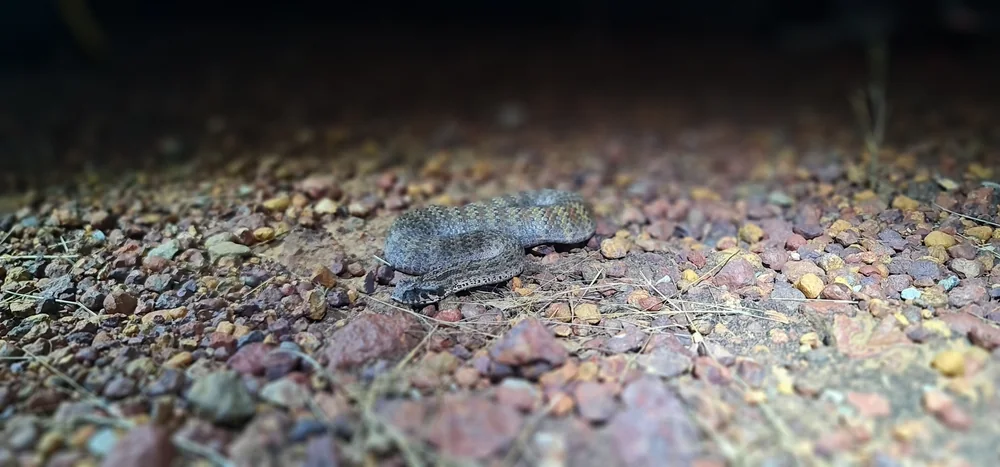
Photo: Max Tibby · CC0 1.0 (Licence)
Elapidae
Top End Death Adder
Acanthophis rugosus
A stocky death adder of the Top End and north-western Queensland, usually marked with alternating pale and dark cross-bands. Some individuals have faint banding, so a brown or grey snake cannot be ruled out by colour alone.
Open identification guideTaxonomy notes
The primary description confirms the Kimberley in WA. It mentions one Adelaide River NT specimen with incomplete data and warns the locality may be erroneous; NT is not treated as a verified state occurrence. Acanthophis lancasteri is an unavailable historical name discussed by later nomenclatural work.
Sources checked
- Australian Reptile Online Database — Kimberley Death Adder (2026-09-25)
- The Reptile Database — Acanthophis cryptamydros (2026-09-25)
- Primary description — Acanthophis cryptamydros (2026-09-25)
- Ellis et al. 2021 — Australian death-adder nomenclature (2026-09-25)
Still not sure?
Compare this snake with more clues.
A profile is a guide, not a reason to approach or handle a snake.