

Pythonidae
Black-headed Python
Aspidites melanocephalus
A large northern python marked by its sharply contrasting black head.
Non-venomous
Identification and appearance
The glossy black head and neck contrast with a cream-yellow to reddish-brown body crossed by narrow dark brown or black bands. It has a robust body and rounded snout.
Typical length
The WA government guide reports lengths up to 3 m. AROD lists a smaller reported maximum of 2.5 m; neither is used to infer a typical adult interval.
Body build
robust
Head appearance
Black head, neck and throat
Key identification features
- Sharply contrasting black head, neck and throat
- Lighter body with darker bands
- Northern Australian python associated with woodland and rocky or coastal forest
Where it is found
Across much of northern Australia, avoiding the most arid areas; the southern limit reaches the North West Cape and Gladstone area.
Habitat
Lives across northern Australia, extending to the northern desert margins. Burrows provide shelter during the day.
Activity
Usually active at night, although daytime activity is also reported.
Diet
Eats reptiles, birds and mammals, including some venomous snakes.
Reproduction
Oviparous; AROD reports an average clutch size of 8.
Medical significance
Non-venomous, but capable of biting. Keep your distance; if the snake is unidentified and a bite is suspected, call 000 and follow snakebite first aid.
What to do if you encounter one
Keep your distance and leave the snake a clear route away. Do not handle it, chase it for a photograph or attempt to inspect its mouth. If it is inside a building, keep people and pets clear and contact a qualified local snake catcher.
Similar-looking snakes
The Woma lacks the black head; compare only from a safe distance and never handle either python.
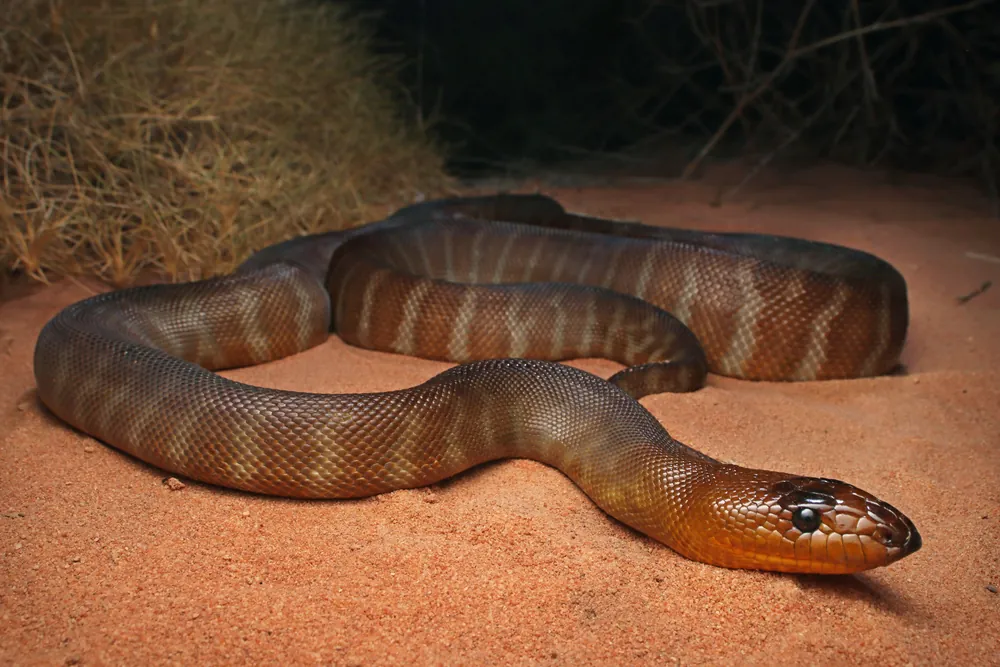
Photo: Connor Margetts · CC0 1.0 (Licence)
Pythonidae
Woma
Aspidites ramsayi
A large python with a pale yellow- to reddish-brown background and numerous dark bands. Juveniles may show a dark eye patch that often fades with age; the species occupies arid and semi-arid inland Australia.
Open identification guideSources checked
- Australian Reptile Online Database — Black-headed Python (2026-09-25)
- The Reptile Database — Aspidites melanocephalus (2026-09-25)
- Western Australian government snake guide — Black-headed Python, p20 (2026-09-25)
- Queensland Government — Snakes of Central Queensland (2026-09-26)
- NESP Threatened Species Hub — Arid Zone Monitoring species profiles (2026-09-26)
Still not sure?
Compare this snake with more clues.
A profile is a guide, not a reason to approach or handle a snake.