
Pythonidae
Woma
Aspidites ramsayi
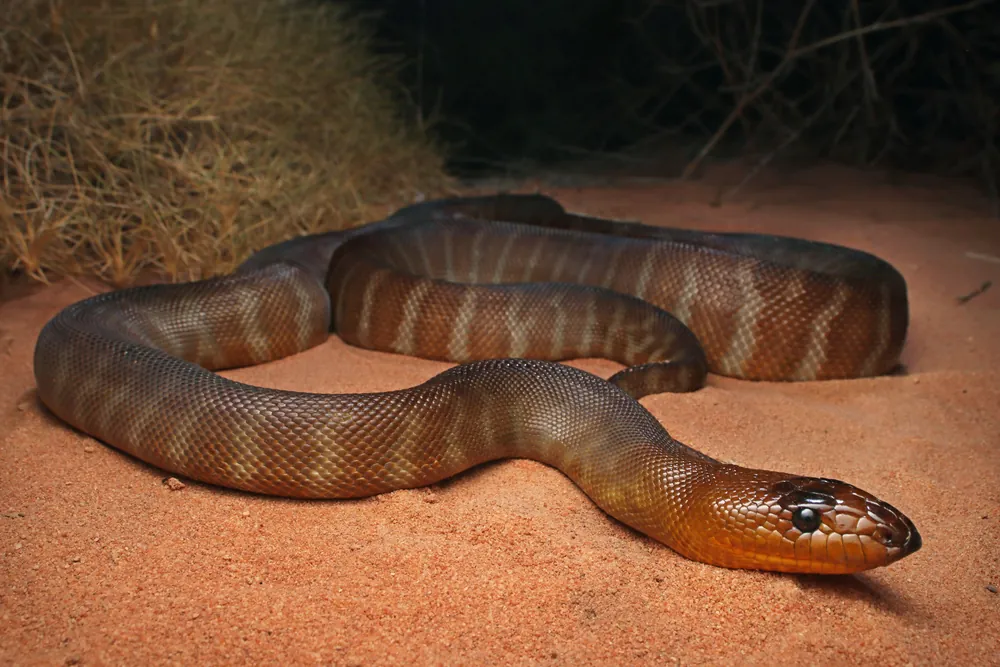
A large python with a pale yellow- to reddish-brown background and numerous dark bands. Juveniles may show a dark eye patch that often fades with age; the species occupies arid and semi-arid inland Australia.
Non-venomous
Identification and appearance
Usually pale yellow- or reddish-brown with many dark bands across the body. Young snakes may show a dark patch above the eye that often fades with age, although it can persist in south-east Queensland; the body is strongly triangular in cross-section.
Other names
Ramsay's python
Typical length
AROD lists a species average of about 150 cm and a separately reported maximum of 270 cm.
Body build
robust
Key identification features
- Many dark cross-bands on a yellowish or reddish-brown body
- A dark mark above the eye may fade as the snake matures
Where it is found
Occurs across arid and semi-arid inland Australia, extending from north-western WA to south-western Queensland. A separate population occurs in south-western WA.
Habitat
Lives in dry inland country, including deserts. Daytime shelters include animal burrows, hollow logs and dense vegetation.
Activity
In a south-western Queensland tracking study, womas climbed to hunt sleeping reptiles on warm nights.
Diet
Reptiles, birds, and mammals.
Reproduction
Oviparous.
Medical significance
The consulted sources do not identify medically significant venom, but a non-venomous snake can still bite. Do not handle it.
What to do if you encounter one
Keep well clear and leave a route towards cover. Do not chase, corner, handle or inspect it. If it is inside a building, keep people and pets away and contact a qualified local snake remover.
Similar-looking snakes
The Black-headed Python is the cited lookalike. Its contrasting black head is a broad clue, not a reason to approach or handle either python.

Photo: Max Tibby · CC0 1.0 (Licence)
Pythonidae
Black-headed Python
Aspidites melanocephalus
A large northern python marked by its sharply contrasting black head.
Open identification guideSources checked
- Australian Reptile Online Database — Woma (2026-09-25)
- The Reptile Database — Aspidites ramsayi (2026-09-25)
- Species account: Woma (2026-09-26)
- Queensland Museum, Memoirs of the Queensland Museum — Nature 56 (2026-09-26)
- Queensland Government — Snakes of Central Queensland (2026-09-26)
Still not sure?
Compare this snake with more clues.
A profile is a guide, not a reason to approach or handle a snake.