

Blackish Blind Snake (Anilios nigrescens), photographed dead on a road.
Typhlopidae
Blackish Blind Snake
Anilios nigrescens
A glossy, worm-like burrowing snake from eastern Australia. It has a nearly uniform body thickness, tiny eyes and a very short tail. Recognising a blind snake is usually easier than telling which blind-snake species it is.
Non-venomous
Identification and appearance
Small, smooth scales cover the cylindrical body. The eyes are reduced to dark spots under scales and the mouth sits beneath the snout. A short spine ends the tail. These features suit a life underground. Colour and an earthworm-like shape alone are insufficient to establish Anilios nigrescens, particularly in a poor photograph.
Other names
Blind Snake, Ramphotyphlops nigrescens
Typical length
AROD gives an average total length of about 38 cm and a maximum of 75 cm.
Body build
slender
Head appearance
small, tiny eyes, not distinct from neck
Key identification features
- Worm-like cylindrical body
- Tiny dark eye spots
- Very short tail ending in a small spine
Where it is found
Eastern Australia, with documented state and territory records in Queensland, NSW, Victoria and the ACT. It is one of the more often encountered blind snakes in the eastern states, but the range contains other blind-snake species too.
Activity
Spends much of its life below ground. Blind snakes are occasionally encountered on the surface, so a rare sighting does not mean they are absent from an area.
Diet
In a 1993 museum study, ant pupae made up most of the recorded prey, followed by ant larvae. Ant eggs and adults were also present.
Reproduction
An egg-laying species; AROD reports clutches of 5–20 eggs.
Medical significance
Blind snakes are not a venom risk to people. Their appearance still needs to be distinguished from other small snakes before any conclusion is drawn.
What to do if you encounter one
Avoid digging it out or removing cover to inspect it. Let the animal disappear into shelter. Its tail spine and defensive smell are reasons to leave it alone, not features to demonstrate by handling.
Similar-looking snakes
Other Anilios species look very similar. Reliable separation may require specialist scale examination; a general 'blind snake' result is more honest than an unsupported species claim.
Typhlopidae
Woodland Blind Snake
Anilios proximus
A relatively large blind snake of eastern and southern mainland Australia.
Open identification guide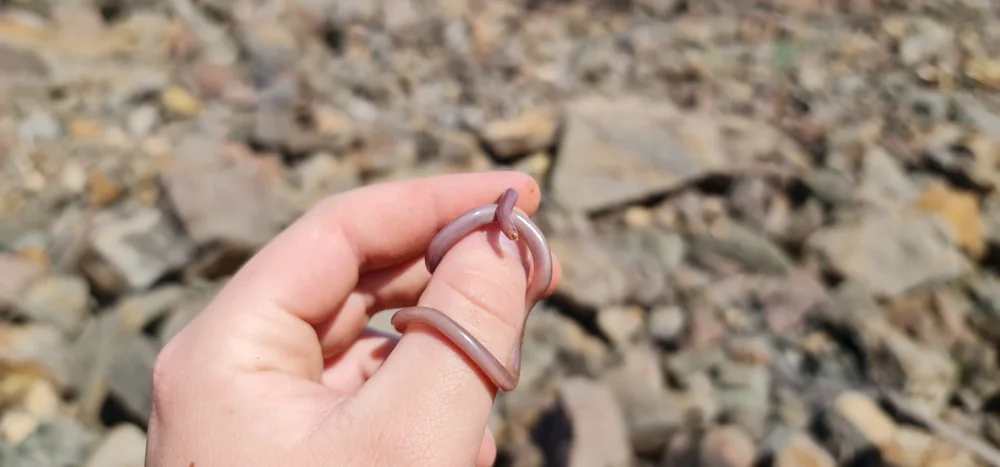
Photo: Max Tibby · CC0 1.0 (Licence)
Typhlopidae
Brown-snouted Blind Snake
Anilios wiedii
A small blind snake recorded in Queensland and New South Wales, with a prominent rounded snout.
Open identification guideTaxonomy notes
Formerly placed in Ramphotyphlops. Broad statements about all blind snakes are kept separate from species-specific size, distribution and reproduction.
Sources checked
- Australian Museum — Blind Snake (2026-09-25)
- AROD — Blackish Blind Snake (2026-09-25)
- Australian Museum — Why blind snakes are difficult to identify (2026-09-25)
- ACT Government — Snakes (2026-09-25)
- Webb & Shine (1993) — Dietary Habits of Australian Blindsnakes (2026-09-26)
- Webb & Shine (1993) — Dietary Habits of Australian Blindsnakes (2026-09-26)
Still not sure?
Compare this snake with more clues.
A profile is a guide, not a reason to approach or handle a snake.