
Colubridae
Brown Tree Snake
Boiga irregularis
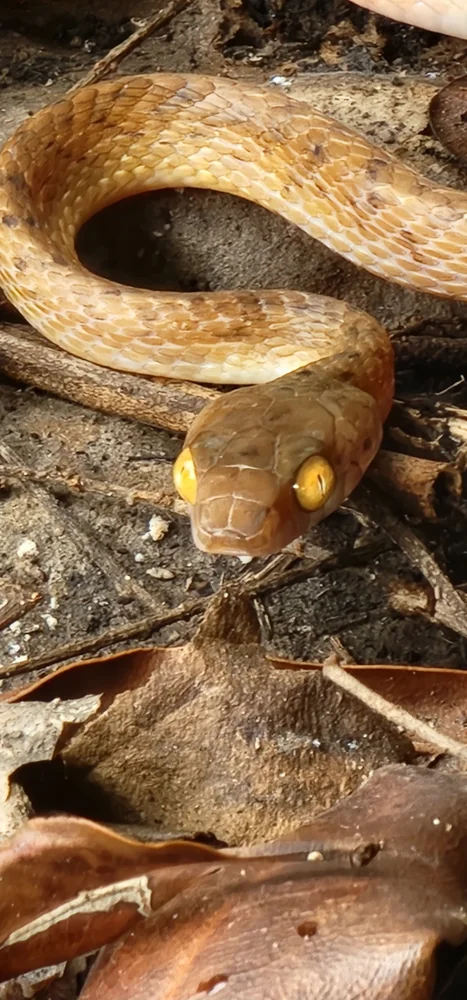
A slender tree snake with a large head, bulbous eyes and vertical pupils. Colour and banding vary across its northern and eastern Australian range, so appearance alone is not a safe approach cue.
Weakly venomous
Identification and appearance
A slender climbing snake with a distinct head and prominent eyes. Eastern animals are often brown or orange-brown with dark bands; western forms may have a pale background and reddish bands.
Other names
Night Tiger, Doll’s Eye Snake, Boiga fusca
Typical length
AROD lists a species average of about 140 cm and a separately reported maximum of 200 cm.
Body build
slender
Head appearance
head distinct from neck
Key identification features
- Slender body and prominent eyes
- Body colour and cross-banding vary geographically
Where it is found
Native to northern and eastern coastal Australia and also found beyond Australia in New Guinea and Indonesia. The introduced Guam population lies outside its native range.
Habitat
This species uses woodland and rainforest as well as built-up areas. It may occupy tree hollows, rocky faces or building rafters, and also spends time on the ground.
Activity
Mostly active at night, climbing trees, rock faces and buildings.
Diet
Eats small vertebrates and bird eggs. Young snakes take frogs and lizards; larger animals also eat birds and mammals.
Reproduction
Oviparous.
Medical significance
The consulted source describes weak venom. Treat a suspected snakebite as an emergency: call 000 and follow snakebite first aid.
What to do if you encounter one
Keep well clear and leave a route towards cover. Do not chase, corner, handle or inspect it. If it is inside a building, keep people and pets away and contact a qualified local snake remover.
Similar-looking snakes
Similar-looking Australian snakes may overlap in colour, banding and habitat; location is not a safe field test. Keep distance and wait for an expert if identification matters.
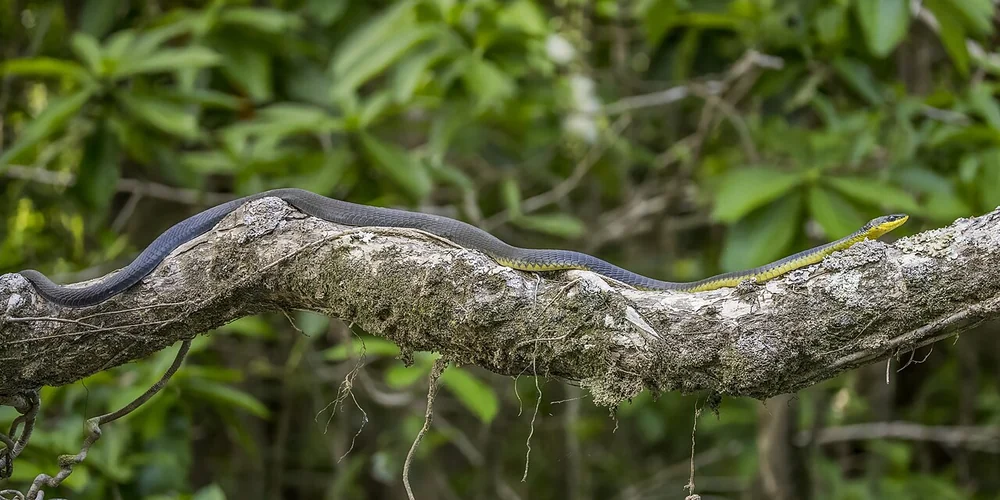
Photo: Charles J. Sharp · CC BY-SA 4.0 (Licence)
Colubridae
Green Tree Snake
Dendrelaphis punctulatus
A very slender, agile snake with a long tail, often seen moving through gardens or low branches. Despite the name it may be olive, brown, black or even blue. Green colour is only one possible appearance of this non-venomous species.
Open identification guideSources checked
- Australian Reptile Online Database — Brown Tree Snake (2026-09-25)
- The Reptile Database — Boiga irregularis (2026-09-25)
- Species account: Brown Tree Snake (2026-09-26)
- Queensland Government, Brown tree snake (2026-09-26)
Still not sure?
Compare this snake with more clues.
A profile is a guide, not a reason to approach or handle a snake.