
_Daintree_2.jpg)
Colubridae
Green Tree Snake
Dendrelaphis punctulatus
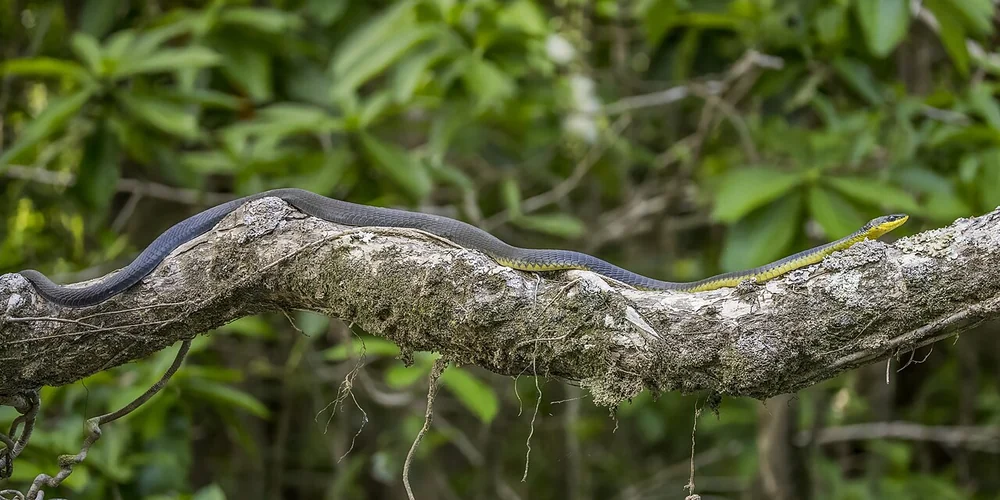
A very slender, agile snake with a long tail, often seen moving through gardens or low branches. Despite the name it may be olive, brown, black or even blue. Green colour is only one possible appearance of this non-venomous species.
Non-venomous
Identification and appearance
The slim body, long fine tail and relatively large eyes are useful overall clues. The underside is commonly yellow or cream. Blue skin between the scales may show when the body expands, but it should never be provoked to reveal this. A sighting in a tree supports the possibility without confirming it.
Other names
Common Tree Snake, Australian Tree Snake
Typical length
Adults are commonly a little over 1 m, with some around 1.5 m; maximum about 2 m.
Body build
slender
Head appearance
elongated, large eyes, slightly distinct from neck
Key identification features
- Very slender body and long fine tail
- Relatively large eyes
- Colour highly variable; often pale or yellow below
Where it is found
Northern and eastern Australia, from the Kimberley through the Northern Territory and Queensland to NSW. It occupies many wooded and vegetated settings; state membership does not mean it occurs everywhere within a state.
Habitat
Woodland, rainforest and tropical gardens all provide habitat for this snake. It also visits verandahs and houses. Night shelters include foliage, hollows and crevices in trees.
Activity
Active by day, searching both vegetation and the ground. At night it usually rests in foliage, a crevice or another sheltered place.
Diet
Mostly frogs and small reptiles such as skinks.
Reproduction
Lays eggs; Queensland guidance records clutches of 4–16.
Medical significance
Not a venomous species, but a colour-based identification is unreliable. Seek emergency help for a suspected snakebite rather than relying on this page.
What to do if you encounter one
Let it move away through vegetation and avoid trying to pick it up. If it has entered a building, isolate the area where practical and contact a licensed remover. Do not assume every slender snake near a tree is this species.
Similar-looking snakes
Brown tree snakes and other slender snakes can be mistaken for it. In northern Queensland another Dendrelaphis species also occurs; a distant view may not separate them.
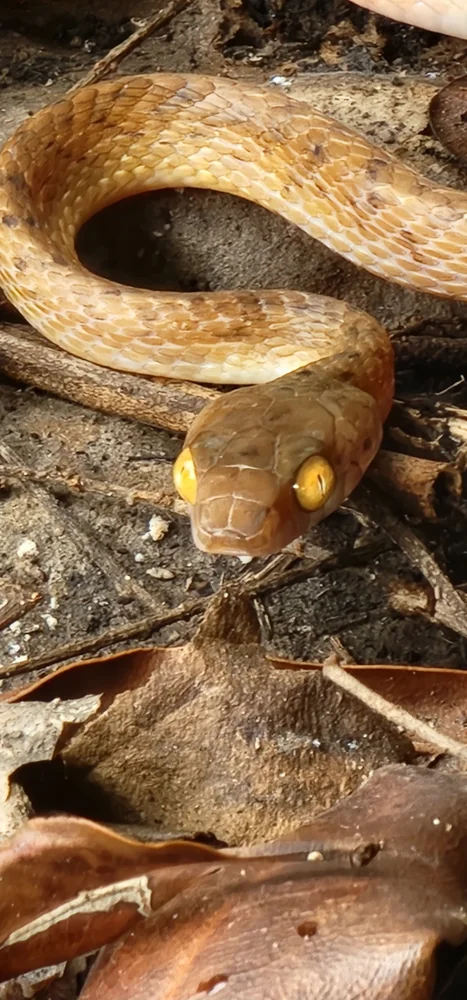
Photo: Bethlea Bell · CC0 1.0 (Licence)
Colubridae
Brown Tree Snake
Boiga irregularis
A slender tree snake with a large head, bulbous eyes and vertical pupils. Colour and banding vary across its northern and eastern Australian range, so appearance alone is not a safe approach cue.
Open identification guide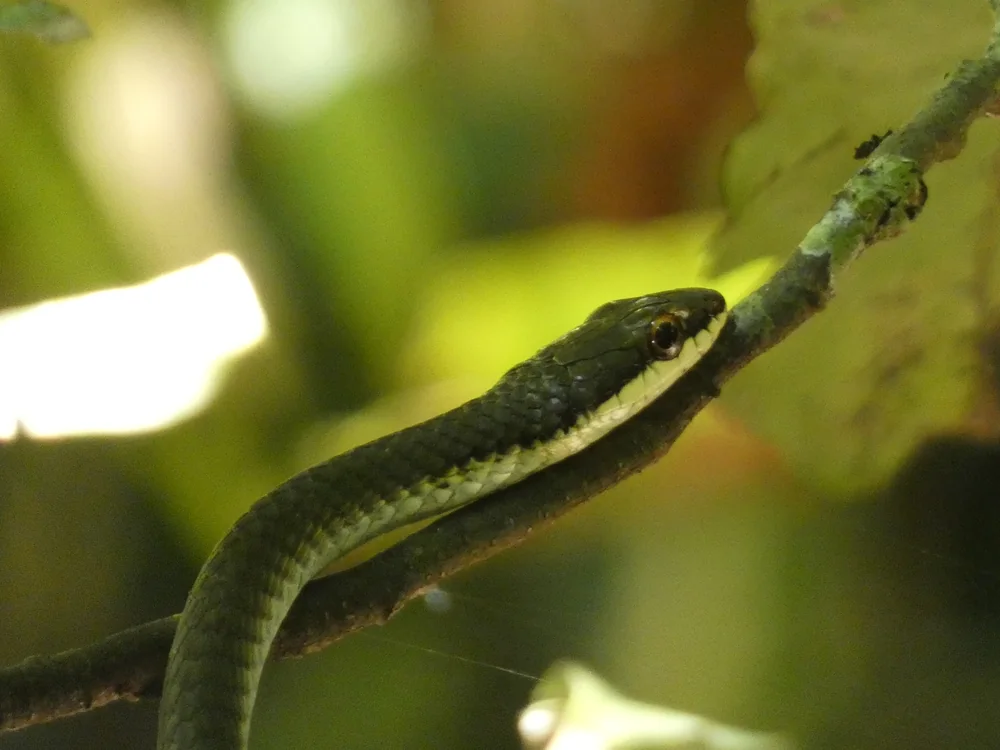
Photo: Kai Squires · CC BY 4.0 (Licence)
Colubridae
Northern Tree Snake
Dendrelaphis calligaster
A slender, daytime-active tree snake recorded in Cape York and Torres Strait.
Open identification guideTaxonomy notes
Uses the accepted spelling Dendrelaphis punctulatus. D. punctulata appears in older government resources.
Sources checked
- Queensland Government — Common Tree Snake (2026-09-25)
- Reptile Database — Dendrelaphis punctulatus (2026-09-25)
- Australian Museum — Tree snake natural history (2026-09-25)
Still not sure?
Compare this snake with more clues.
A profile is a guide, not a reason to approach or handle a snake.