
Elapidae
Eastern Turtle-headed Sea Snake
Emydocephalus annulatus
An egg-eating marine snake with banded and dark colour forms.
Venom apparatus is greatly reduced; this does not mean the species is safe to handle.
Identification and appearance
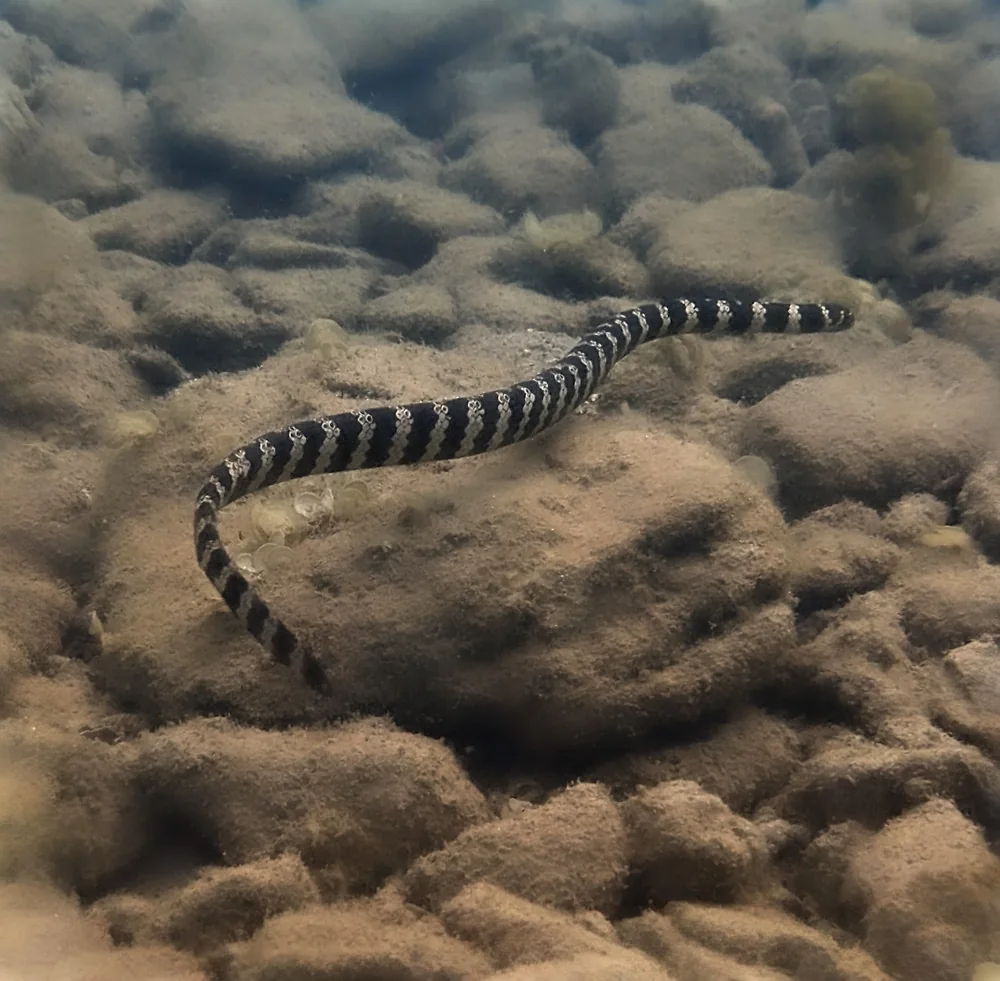
A thick-bodied sea snake. A New Caledonian study describes both black-and-white banded individuals and predominantly dark individuals; banding alone does not identify the species.
Other names
Egg-eating Sea Snake
Typical length
In a New Caledonian study population, adult females averaged 61.9 cm snout–vent length and males 56.2 cm. These measurements exclude the tail and are not Australian total-length averages.
Body build
robust
Key identification features
- Thick-bodied marine snake
- Banded and dark colour forms are documented
- Feeds on fish eggs
Where it is found
Offshore northern Australian and Timor Sea/Coral Sea records; Western Australian coastal records may belong to Emydocephalus orarius, so this entry does not assign all WA coastal records to E. annulatus. The current database also lists New South Wales.
Habitat
In New Caledonia, field studies record this species in shallow reef waters over coral, rubble and rocks, with sand in deeper parts of the study bay.
Activity
A study in New Caledonia found that individuals moved into newly flooded shallows as the tide rose.
Diet
Fish eggs.
Reproduction
Live-bearing.
Medical significance
Human medical significance is not established for this reduced venom apparatus. Treat any possible bite as an emergency, call 000 and do not handle the snake.
What to do if you encounter one
Keep your distance in the water or on shore. Do not touch, catch or attempt to move a sea snake, including one washed onto a beach. Keep other people and pets away.
Similar-looking snakes
Western Turtle-headed Sea Snake was recognised as a separate species in 2020. It is known mainly from soft-bottomed trawl grounds, while Eastern Turtle-headed Sea Snake usually inhabits coral reefs. This habitat difference alone does not identify an individual snake.
Taxonomy notes
Recent work separates some Western Australian coastal material as Emydocephalus orarius; the scope of E. annulatus records remains qualified.
Sources checked
- Atlas of Living Australia — Eastern Turtle-headed Sea Snake (2026-09-25)
- AROD — Turtle-headed Sea Snake (older taxonomic scope) (2026-09-26)
- Nankivell et al. 2020 — Emydocephalus coastal split (2026-09-26)
- Scientific Reports — Turtle-headed sea snake ecology (2026-09-25)
- The Reptile Database — Emydocephalus annulatus (2026-09-25)
- ANZCOR — First Aid Management of Australian Snake Bite (2026-09-25)
Still not sure?
Compare this snake with more clues.
A profile is a guide, not a reason to approach or handle a snake.