
Typhlopidae
Flowerpot Snake
Indotyphlops braminus
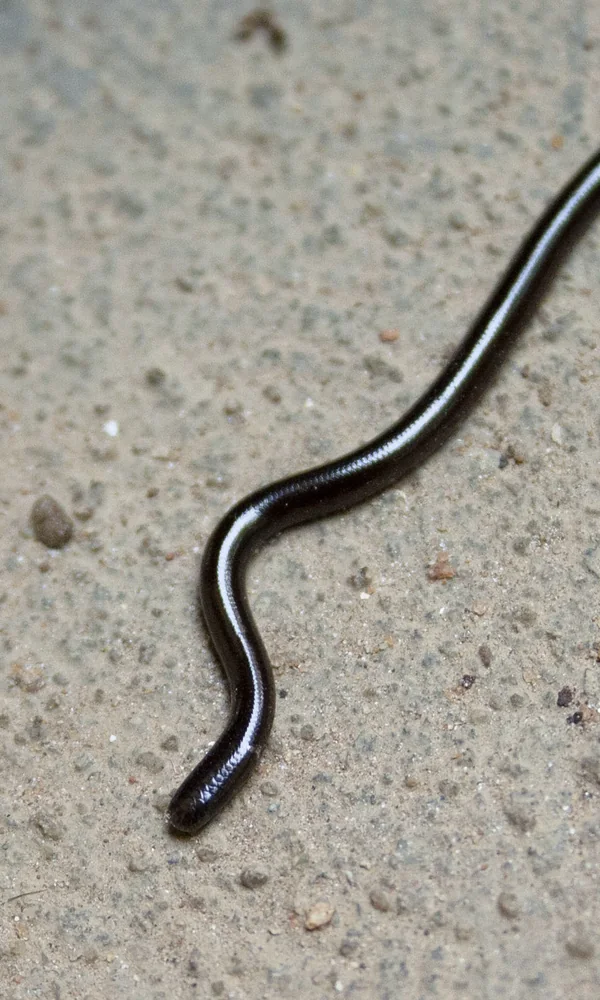
A tiny introduced blind snake, usually shiny silver-grey, charcoal-grey or purple with a blunt head and tail. Australian records began around Darwin, the Torres Strait and Townsville, with the account describing continued spread.
Non-venomous
Identification and appearance
A small, thin, shiny grey-to-purple blind snake with a blunt head and tail that can be difficult to tell apart; the species is non-venomous.
Typical length
AROD lists a species average of about 12 cm and a separately reported maximum of 17 cm.
Body build
slender
Key identification features
- Small, thin and shiny silver-grey, charcoal-grey or purple body.
- Blunt head and tail with an indistinct neck.
- Tiny pointed tail spur.
Where it is found
The Australian account describes early records around Darwin, the Torres Strait and Townsville and says the introduced species is continuing to spread. The checked state list is limited to the Northern Territory, Queensland and Western Australia.
Habitat
This introduced snake uses gardens in Australia, with records from Darwin and Katherine.
Reproduction
Egg-laying.
Medical significance
Non-venomous, but do not handle it. If identity is uncertain and a bite is suspected, call 000 and follow snakebite first aid.
What to do if you encounter one
Keep well clear and leave a route towards cover. Do not chase, corner, handle or inspect it. If it is inside a building, keep people and pets away and contact a qualified local snake remover.
Similar-looking snakes

Blackish Blind Snake (Anilios nigrescens), photographed dead on a road.
Photo: Max Tibby · CC0 (Licence)
Typhlopidae
Blackish Blind Snake
Anilios nigrescens
A glossy, worm-like burrowing snake from eastern Australia. It has a nearly uniform body thickness, tiny eyes and a very short tail. Recognising a blind snake is usually easier than telling which blind-snake species it is.
Open identification guideTaxonomy notes
The introduced Australian range is described as expanding; current Australian occurrences stated here are QLD, WA and NT.
Sources checked
- Australian Reptile Online Database — Flowerpot Snake (2026-09-25)
- The Reptile Database — Indotyphlops braminus (2026-09-25)
- Florida Museum — Brahminy Blindsnake account (2026-09-26)
- Fauna of Australia — blind snakes (2026-09-26)
Still not sure?
Compare this snake with more clues.
A profile is a guide, not a reason to approach or handle a snake.