
Elapidae
Little Whip Snake
Suta flagellum
A small venomous southern Australian snake also known as the Whip Hooded Snake.
Venomous
Identification and appearance
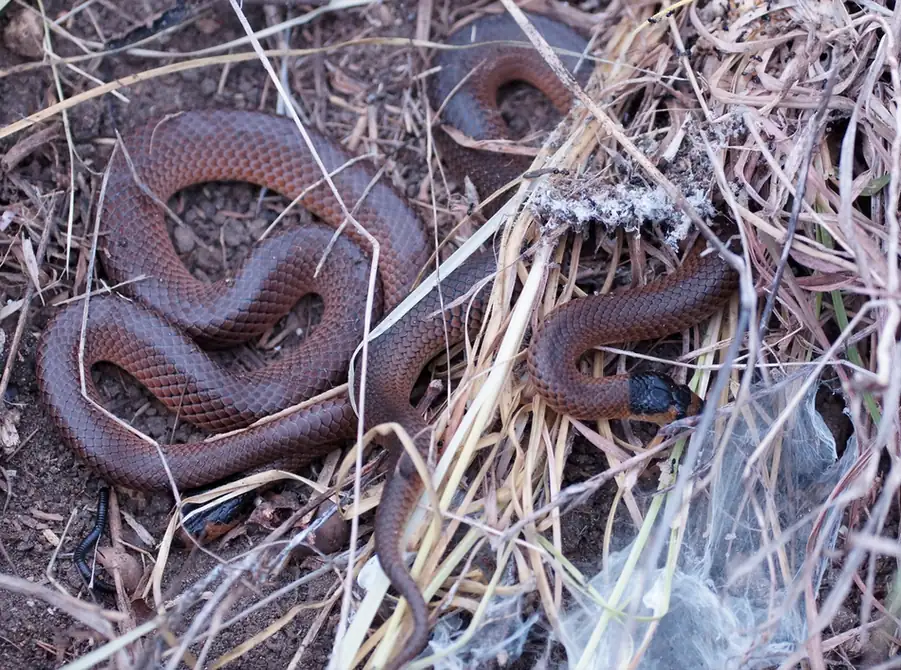
Dark scale edges give the tan to orange upper body a fine net-like appearance. A black hourglass-shaped patch covers the head and nape; some snakes also have a separate dark snout band. The body is slender.
Typical length
The NSW Government says the species reaches 45 cm; this is an attributed reported maximum, not a typical adult interval.
Body build
slender
Head appearance
black hourglass-shaped head and nape marking
Key identification features
- Slender tan or orange-brown body
- Reticulated scale edging
- Local black hourglass head-and-nape patch
Where it is found
New South Wales, South Australia and Victoria in the current account.
Activity
Mainly nocturnal.
Diet
Lizards and frogs.
Reproduction
Live-bearing.
Medical significance
Accounts describe low usual danger to people, but this cannot establish the safety of an unidentified snakebite. For any suspected bite, call 000 and follow snakebite first aid.
What to do if you encounter one
Keep clear and do not handle it. Use a qualified snake catcher or local wildlife authority if it is trapped near people.
Similar-looking snakes
Some young Eastern Brown Snakes have similar brown bodies and dark head markings. Small size and a dark head alone do not identify a Little Whip Snake.

Photo: Donald Hobern from Copenhagen, Denmark · CC BY 2.0 (Licence)
Elapidae
Eastern Brown Snake
Pseudonaja textilis
An Eastern Brown Snake is not always brown. Adults can be tan, orange-brown or nearly black, while young snakes may have striking dark bands. A relatively small head and slender body are more useful clues than the name alone.
Open identification guideSources checked
- The Reptile Database — Suta flagellum (2026-09-25)
- NSW Government — Little Whip Snake (2026-09-26)
- NSW Government — Grasslands: Little whip snake (2026-09-26)
Still not sure?
Compare this snake with more clues.
A profile is a guide, not a reason to approach or handle a snake.