

.jpg)
Elapidae
Eastern Brown Snake
Pseudonaja textilis
An Eastern Brown Snake is not always brown. Adults can be tan, orange-brown or nearly black, while young snakes may have striking dark bands. A relatively small head and slender body are more useful clues than the name alone.
Highly venomous
Identification and appearance
The head barely widens from the neck. Many adults look fairly uniform above, but hatchlings can have a dark head patch and neck band, with or without bands along the body. Those markings usually fade, though some adults retain them. This variation means a small banded snake cannot be ruled out as an Eastern Brown.
Other names
Common Brown Snake
Typical length
Adults average about 1.5 m; the Australian Museum reports a reliably measured maximum of 2.013 m.
Body build
slender, medium
Head appearance
small, barely distinct from neck
Key identification features
- Small head with little separation from the neck
- Slender to medium build
- Adults often plain; juveniles can be strongly banded
Where it is found
Widespread through eastern Australia, including Queensland, NSW, the ACT, Victoria and South Australia, with isolated Northern Territory populations. Western Australian listings are inconsistent between sources and are not treated here as a verified current range.
Habitat
Eastern Brown Snakes seem to favour open landscapes such as woodland, scrubland and savannah grassland, while arid inland animals may use seasonally flooded watercourses and swampy areas. They shelter under logs and rocks, in soil cracks and animal burrows, and may use man-made cover.
Activity
Mainly active in daylight; hot weather can shift foraging towards late afternoon or evening.
Diet
Eats vertebrates, especially rats and mice, as well as reptiles, frogs and birds. Food and shelter can bring it into farmland and settlement edges.
Reproduction
Lays eggs.
Medical significance
A bite can cause life-threatening envenoming. Small size or faint bite marks do not reduce the need for emergency care.
What to do if you encounter one
Give it room to move away. Do not stand between it and cover, chase it for a photograph or attempt to inspect its mouth. If it is inside, keep people and pets out of the room and seek a licensed snake remover.
Similar-looking snakes
Other brown snakes, mulga snakes and taipans can overlap in appearance. Head shape, colour and location are clues, not a safe field test.
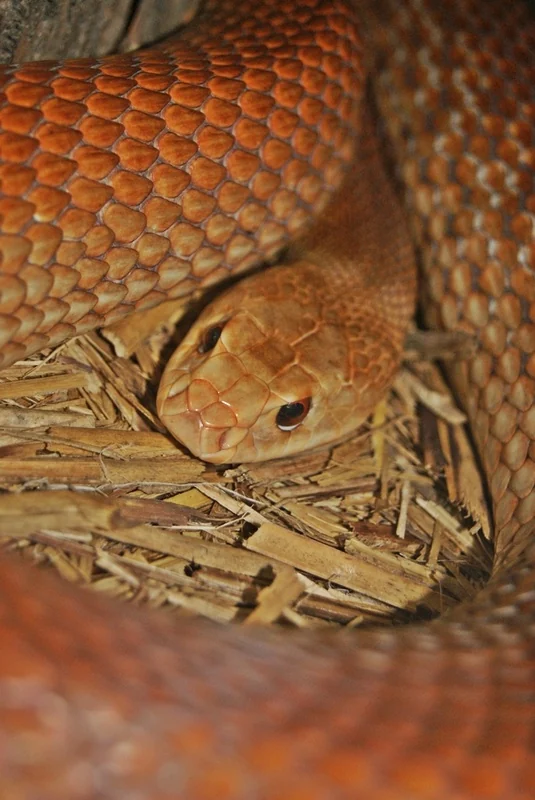
Photo: Danny S. · CC BY-SA 4.0 (Licence)
Elapidae
Coastal Taipan
Oxyuranus scutellatus
A large snake of northern and north-eastern Australia, often with a pale face and a noticeably narrower neck. Its body may be reddish-brown, dark brown or almost black. Colour alone can easily lead to confusion with brown snakes or mulga snakes.
Open identification guide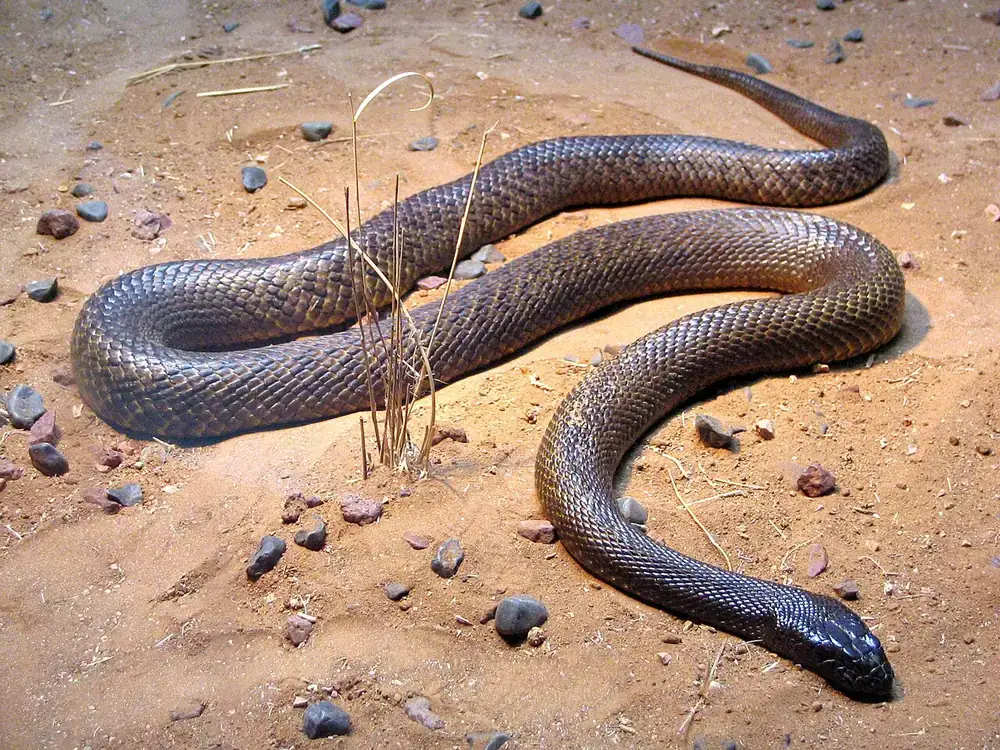
Photo: Photo by XLerate · CC BY-SA 3.0 (Licence)
Elapidae
Inland Taipan
Oxyuranus microlepidotus
A large brown snake of the remote Channel Country, strongly associated with cracking clay soils. The head is generally darker than the body, which can change noticeably with the season. It is unlikely to be the snake seen in an ordinary coastal backyard.
Open identification guide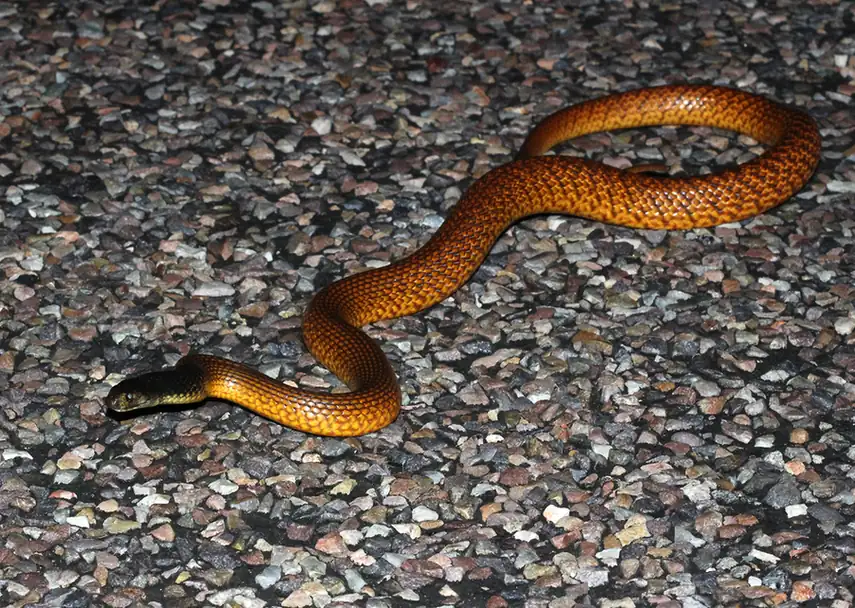
Photo: Lachlan Copeland · CC BY-SA 4.0 (Licence)
Elapidae
Western Brown Snake
Pseudonaja mengdeni
A slender inland brown snake with yellow, orange or brown body forms and variable dark markings.
Open identification guide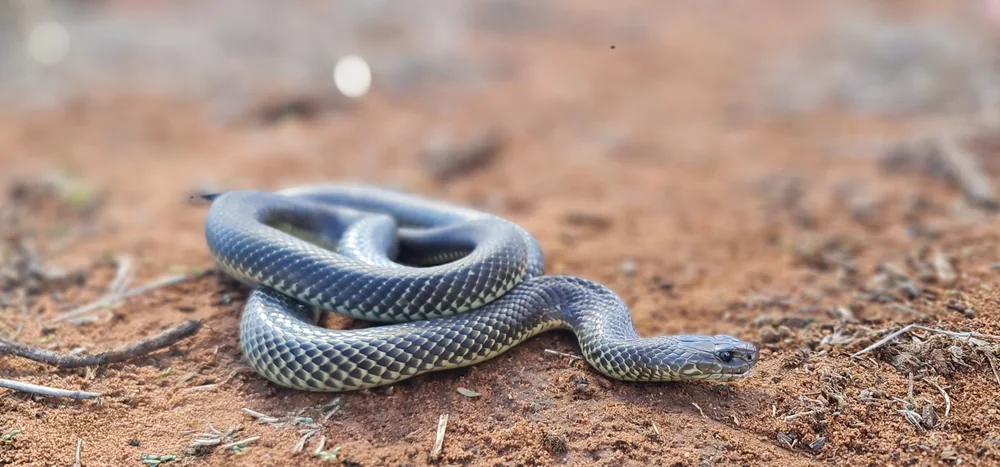
Photo: Max Tibby · CC0 1.0 (Licence)
Elapidae
Mulga Snake
Pseudechis australis
A large, variable snake widespread across most of Australia.
Open identification guideTaxonomy notes
Western Australian occurrence requires reconciliation; older AROD and specimen listings differ from current museum range summaries.
Sources checked
- Australian Museum — Eastern Brown Snake (2026-09-25)
- Queensland Government — Eastern Brown Snake (2026-09-25)
- ACT Government — Snakes (2026-09-25)
- AROD — Eastern Brown Snake (2026-09-25)
Still not sure?
Compare this snake with more clues.
A profile is a guide, not a reason to approach or handle a snake.