

Elapidae
Inland Taipan
Oxyuranus microlepidotus
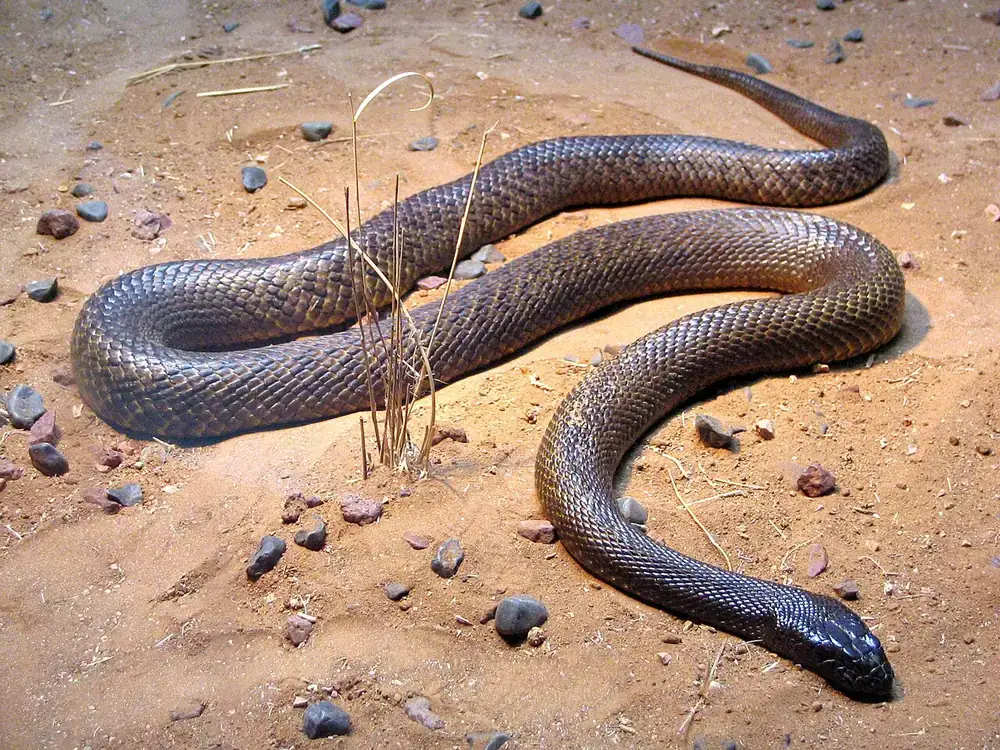
A large brown snake of the remote Channel Country, strongly associated with cracking clay soils. The head is generally darker than the body, which can change noticeably with the season. It is unlikely to be the snake seen in an ordinary coastal backyard.
Highly venomous
Identification and appearance
A deep, rather rectangular head sits above a robust body. Colour runs from light fawn to dark brown; dark edges on individual scales can form a broken herringbone effect. The head and neck are usually darker, especially in cooler months. These are useful comparisons in a distant photograph, but brown snakes can still look similar.
Other names
Fierce Snake, Small-scaled Snake, Lignum Snake
Typical length
Adults average about 2 m; recorded total length reaches 2.5 m.
Body build
robust
Head appearance
deep, rectangular
Key identification features
- Head and neck commonly darker than body
- Robust build and deep head
- Fine dark scale edging may form a broken pattern
Where it is found
The documented present-day range centres on south-western Queensland and north-eastern South Australia. Old NSW and Victorian records are historical.
Habitat
Inland Taipans are associated with deep cracking clay and loam on floodplains, but may move onto nearby gibber plains, dunes and rocky outcrops where cover is available. They shelter in soil cracks, crevices and mammal burrows.
Activity
Mostly seen above ground in the morning, using cracks and burrows as shelter. Cooler weather can allow afternoon activity.
Diet
Feeds on mammals, particularly rats and mice. Changing rodent abundance is an important part of life in its dry inland habitat.
Reproduction
Lays eggs, with published clutch sizes generally in the low teens to about twenty.
Medical significance
Its venom can produce life-threatening envenoming. Laboratory venom potency does not tell a visitor how likely an encounter is or how an individual snake will behave.
What to do if you encounter one
Do not approach soil cracks or burrow entrances to get a better look. A brief sighting is enough reason to give the animal space. Record the general locality only once safely clear; identification is secondary to distance.
Similar-looking snakes
Several brown snakes share its general colour. The coastal taipan typically has a paler face, but neither that contrast nor the word 'inland' confirms an identification.

Photo: Donald Hobern from Copenhagen, Denmark · CC BY 2.0 (Licence)
Elapidae
Eastern Brown Snake
Pseudonaja textilis
An Eastern Brown Snake is not always brown. Adults can be tan, orange-brown or nearly black, while young snakes may have striking dark bands. A relatively small head and slender body are more useful clues than the name alone.
Open identification guide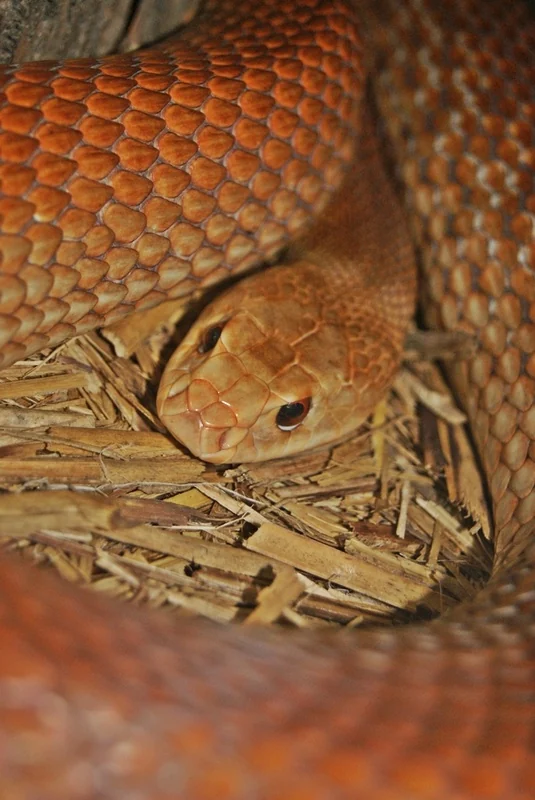
Photo: Danny S. · CC BY-SA 4.0 (Licence)
Elapidae
Coastal Taipan
Oxyuranus scutellatus
A large snake of northern and north-eastern Australia, often with a pale face and a noticeably narrower neck. Its body may be reddish-brown, dark brown or almost black. Colour alone can easily lead to confusion with brown snakes or mulga snakes.
Open identification guide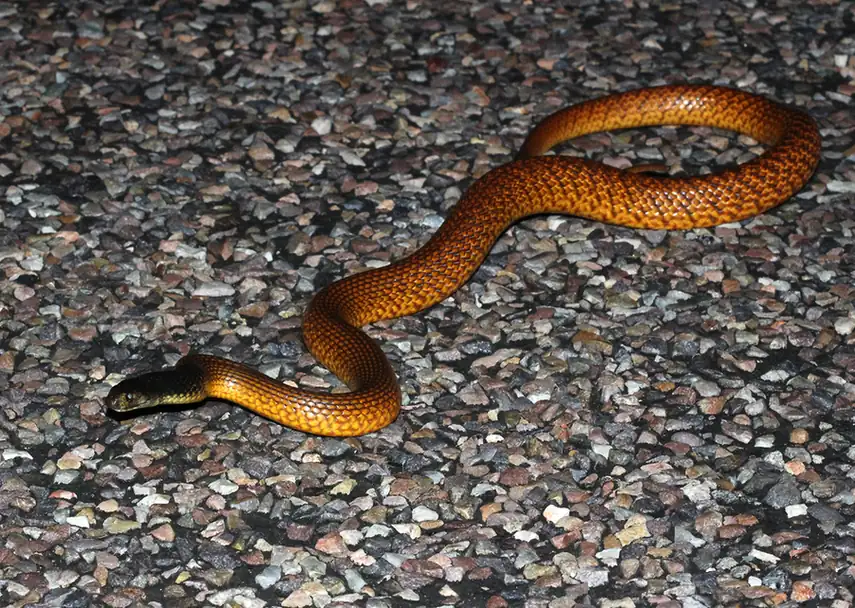
Photo: Lachlan Copeland · CC BY-SA 4.0 (Licence)
Elapidae
Western Brown Snake
Pseudonaja mengdeni
A slender inland brown snake with yellow, orange or brown body forms and variable dark markings.
Open identification guideTaxonomy notes
Older range lists can include NSW without distinguishing historical records. This profile follows the Australian Museum's explicit present-day versus historical distinction.
Sources checked
- Australian Museum — Inland Taipan (2026-09-25)
- AROD — Inland Taipan (2026-09-25)
- Queensland Government — Dangerous animals (2026-09-25)
Still not sure?
Compare this snake with more clues.
A profile is a guide, not a reason to approach or handle a snake.