

Elapidae
Marsh Snake
Hemiaspis signata
Marsh Snake is a small east-coast snake with an olive to grey back, dark belly and paired pale facial lines.
Venomous
Identification and appearance
The Queensland government describes an olive to grey upper surface, grey to black belly and two narrow pale lines on each side of the face running through the upper lip and from the eye onto the neck. The species is small but should still be treated as venomous.
Other names
Black-bellied Swamp Snake, Swamp Snake
Typical length
The Queensland government describes a length up to 50 cm; AROD lists a 60 cm species average. The conflicting conventions are retained without creating a typical interval.
Head appearance
Two narrow pale facial lines on each side
Key identification features
- Olive to grey above
- Grey to black belly
- Two narrow pale facial lines on each side
Where it is found
Eastern Australia in New South Wales and Queensland; Queensland government records include the Cairns region and wetland areas.
Activity
Can be active during daylight and after dark.
Diet
Frogs and skinks.
Reproduction
Live-bearing; the Queensland government reports up to 20 young.
Medical significance
Treat any suspected bite as an emergency. Call 000 and follow Australian snakebite first aid; do not wait for identification.
What to do if you encounter one
Keep clear and do not attempt to catch or relocate the snake.
Similar-looking snakes
White-lipped and Mustard-bellied Snakes are useful comparisons. Marsh Snakes have two pale facial lines; White-lipped Snakes have one along the upper lip. A Mustard-bellied Snake usually has a pale neck band that Marsh Snakes lack.
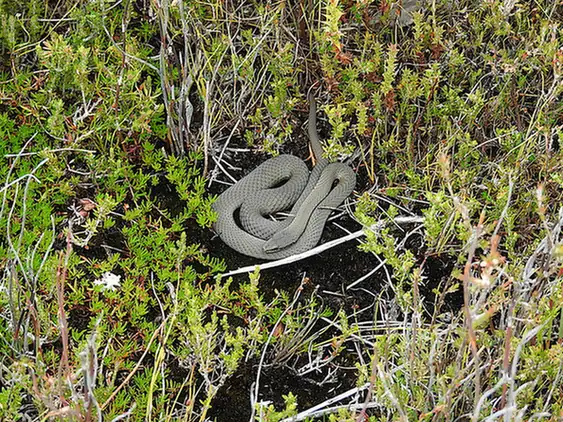
Photo: george_vaughan · CC0 1.0 (Licence)
Elapidae
White-lipped Snake
Drysdalia coronoides
White-lipped Snake is recorded across south-eastern Australia, including Tasmania and New South Wales. It varies from olive-brown and grey to reddish brown or dark grey, with a white stripe on the upper lip and no pale or dark nape band.
Open identification guide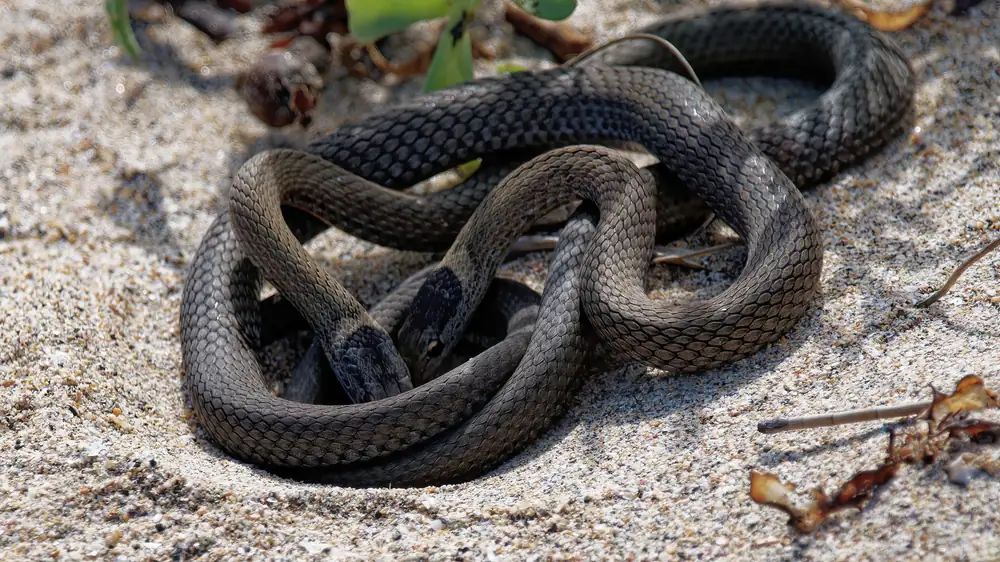
Photo: Roman Soroka · CC BY 4.0 (Licence)
Elapidae
Mustard-bellied Snake
Drysdalia rhodogaster
A small south-eastern snake with a dark head and yellow-orange nape band.
Open identification guideTaxonomy notes
Also called the black-bellied swamp snake; current name Hemiaspis signata.
Sources checked
- Queensland Government — Snakes of the Cairns region (2026-09-26)
- AROD — Marsh snake (2026-09-26)
- The Reptile Database — Hemiaspis signata (2026-09-26)
- ANZCOR — Australian snake bite first aid (2026-09-26)
- AROD — direct similar-species comparison (2026-09-26)
- AROD — direct similar-species comparison (2026-09-26)
- DCCEEW, Fauna of Australia 2A — Reptilia — Squamata — Elapidae (2026-09-26)
Still not sure?
Compare this snake with more clues.
A profile is a guide, not a reason to approach or handle a snake.