

Elapidae
Monk Snake
Suta monachus
A slender hooded snake of inland Western Australia, South Australia and the south-western Northern Territory.
Venomous
Identification and appearance
The body can be reddish brown, red or pale orange, usually without a strong body pattern. A dark hood covers the head and reaches onto the neck.
Other names
Hooded Snake, Inland Hooded Snake
Typical length
The cited study reports a maximum total length of 46 cm; this is not a typical adult interval.
Body build
slender
Key identification features
- Moderately slender build
- Reddish-brown to bright red or pale orange colouration
- Black hood on head and nape
Where it is found
Western Australia, South Australia and the south-western Northern Territory.
Activity
Nocturnal activity is recorded, especially in cooler seasons.
Reproduction
Live-bearing.
Medical significance
For any suspected snakebite, call 000 and follow snakebite first aid. Do not wait for identification.
What to do if you encounter one
Keep well clear, leave a route for the snake to move away and do not approach for a closer look. If it is inside a building, keep people and pets away and contact a qualified local snake catcher.
Similar-looking snakes
Pilbara Hooded Snake is a similar-looking species from neighbouring areas. Their differences involve several features, so a single marking is not enough to distinguish them.
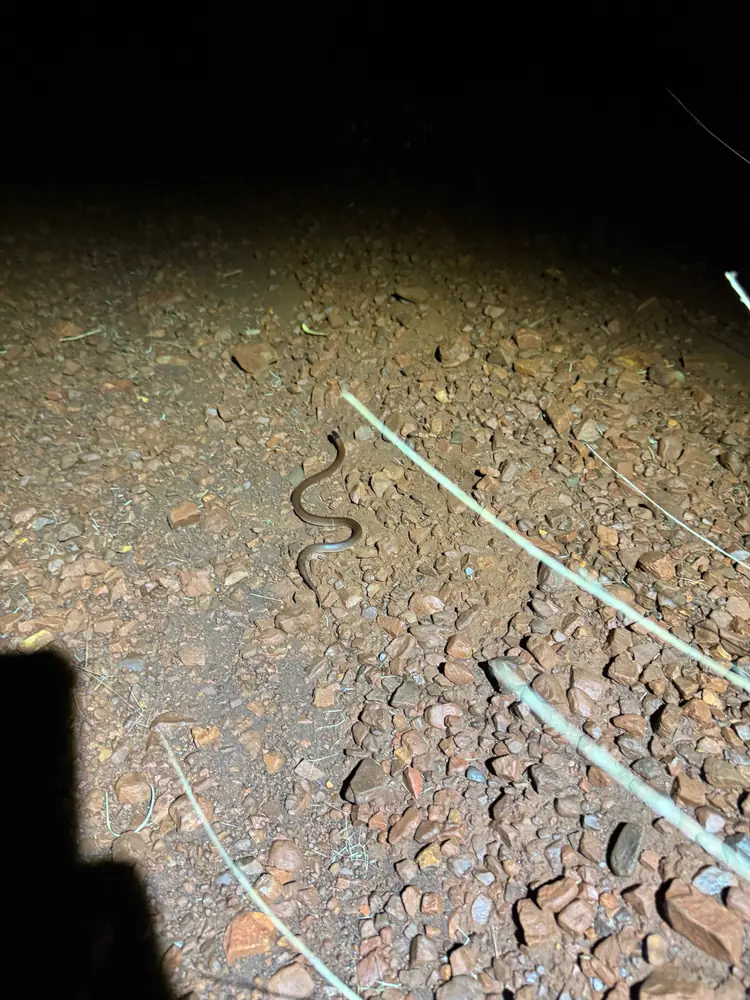
Photo: Tyler Anthony · CC BY 4.0 (Licence)
Elapidae
Pilbara Hooded Snake
Suta gaikhorstorum
A moderately robust venomous snake of the Pilbara, with a reddish body and dark head hood.
Open identification guideTaxonomy notes
The Pilbara population formerly included here was described as Suta gaikhorstorum in 2020.
Sources checked
- The Reptile Database — Suta monachus (2026-09-25)
- Maryan et al. 2020 — Suta taxonomy (2026-09-26)
- Maryan et al. 2020 — What’s under the hood? (2026-09-26)
Still not sure?
Compare this snake with more clues.
A profile is a guide, not a reason to approach or handle a snake.