
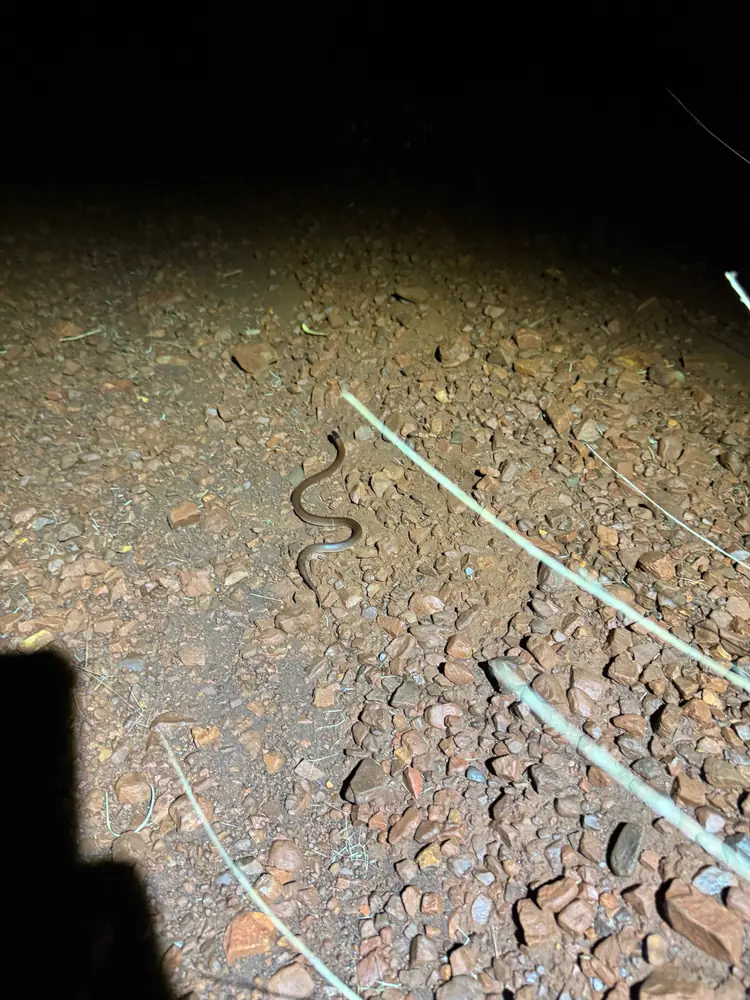
Elapidae
Pilbara Hooded Snake
Suta gaikhorstorum
A moderately robust venomous snake of the Pilbara, with a reddish body and dark head hood.
Venomous
Identification and appearance
A dark hood covers the head and nape, contrasting with a brown to bright red body. The body is moderately robust and usually appears unpatterned, although faint fine-scale markings can occur.
Typical length
Maryan et al. (2020) report total lengths up to 46 cm; sample means were 35.9 cm for males and 35.2 cm for females, not a typical-adult interval.
Body build
robust
Head appearance
Dark hood contrasting with the reddish-brown body
Key identification features
- Moderately robust body
- Reddish-brown to red body with a dark hood
- Pilbara stony plains and woodland or grass understorey
Where it is found
Pilbara region of Western Australia, especially stony plains and associated woodland and grass understorey.
Activity
Primarily nocturnal.
Medical significance
Human clinical significance is not established in the checked sources. Treat any possible bite as an emergency and call 000.
What to do if you encounter one
Keep your distance and leave the snake a clear route away. Do not handle it, chase it for a photograph or attempt to inspect its mouth. If it is inside a building, keep people and pets clear and contact a qualified local snake catcher.
Similar-looking snakes
Monk Snake is a similar-looking species from neighbouring areas. Their differences involve several features, so a single marking is not enough to distinguish them.

Photo: Lawrence Hylton · CC BY 4.0 (Licence)
Elapidae
Monk Snake
Suta monachus
A slender hooded snake of inland Western Australia, South Australia and the south-western Northern Territory.
Open identification guideSources checked
- Atlas of Living Australia — Pilbara Hooded Snake (2026-09-25)
- Maryan et al. 2020 — Suta gaikhorstorum diagnosis (2026-09-25)
- The Reptile Database — Suta gaikhorstorum (2026-09-25)
- ANZCOR — First Aid Management of Australian Snake Bite (2026-09-25)
- Maryan et al. 2020 — What’s under the hood? (2026-09-26)
Still not sure?
Compare this snake with more clues.
A profile is a guide, not a reason to approach or handle a snake.