
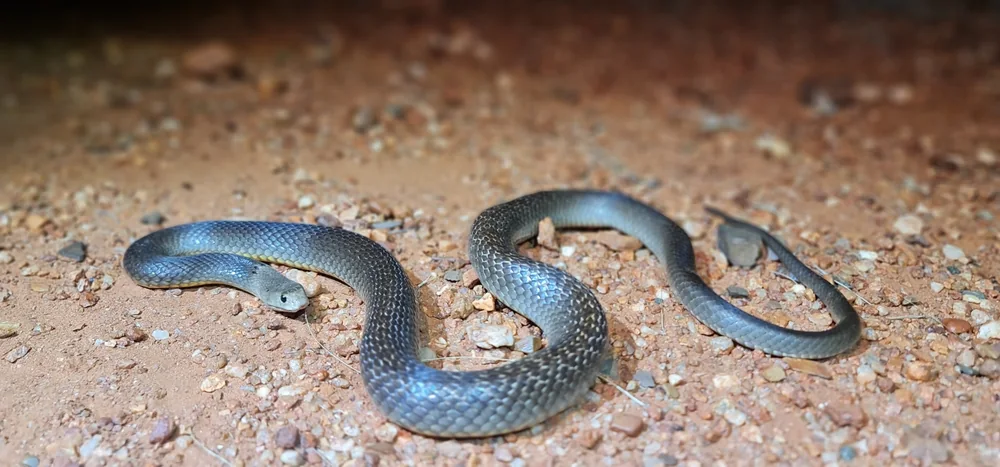
Elapidae
Northern Brown Snake
Pseudonaja nuchalis
A dangerously venomous brown snake of tropical northern Australia.
Dangerously venomous
Identification and appearance
The back can be plain brown or black, or brown with dark speckling and a net-like pattern. Some individuals are darker toward the head.
Typical length
The Australian Venom Research Unit lists a length of 1.3–1.5 m without defining a typical adult interval or maximum. Older size figures for the broader Western Brown complex are not used here.
Body build
slender
Key identification features
- Brown or black upperparts
- Plain, speckled or reticulate pattern variation
- Northern Australian range
Where it is found
Northern Territory Top End and Gulf of Carpentaria, Cape York in Queensland, and the Kimberley in Western Australia. The historical Western Brown complex included other species now treated separately.
Diet
Frogs, lizards, snakes and small mammals.
Reproduction
Egg-laying.
Medical significance
For any suspected snakebite, call 000 and follow snakebite first aid. Do not wait for identification.
What to do if you encounter one
Keep clear and do not handle it. Use a qualified snake catcher or local wildlife authority if it is trapped near people.
Similar-looking snakes
Northern Browns can resemble Western and Eastern Brown Snakes. Northern and Western Browns were once grouped under the same name, so older labels can be misleading.
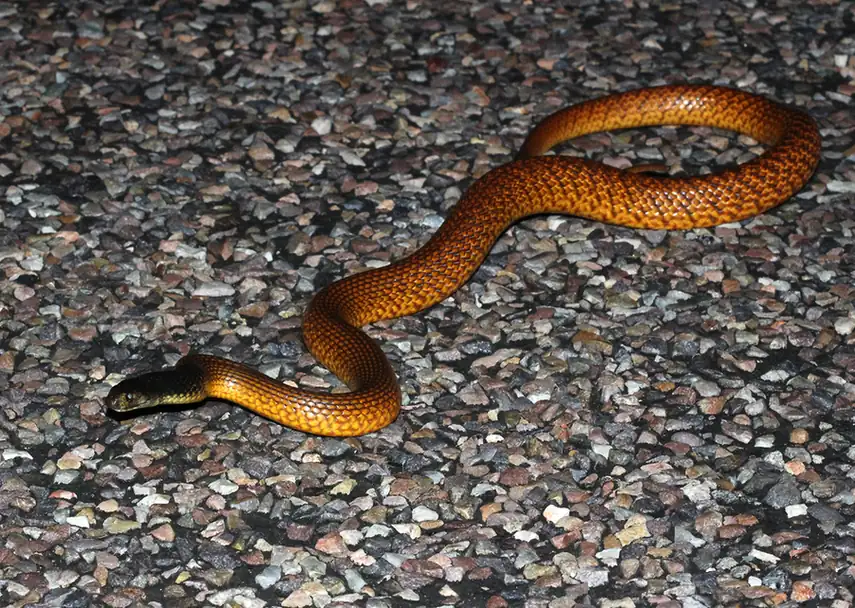
Photo: Lachlan Copeland · CC BY-SA 4.0 (Licence)
Elapidae
Western Brown Snake
Pseudonaja mengdeni
A slender inland brown snake with yellow, orange or brown body forms and variable dark markings.
Open identification guide
Photo: Donald Hobern from Copenhagen, Denmark · CC BY 2.0 (Licence)
Elapidae
Eastern Brown Snake
Pseudonaja textilis
An Eastern Brown Snake is not always brown. Adults can be tan, orange-brown or nearly black, while young snakes may have striking dark bands. A relatively small head and slender body are more useful clues than the name alone.
Open identification guideTaxonomy notes
Skinner 2009 separated the broad complex, including aspidorhyncha and mengdeni. The modern nuchalis record here follows the NT, QLD and WA treatment in AROD and AVRU; Western Brown and Gwardar are not presented as unqualified current synonyms because AVRU uses those names for mengdeni.
Sources checked
- Australian Reptile Online Database — Northern Brown Snake (2026-09-25)
- The Reptile Database — Pseudonaja nuchalis (2026-09-25)
- Skinner 2009 — Pseudonaja species complex revision abstract (2026-09-26)
- Australian Venom Research Unit — Common brown snake account (2026-09-26)
- Australian Museum — species comparison (2026-09-26)
- Australian Museum — species comparison (2026-09-26)
Still not sure?
Compare this snake with more clues.
A profile is a guide, not a reason to approach or handle a snake.