
Pythonidae
Olive Python
Liasis olivaceus
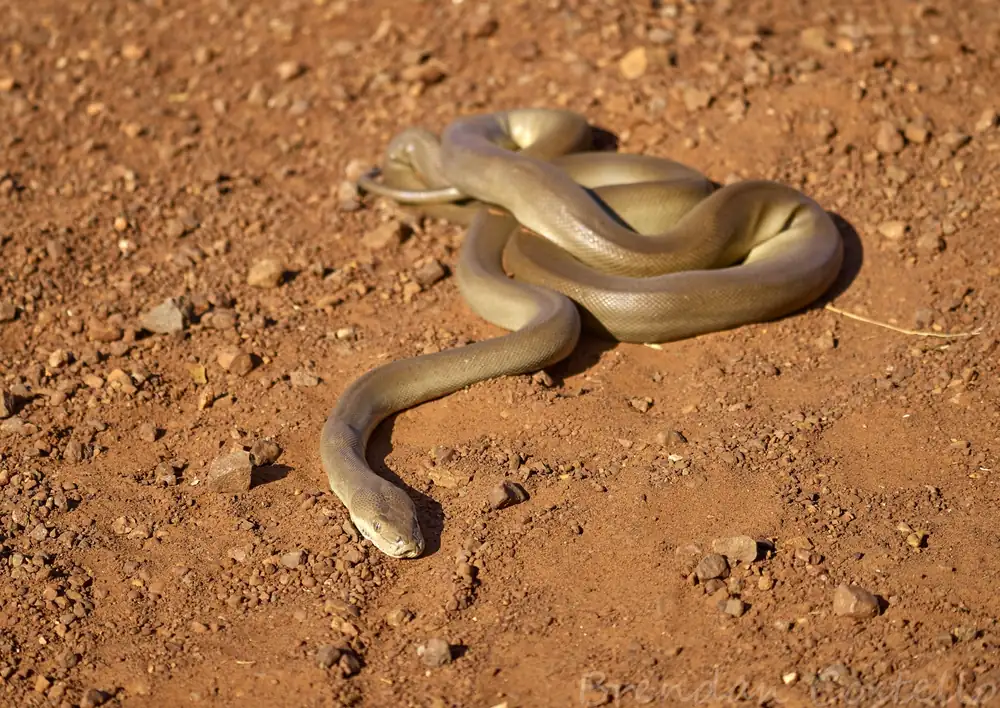
A very large olive python of drier northern Australia. The Pilbara subspecies occurs in Western Australia, while the species-level range also includes the Northern Territory and Queensland.
Non-venomous
Identification and appearance
A large python whose upper body ranges from pale fawn to olive-brown or rich brown. The underside is pale. This profile covers the whole species, including the Pilbara subspecies.
Typical length
AROD lists a species average of about 200 cm and a separately reported maximum of 650 cm.
Key identification features
- Large python with fawn, olive-brown or rich brown upperparts
- Pale underside
- Northern Australian range, including a separate Pilbara form
Where it is found
The species occupies drier northern Australia, with Australian records in Queensland, the Northern Territory and Western Australia. The Pilbara subspecies Liasis olivaceus barroni is confined to a WA region and does not represent the whole species range.
Habitat
Olive Pythons use rocky areas near water across northern Australia, as well as open forest, woodland and savannah.
Activity
Mainly active at night; may bask during the day.
Diet
Small mammals and birds.
Reproduction
Egg-laying.
Medical significance
Non-venomous, but do not handle it. If identity is uncertain and a bite is suspected, call 000 and follow snakebite first aid.
What to do if you encounter one
Keep well clear and leave a route towards cover. Do not chase, corner, handle or inspect it. If it is inside a building, keep people and pets away and contact a qualified local snake remover.
Similar-looking snakes

Rough-scaled Python (Morelia carinata) on a branch at Prague Zoo (captive).
Photo: Petr Hamerník / Zoo Praha · CC BY-SA 4.0 (Licence)
Pythonidae
Rough-scaled Python
Morelia carinata
A large, keeled python of the northern Kimberley, with brown upperparts and paler reticulation in monsoon forest around gorges.
Open identification guide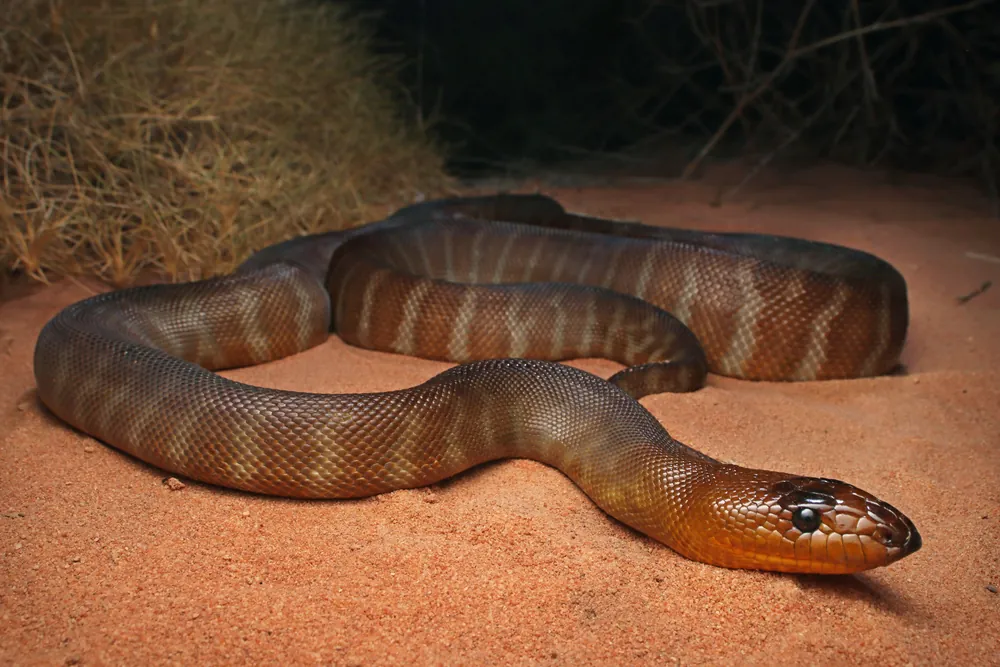
Photo: Connor Margetts · CC0 1.0 (Licence)
Pythonidae
Woma
Aspidites ramsayi
A large python with a pale yellow- to reddish-brown background and numerous dark bands. Juveniles may show a dark eye patch that often fades with age; the species occupies arid and semi-arid inland Australia.
Open identification guideTaxonomy notes
Liasis olivaceus is presented here as Olive Python. Liasis olivaceus barroni is the Pilbara subspecies, while the species-level range also includes the broader northern Australian form.
Sources checked
- Australian Reptile Online Database — Olive Python (2026-09-25)
- The Reptile Database — Liasis olivaceus (2026-09-25)
- DBCA — Partnering to protect Pilbara Olive Pythons (2026-09-26)
- Queensland Government — Olive Python, Mt Isa region (2026-09-26)
- Species account: Olive Python (2026-09-26)
Still not sure?
Compare this snake with more clues.
A profile is a guide, not a reason to approach or handle a snake.