

Elapidae
Rough-scaled Snake
Tropidechis carinatus
A dangerously venomous, strongly keeled snake of wetter habitats in eastern Australia.
Dangerously venomous
Identification and appearance
Dark crosswise markings stand out most clearly on the front of the brown or olive body and may fade in older snakes. The head is distinct from a slender to moderately built body, and the scales have pronounced ridges. It can resemble a keelback, so appearance alone must not be used to judge safety.
Other names
Clarence River Snake
Typical length
Australian Museum and AROD report an average size around 75 cm and a reported maximum around 1 m.
Body build
slender, medium
Head appearance
Distinct head
Key identification features
- Strongly keeled body scales
- Transverse dark blotches are strongest toward the front of the body
- Wet eastern habitat and resemblance to keelback
Where it is found
Two separated Australian regions: the tropical north Queensland coast between Mossman and Tully, and the east coast from the central New South Wales coast to Fraser Island in Queensland.
Habitat
Rough-scaled Snakes use moist forest, shrubland and heath, as well as artificial grassland usually near a swamp or watercourse. Shelter sites include tree hollows, cracks and cavities, and ferns growing on trees.
Activity
Mostly nocturnal and crepuscular; it may bask during the day.
Diet
Frogs and other vertebrate prey, including lizards, birds and mammals.
Reproduction
Live-bearing; AROD reports an average litter size of 10.
Medical significance
A bite may cause serious envenoming. Treat any suspected bite as an emergency, call 000 and do not wait for identification.
What to do if you encounter one
Keep your distance and leave the snake a clear route away. Do not handle it, chase it for a photograph or attempt to inspect its mouth. If it is inside a building, keep people and pets clear and contact a qualified local snake catcher.
Similar-looking snakes
Keelbacks can share wet habitats and a rough-looking surface; the source comparison uses scale arrangement that should not be examined on a live snake.
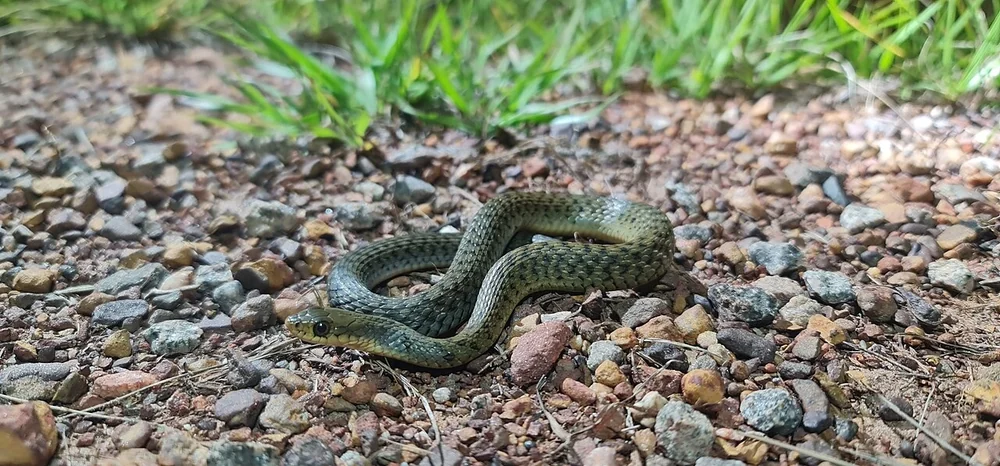
Photo: Max Tibby · CC0 (Licence)
Colubridae
Common Keelback
Tropidonophis mairii
A small non-venomous snake often found around freshwater in northern and eastern Australia. Its grey or olive-brown body commonly carries broken dark bands. It closely resembles the venomous rough-scaled snake, so neither the waterside setting nor rough-looking scales proves an identification.
Open identification guideSources checked
- Australian Reptile Online Database — Rough-scaled Snake (2026-09-25)
- Australian Museum — Rough-scaled Snake (2026-09-25)
- The Reptile Database — Tropidechis carinatus (2026-09-25)
- ANZCOR — First Aid Management of Australian Snake Bite (2026-09-25)
- Queensland Government — Rough-scaled Snake (2026-09-26)
Still not sure?
Compare this snake with more clues.
A profile is a guide, not a reason to approach or handle a snake.