

Colubridae
Common Keelback
Tropidonophis mairii
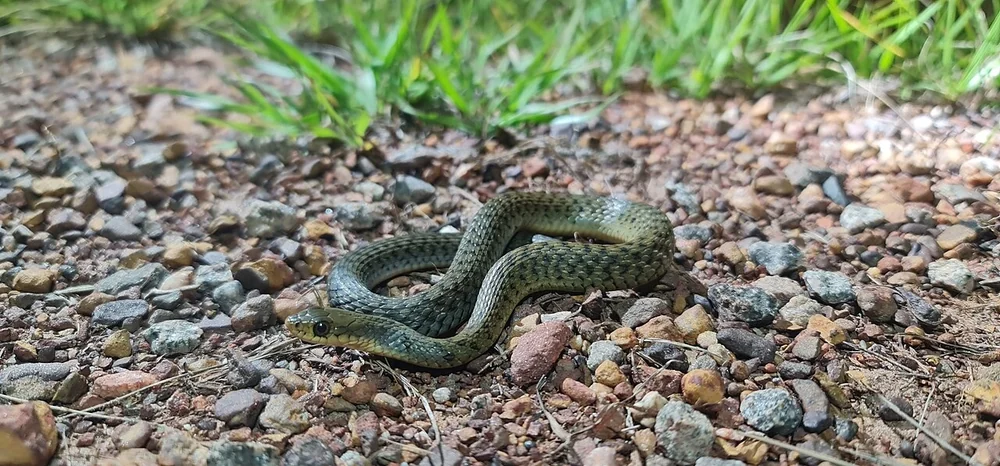
A small non-venomous snake often found around freshwater in northern and eastern Australia. Its grey or olive-brown body commonly carries broken dark bands. It closely resembles the venomous rough-scaled snake, so neither the waterside setting nor rough-looking scales proves an identification.
Non-venomous
Identification and appearance
Raised ridges along the upper scales give the back a textured appearance. The dark pattern can be faint, irregular or broken into flecks. The belly is usually pale, with darker edges to its broad scales. Use features already visible from a distance; feeling the scales or trying to expose the underside is unnecessary and unsafe.
Other names
Keelback, Freshwater Snake, Mair's Keelback
Typical length
Most adults are about 50–75 cm. Queensland guidance gives up to 1 m; AROD records a 1.2 m maximum.
Key identification features
- Ridged upper scales
- Grey to olive-brown with darker broken bands
- Frequently associated with creeks, dams or swamps
Where it is found
Northern Australia from the Kimberley through the Northern Territory and Queensland, extending into north-eastern NSW. It is particularly associated with freshwater and nearby cover rather than marine environments.
Habitat
Keelbacks favour damp freshwater margins, including swamps, creeks and dams. They also occur in eucalypt forest and urban creeks, using vegetation, fallen timber and unoccupied burrows as cover.
Activity
Can be active during either daylight or darkness, depending on conditions. It shelters among vegetation, fallen timber or empty burrows.
Diet
Feeds on frogs, tadpoles and small reptiles. It can tolerate some cane-toad toxin and eat smaller toads, but this should not be described as unlimited immunity.
Reproduction
Lays eggs. Published clutch figures vary, so no single clutch count is used here.
Medical significance
The species itself is non-venomous; confusion with rough-scaled snakes is the practical concern. A suspected bite should still be treated as an emergency.
What to do if you encounter one
Leave it undisturbed beside the water and do not catch it for a closer comparison. A photograph may support an expert opinion, but only if it can be taken without approaching or delaying first aid.
Similar-looking snakes
Rough-scaled snakes are the important lookalike. Scale details used by specialists are not suitable for a public handling test. A small banded snake may also be a juvenile of another species.

Photo: Ged Tranter · CC BY 4.0 (Licence)
Elapidae
Rough-scaled Snake
Tropidechis carinatus
A dangerously venomous, strongly keeled snake of wetter habitats in eastern Australia.
Open identification guide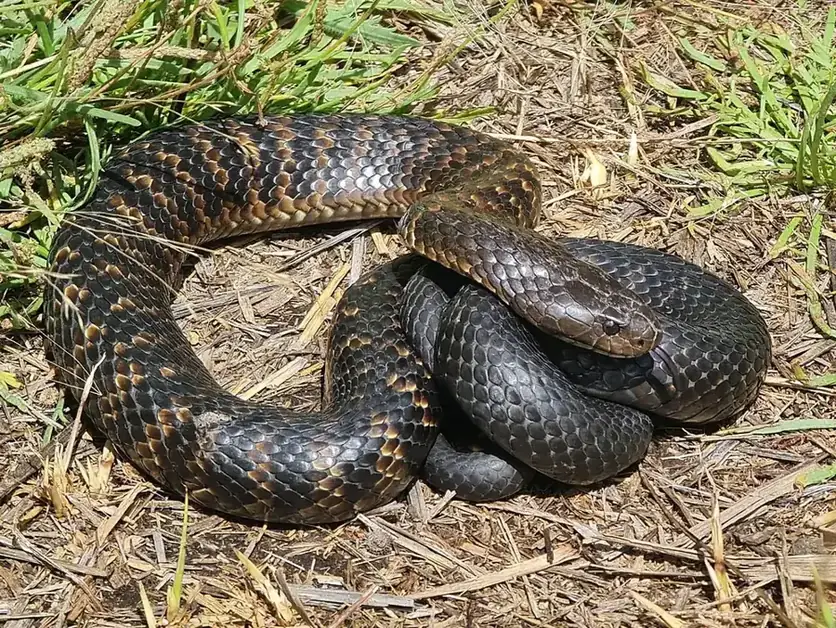
Photo: Max Tibby · CC0 (Licence)
Elapidae
Tiger Snake
Notechis scutatus
Tiger snakes may be banded, faintly marked or completely plain. They are robust snakes associated with many southern wetlands, but also occur in drier habitats. A black snake in Tasmania, or one without stripes, can still be a tiger snake.
Open identification guideTaxonomy notes
Family retained as Colubridae to match the cited Reptile Database; Natricidae is used in some recent literature.
Sources checked
- Queensland Government — Keelback (2026-09-25)
- AROD — Keelback (2026-09-25)
- Reptile Database — Tropidonophis mairii (2026-09-25)
Still not sure?
Compare this snake with more clues.
A profile is a guide, not a reason to approach or handle a snake.